Showing posts with label Politics. Show all posts

Wednesday, January 24, 2007

The Left, Caste and Dalits: A Troubled Relationship

(This post appeared at Jack Stephen's blog, The Mustard Seed. My thanks to Jack for having invited me for writing the post).

The Indian Left has had a troubled association with the caste question.

The major reason, in case of the Left has been the over arching importance that Marxism has attached to class and class conciousness. This has been true of the Marxist Left which includes the original and later CPI, the CPM and even most of the Maoist formations. The socialist parties, specially under Ram Manohar Lohia and to a lesser extent Acharya Narendra Dev acknowledged the issue of caste since the fifties though from the backward caste, and not a Dalit perspective.

This post, however, focuses on the relationship between the Marxist Left and Dalit politics.

The class based approach of the Marxist Left gave little importance to caste, and even saw it as an impediment for growth of class consciousness. It's mass fronts consisted of the trade unions, the peasant associations, landless agricultural workers. Outside these class based fronts were those for women, students and the cultural wing (the famous Indian People's Theater Association).

No scope was seen for a Dalit or any other caste based association. In fact, when the DS4 of Kanshi Ram began to grow in the 1980s, it was seen, even by those cadres in the existing communist parties who came from a Dalit background, as reactionary and dangerous- since these threatened to break the unity of the class based fronts along casteist lines. At no time, till the Mandal Commission forced it to take a firm stand, did the Indian Left see centrality of the caste question in India.

Within the CPI and the CPM, the leadership has been, even till recently, primarily drawn from the Brahmins or the local dominant castes, with very few exceptions. Neither have these parties made any conscious attempt to bring cadre from the Dalit strata into leadership positions. Instead, they have recreated in their internal structures the imbalances of society.

This is not to deny the fact that they have also been relatively less susceptible to casteism, and many among their cadre continue to be within these parties because of the relative absence of casteism within these parties in comparison with others. This is especially so where Dalit movement has been weak or non- existent.

In comparison with some other countries, the Indian communists' participation and acceptance of parliamentary politics has been long and unquestionable. However the stress of political action also blunted the social and mass based actions that these parties should have been involved in.

This came out very clearly when, after the CPI(M) Congress in 1998, in reply to a question as to why the Left had failed to strike roots in Uttar Pradesh, the then party General Secretary H.S. Surjeet explained the reasons thus:
"There has been no social reform movement in the state".
This surely is a case of putting the cart before the horse, since for those on left of the political spectrum, reforms are only a part of a much more comprehensive radical agenda. The task of the left is to carry out changes that go beyond reforms and not wait for others to carry out the job. Surjeet's words raise an existential question for the CPI(M).

Another reason of this dichotomy between the Left and the Dalit movement has been that Dr. Ambedkar, by far the most towering leader of the Dalit movement if not its only one till the rise of Kanshi Ram, had been an opponent of Marxism. His focus remained the social upliftment of the Dalits and as a politician his sensibilities honed in English liberalism restricted his view. W.N. Kuber puts it thus:
In 1937, (Ambedkar) founded the Independent Labour Party, for sometime joined hands with the communists in the labor field but did not take consistent attitude and fight class battles. Though his community was downtrodden and landless and mostly wage- earners, still he could not make them class- conscious, because of the weakness in his inherent thinking. After the Poona Pact he tried to lead the working class, but failed and left the field forever, and chose to become the leader of his community.
(source: Ambedkar: A Critical Study by W.N. Kuber, 1973. Page 304)

His insistence on Buddhism as an alternative to Marxism also did not help to build bridges.
Buddhistic countries that have gone over to communism do not understand what communism is. Communism of the Russian type aims at bringing it about by a bloody revolution. The Buddhist communism brings it about by a bloodless revolution. The South East Asians should give a political form to Buddha's teaching.... Poverty cannot be an excuse for sacrificing human freedom.

(Source: Ambedkar, Life and Mission, page 487, quoted in Kuber).

To the over arching importance that Dr. Ambedkar gave to conversion as a salvation for the Dalits (then called the Depressed Classes), the scholarly CPI leader Hiren Mukerjee commented:
But merely by changing one's religion, one cannot bring a solution, particularly to the kind of problem that we have in our country. That is why I say the conversion to Buddhism was a gesture, a moral gesture, with certain conceptual connotations of its own. Buddhism is a magnificent religion, but somehow it was eased out of India. If by some miracle, Buddhism is brought back again, well and good. But things do not happen in real life like that.
(source: Hiren Mukerjee: Gandhi, Ambedkar and the Extirpation of Untouchability, page 46, quoted in Kuber)

If the Left parties are more sensitive to the caste question in recent years, it is because of the battle lines that were drawn in the aftermath of the Mandal Commission and also because of the political base that caste based parties, especially the Bahujan Samaj Party have been to create for themselves. While these made a dent in the following of all existing parties, the ones specially impacted were the Congress and the Left.

The second reason is the recognition of near absolute identity of the Dalits as one of the more oppressed sections in the country. Earlier observers, even among the most radicals ones, disdained this. Groomed in the modernist, Nehruvian framework in the backdrop of global appeal of Marxism, the caste factor was pushed under the carpet. It was even seen as an obstacle in establishing class-consciousness.

This has now changed, and rightly so. The communists and the Dalit movement share a complementary role. While the Dalit movement has articulated the social and political aspirations of the oppressed community, it has lacked a firm economic program, with the result that once power is gained (in Uttar Pradesh, for example), the lack of a class based theoretical perspective restricts it to either parliamentary politics or the perspective, often narrow, of a single leader. A Marxist understanding and placing the Dalit movement within a larger national and world wide struggle for emancipation complements this social and political approach.

It is not that this has not been attempted, it was there during the brief existence of the Dalit Panthers Movement in the 1970s before its disintegration. It was also there in the approach of Sharad Patil who broke away from the CPM to form the Satyashodak Communist Party in Maharastra in the 1980s.

Given the ossification in the dominant Left, however, this dialogue will have to be initiated by the cadre of the Dalit movement and independent Marxists.

(This post owes much to Raghbir Singh, with whom I've had numerous discussions on the topic. He had first "warned" me about the "threat" from DS4 way back in 1987. Needless to say, we have both substantially revised our understanding since then.)

Saturday, January 20, 2007

Perry Anderson on Russia Today

Perry Anderson has a long, illuminating take on Russia under Putin encompassing arts, culture, literature the state of the intelligentsia and political analysis.
Such tensions have certainly not silenced the arts. Fiction aiming at more than entertainment has never avoided the Soviet experience. Since the 1990s, however, representations of it have tended to become volatilised in the blender of de-realisations that typifies much current literature. Russian fiction has always had strong strains of the fantastic, the grotesque, the supernatural and the utopian, in a line that includes not only Gogol and Bulgakov – presently the two most fashionable masters – but such diverse figures as Chernyshevsky, Leskov, Bely, Zamiatin, Nabokov, Platonov and others. What is new in the current versions of this tradition is their cocktail of heterogeneous genres and tropes of an alternative reality, which seeks to maximise provocation and dépaysement. But such formal ingenuity, however startling, tends to leave its objects curiously untouched. The same techniques can dispose of Communist and post-Communist realities alike, as a single continuum. In Viktor Pelevin’s most lyrical work, The Clay Machine-Gun, the Cheka of the Civil War, the bombardment of the White House and the contemporary Russian mafia dance and merge in the same phantasmagoria. At its best, such literature is splendidly acrobatic. But, satirical and playful, most of it is too lightweight to impinge on deeper structures of feeling about the past. Scholarship is another story.
Technorati Tags: , ,

Thursday, December 28, 2006

Understanding the Spirit of Indian Politics

(This unusually long post was written at Krish's blog in four parts. The last part appeared today.
Thanks to Krish for having provided the space and opportunity to write there.)

Defining the Ethos of Indian Politics

Indian politics after Independence has to be seen in the context of the national struggle for freedom.

The Indian freedom struggle was marked by few characteristics that ingrained a certain ethos or spirit that has continued for more than the past half a century though interrupted intermittently- most powerfully in the six years under the shadow of the mushroom cloud that rose up in 1998.

The key to this ethos was acceptance of India as not only a territorial concept but also one that was united by its common struggle against economic drain by British colonialism, an acceptance of its unity in diversity and also of its identification with worldwide struggle against imperialism.

Today, much of this may sound as Leftist banter. But none of these were the product of the Left in India, which, in its contemporary Marxist incarnation came into being only in the 1920s and acquired some political organization in the aftermath of the Civil Disobedience Movement, which also coincided with the worldwide crescendo of the Marxist Left in the aftermath of the Depression. What the Left provided was a deeper and stronger thrust on these elements and a firmer theoretical basis based on Lenin’s analysis of Imperialism as the highest stage of capitalism.

It was the Indian nationalists starting with Dadabhai Naoroji and RC Dutt who pointed to the economic basis of (un)British rule in India than indulging in a xenophobic or religious phobia. It’s acceptance of “unity in diversity” was articulated by Mahatma Gandhi himself- sometimes going to the other extreme, for example, during the Khilafat movement, but what stands out is the inclusiveness that permeated Gandhiji’s vision. It was accepted only to differing degrees within the Indian National Congress leadership- itself a conglomeration of various forces and groups, more of an umbrella organization rather than a political party.


Its identification with other movements against imperialism came, admittedly, only after 1927 after Jawaharlal Nehru attended the Brussels Congress against Imperialism. But the opposite, that is, the participation of non Indians in the INC had been a reality since much earlier (I need not list the names, but some of them come instantly to mind are Madame Blavatsky, CF Andrews, Meeraben).

Within the INC leadership, it was Jawaharlal Nehru who, above all, and almost single-handedly carried forward this ethos in all respects. He differed fundamentally with Mahatma Gandhi on many issues but most strategically on the question of modernization. While Gandhiji advocated an essentially Narodnik (or ‘back to an idealized village economy’) approach, Jawaharlal advocated an uncategorical acceptance of modernization (”dams are the temples of modern India”).


Jawaharlal’s own fascination of Socialism specially under the influence of Professor Harold Laski, was clear, even if shifting in its stress at various times. The 1955 Avadi session of the INC outlined “Our Basic Approach

‘In order to realise the object of the Congress as laid down in Article I of the Congress constitution, planning should take place with a view to the establishment of a socialistic pattern of society, where the principal means of production are under social ownership or control, production is progressively speeded up and there is equitable distribution of the national wealth.’ On the Five Year Plans the resolution read, ‘The First Five Year Plan was based on a public sector and a private sector. The public sector must play a progressively greater part, more particularly, in the establishment of basic industries.
In reality, the “socialistic pattern” came to mean no more than “nationalization”, that is, state ownership of industries. Jawaharlal insisted that increasing productive capacities of the nation in the making had to be built before the question of distribution could be taken up. This model was called “mixed economy”, which referred not so much to the question of distribution that the State was, on the whole, to ignore during his reign, but merely to the question to ownership. ‘Socialism’ was a vague intent for the State (”socialistic pattern”, not even “socialism”) and not a matter of policy for the government.

The idea was to nurture Indian capitalism by channeling public funds to build a state- owned industrial base. This was an experiment that had been carried out in “socialist” USSR, a model then for all industrially backward countries. Indeed, the USSR’s model gave rise to many variants, and with the benefit of hindsight, the Indian model of mixed economy was rather creative, combining planning within a capitalist framework.

More on this later. At this point it is sufficient to make the point that of all the Congress leaders, only Jawaharlal had given enough thought to the economic foundation of the country. Gandhiji’s own ideas on this (articulated most pithily in his Hind Swaraj) were at best ignored by all except his least influential admirers). It is no coincidence that post- 1947, this fringe of Gandhians were left with practically no agenda after independence had been won.

The only other persons in the INC who were modern in their outlook were Mohammad Ali Jinnah and Subhas Chandra Bose. That Jinnah fell victim to communalism, and indeed, became the Muslim League’s nationally acceptable face, is a sad story that needs separate treatment altogether.

I am not sure what Subhas Chandra Bose’s ideas on economic development were, possibly they were close to Nehru’s but he was not in the picture during the decisive years of 1947-55. All other major leaders like Vallabhbhai Patel, C Rajgopalachary and Maulana Azad were either organizers of the party (Patel) or regional or section satraps/ representatives (CR, the Maulana to some extent). Those who were to come to prominence in 1969 and form the Syndicate bloc in 1969 came from this wing.

Despite the fact that Gandhiji shared his social conservatism with Patel and CR, it was Jawaharlal that he passed on the mantle to: “Jawaharlal will speak my language when I am gone.” This was nothing but Gandhiji’s acceptance of modernization, in his own- some will say,convoluted- manner.

Jawaharlal continued the discourse on economics that had been started by Dadabhai Naoroji and the other critics of colonial economics. He built on this borrowing contemporary themes- from Fabian socialism as well as Marxism and later Russian “socialism”, but unswervingly committed to building capitalism.

It was this state- capitalist structure whose dismantling began in 1991 and continues. It is at best amusing, if not outright hilarious,to see the proponents of neo- liberalism criticize “Nehruvian socialism”, when no such thing existed.


***
The Challenge to the Ethos

Despite the broad hegemony that the INC was able to achieve, it was challenged by radical voices from the fringes even during the national struggle for freedom. These were the Communist Party, the Muslim League, the Hindu Mahasabha and BR Ambedkar’s Depressed Classes movement.

The Communist influence was partly because of reflected glory of the Russian Revolution (it should not be forgotten that to the outside world, the USSR was an undiluted “success story” in the thirties) but also because of the much strongly committed intelligentsia that it was able to rally around itself and who carried the influence of socialist ideas much greater than warranted by the numerical strength of the CP.

In terms of organization, the Communists were far ahead of realizing the significance of an organized assault on political power and had some of the most committed cadre. Bhagat Singh’s sacrifice at the tender age of 23, and his espousal of socialism led to many of his associates to join the CP (among his jailed compatriots was Ajoy Ghosh, the future General Secretary of the CPI).

The Communists, while they may have had tactical disagreements with the INC at some points, were the radical wing of the Indian struggle for freedom. This came from their understanding of imperialism as well as the fact that in many states the communists were those young men and women who felt that the INC’s goal of political freedom was limited. In some states the a number of INC leaders came over to the CPI (Kerala, for example), and in some others maintained participation in both the INC and the CPI.

The Congress Socialist Party (CSP) within the INC represented a more organized wing, and perhaps even a bridge with the CPI. The CSP was to emerge as a separate, though peripheral force in the 1950s, and only after the 1990s did it get re- incarnated in shapes and forms that someone like Acharya Narendra Deva could not have envisaged then. But more on this later.

The Muslim League, the Hindu Mahasabha and the Depressed Classes movement shared a perspective that was different and even opposed to these three fundamental aspects. All these formations saw internal enemies as more immediate and major threats and the British as a stabilizing force, even feeling that the British were better than their “other”- the Muslim League was scared of a Hindu dominated Congress leadership, the Hindu Mahasabha was scared of the Muslim “snakes” and the Depressed Classes of the dominant upper caste (if not Brahmin) domination of the Congress. The Depressed Classes did have a point- the leadership of the INC, the CPI and the Hindu Mahasabha were indeed Brahmin dominated.

It also needs to be remembered here that the RSS, the major formation of the Hindutva Right was formed as much to counter the lower caste upsurge in Maharashtra specifically in Nagpur, as to fight the Muslims.

Sumit Sarkat et al have provided insight on the RSS in their tract “Khaki Shorts and Saffron Flags”:
“The centrally of Maharashtra In the formation of the ideology and organisation of Hindutva in the mid -1920’s might appear rather surprising, as Muslims were a small minority and hardly active, and there had been no major riots in the region during the early 1920′8. But Maharashtra had witnessed a powerful anti -Brahmin movement of backward castes from the 1870’s onwards when Jyotiba Phule had founded his Satyashodhak Samaj.

By the 1920′8, the Dalits too had started organising themselves under Ambedkar. Hindutva in 1925 and in 1990-91; was an upper caste bid to restore a slipping hegemony: RSS’s self -image of its own history makes this abundantly clear. There was, in addition, the distrust felt for the new Gandhian Congress on the part of a section of the predominantly Chitpavan Brahmin Tilakites. It is symptomatic that B.S.Monje, an old associate of Tilak, was one of the five who founded what became the RSS on Vijaya Dashami day, 1925″ {pg10-11).
The Muslim League, the Hindu Mahasabha and the Depressed Classes movement, each of these focused on sectional interests rather than on an over arching “national” interest. despite a much firmer theoretical understanding of colonialism and imperialism, the Communists were restricted by their dogmatism derived from MN Roy and later RPD’s “India Today”.

This is not to deny that some of the sectional fears and the reality of contradictions between various classes and sections in India existed at the time, but the fact is that they did not see the common principal enemy of the Indian peasant- which was colonialism.

***
Negation of the Ethos

Post independence, with the Muslim League practically out of the picture, the major political formations were the INC- now re-incarnated as a political party, the CPI, the Bharatiya Jan Sangh (with its lone representative S. Mukherjee), the “Socialists” who now advocated an essentially backward caste politics (Ram Manohar Lohia) and the (c)overtly capitalist PSP.

For all of Ambedkar’s qualities, he remained in political backwaters and also led his followers into the same- something that was to change a few decades after his death (and hence the significance of Kanshi Ram).

This framework was sustained more or less in its 1950s form till the late eighties. A lot of change in social structures had taken place in the meanwhile; the Green Revolution had altered the social base of the peasantry in many states in the country led to the emergence of new political parties or of hitherto marginal ones.

Most of these parties are in some way or the other linked to their predecessors of the 1950s in one way or the other. The INC and the CPI/CPM remained perhaps the only one with direct lineages to the 1950s, and even to the days before independence.

The Lohiate groups manifested themselves in various ways, generally these are led by one or few personalities and have “Janta” and/or “socialist” in their names, the major ones being the Samajwadi Party, Lalu Yadav’s Rashtriya Janta Dal, and the Nitish Kumar led Janta Dal (U). The only significant exception is the Bahujan Samaj Party. Though it can, technically speaking, trace itself to Ambedkar’s Indian Labour Party and later the RPI), it had practically nothing to start off with in the states where it is powerful today (UP and MP).

South and East India has shown relatively more resilience in terms of older political parties continuing to remain the major players,though the TDP’s rise in 1980 was certainly spectacular (marking the rise of both Telugu sub- nationalism and the emergence of new castes (the Kammas) in politics.)

The second major emergence at the same time was that of the Bharatiya Janta Party (BJP), which was amazingly, able to build hysteria against the Muslims. The fact that Muslims are worse off than even the Dalits, indicates not only the communal anti- Muslim nature of the BJP but also its essentially anti- poor nature.

Much to the chagrin of Marxists, the developments in the last few decades generally over the world, but particularly in India, have indicated the rise of identity based movements. It places them in a difficult situation where class consciousness and not primordial identities determine the nature of political alliances. It places them in a difficult situation where primordial identities and not class consciousness determine the nature of political alliances. It is all the more piquant when identity overlaps with broad economic classes. This, in the background of the collapse of the Soviet Union and the economic model of “existing socialism” placed them in a state of stupor, of a paralysis. Communist influence between 1962- 1990 was in a state of stifling stagnation and actually declined in many areas like Bihar, Andhra Pradesh and Punjab.

The INC also underwent a massive crisis in the face of the rise of the BJP and the OBC political parties especially in the “BIMARU” states (also called the “Hindi heartland”). Decades of power had corrupted the party to such an extent that a mere hint of failure at the polls makes Congressmen flock to the BJP in hordes. Ideological loyalty had over the years given place to personal loyalties, and even this was based on favors and when the source of those favors- political power at the Center- seemed to dry up, an exodus happened, particularly to the BJP.

What amazed all political analysts was the dramatic rise of the BJP, of course the oft cited comparison with 2 MPs to 88 MPs in 1991 elections is an exaggeration since the Jana Sangh component during the Janta Party rule had been considerable. But still the rise of the BJP was something unexpected and unforeseen. The CPI and the CPM had treated both the Congress, the representative of the bourgeoisie and the BJP, the representative of communal fascism as not only equal, but the Left also entered into an unholy alliance with it within the National Front in 1989.

It took the destruction of the Babri Masjid, the Gujarat pogrom of 2002 and the grisly riots in other states in the interim period for them to realize the difference between the two parties. The Left support to the present UPA government, therefore, is based on the realization that despite the differences with the INC especially on economic policies, the Left and the Congress share the same political ethos.

The present day BJP traces its origin to the Bhartiya Jana Sangh though for a brief period some of its leaders merged into the Janta Party in the seventies (I believe that the BJS, and its founder leader Balraj Madhok both exist, at least on paper). Even before that, it can be linked to the Hindu Mahasabha. One of the Hindu Mahasabha’s leader Shyama Prasad Mukerjee was to later found the BJS. Nathu Ram Godse, another member of the same outfit, had assassinated Mahatma Gandhi in 1948.

The RSS itself had focused its energies in galvanizing Hindu youth against the Muslim “enemies”, since its formation in 1925. The Hindu Mahasabha, too had directed its energies towards the same goal. In terms of its overall, it came closer to the Muslim League than to the INC.

After Gandhiji’s assasination in 1948, the RSS was indicted by the judicial commission investigating the Mahatma’s assassination for creating an atmosphere where a group of political activists planned and carried the assassination of the most outstanding advocate of ahimsa. Because of the repercussions that the Sangh faced in the immediate aftermath of the murder, it’s castigation of the Mahatama became oblique. So, while Jawaharlal comes in for direct rebuke in Golwalkar’s “Bunch of Thoughts”, his abuse of Gandhi is implied though unmistakable.

Golwalkar says:
“Those who declare ‘No swaraj without Hindu- Muslim unity’ have thus perpetrated the greatest treason to our society. They have committed the most heinous sin of killing the life- spirit of a
great and ancient people. To preach impotency to a society which gave rise to Shivaji who, in the words of the historian Jadunath Sarkar, ‘proved to the whole world that the Hindu has drunk the elixir of immortality’ and to break the self- confident and proud spirit of such a great and virile society has no parallel in the history of the world for sheer magnitude of its betrayal”.(page 150,151, 1966 edition of Bunch of Thoughts)
His criticism of the Mahatma is more than evident, despite the thin veneer. His criticism of Jawaharlal, indeed, a perverted hatred for the man and what he symbolized in the same book provides the backdrop to the later hatred for Jawaharlal that came into prominence.

This leads me to some conclusive summarization of the ideological character of the assault on India and its concept in the last two decades, since the launch of the infamous Toyota yatra.

This assault has been on both economic and the political fronts, the first one manifested as reneging on “Nehru’s socialism” and the second one, sometimes covertly in cultural terms, but more often than not in showing the Muslims, Christians and minorities in general as the enemies, the fifth columnists in the country- in other words, it harked back to the days of the nationalist struggle where the internal enemies, and not the colonial state were seen as the enemies.

It is a perversity of our times, that a party that had no role to play in one of the greatest movement of men and women in the 20th century next only, in terms of the populations involved, to the Chinese Revolution in 1949, took on the garb of a “nationalist” party!

The inter relation of the two- the assault on the basic premises of the Indian Nation, its inclusiveness and modern vision rooted in the elements of Enlightenment from within the Indian tradition and the overwhelming fascination with neo- liberal economics is hard to miss.Under the globalization that came to be synonymous with neo- liberalism of the 1980s the only major opponent is the national state.

Despite the quintessentially capitalist nature of the Indian state established during the days of Jawaharlal Nehru, it also embodies the anti- imperialist and anti- colonial elements.

It is these elements that have been assault since 1991, by elements from within the INC but most rabidly by the Hindutva BJP. While much was wrong, and stifled development especially after the 70s, and needed to be corrected, the last 15 years have seen the shrill assault against everything. The baby is being thrown out along with the bathwater.

In the backdrop of a decrease in the euphoria over the defeat of ‘existing socialism’ in Eastern Europe in the West, even its decrease in the “war against terror” (another term for war against Islam), it is strange that many in India still seem to clap to its otherwise fading echo. There are sounds from other parts of the world that it needs to wake up to, most resoundingly in South America where majority of the countries have turned to the Left.

As the early part of the 21st century comes to resemble, more and more, the early part of the 20th century, it serves neo- liberalism (another term for neo- colonialism) to forget the struggle against the colonialism. The cause is expedited by a party that wants to erase the struggle of the Indian freedom fighters and replace it with those situated in a mythical past.

***
Recovering the Ethos

The Left world wide has historically voiced the concerns against the dominant classes. It has set itself as its goal, the emancipation of the working people, of the subjugated against ruling classes. It is the Left that in India has to recover, and leverage, the ethos of the Indian freedom struggle. It will be represented not only the Communist Parties but also any other group, political party and movement that carries forward that ethos.

The success of Marxist theory between 1917 to the sixties was so great (spawning Marxist schools of thought in many disciplines) that it became difficult to separate the Marxist method from the theory. And classical Marxist theory had very little patience with both the ‘nation’ and identity based movements, except in class based context. This is something that was rectified to a large extent in many other countries but not sufficiently in India, primarily because in India, the communist movement was not without successes and it never felt the need to question its basic premises, and hence there has been no ‘New Left’ in India.

The Left is situates itself the fact that one cannot be “left” in certain aspects while being “right” on others and that xenophopia (manifested in India by Hindutva) and globalization are two faces of the same animal.

The Left in India will be made of up of the many movements that will work sometimes in a contradictory manner. It will be built up of organic intellectuals from a Dalit resurgence, from the backward castes, the middle and poor classes and from the sensitive intelligentsia from the ruling classes who realize both the immorality of the increasing gaps between the rich and the poor and the unsustainable nature of “development” fostered by neo- liberalism.

The intellectual tradition for an Indian Left consists of the path breaking method and theories of Karl Marx and F. Engels and the political intensity of Lenin, Trotsky, Rosa Luxemburg and Antonio Gramsci. It also draws from the literature and traditions of dissent from within India and South Asia, of Charvaka and Sufism, of the Buddha and Kabir. The political traditions that it carries forward are not only political leaders like Mahatma Gandhi, Jawaharlal Nehru and Bhagat Singh, but also Babasaheb Ambedkar and the subaltern protests of Birsa Munda. It cannot but find itself within the fraternity of those who struggle for the weakest of the weakest even as they also sympathise with similar movements across the world that wage a daily struggle against oppression, including the working people in the West who lose their jobs as corporates look for profits in the poorer nations.

The Left in India will embrace internationalism- the universal brotherhood of mankind, not the forced corporatization of the world that goes under the name of globalization.

It will have its heretics. It will learn from them as well.

Monday, December 25, 2006

"We locked away Gandhi on Feb 28"

"Terror was unleashed at Godhra Station because this country follows Gandhi, we locked away Gandhi on Feb 28 (2002), reform yourselves or we will forget Gandhi. Till we follow Gandhi's policies of non- violence ... kneeling before Muslims, terrorism cannot be eliminated. Brothers we have to abandon Gandhi."
- Praveen Togadia (quoted from his speech in the video)

A heart wrenching documentary Final Solution on the Gujarat pogrom of 2002 and subsequent elections in the Hindutva laboratory.


Link to google videos

Link via comment at All Things Pakistaniat

Tuesday, December 19, 2006

Indian Politics- A Dialogue

I am blogging, for much of this week at Krish's blog. The first post in the 4- post series appeared on Monday. The remaining will appear over this week and next. See the introductory note if you are interested in following the debate. The 4 posts are:
Part 1: The Defining Ethos of Indian Politics (Monday, 18 Dec )
Part 2: The Challenge to the Ethos (Thursday, 21 Dec)
Part 3: Negation of the Ethos (Monday, 25 Dec)
Part 4: Recovery of the Ethos (Thursday, 28 Dec)


Sunday, December 10, 2006

Augusto Pinochet and India


Salvador Allende (right) and Augusto Pinochet

Augusto Pinochet, the former Chilean dictator who overthrew the first democratically elected Marxist government in history and who died today at the age of 91, may have been little known in India but he cast a short but eventful shadow on recent Indian history.

The overthrow of Salvador Allende's government in the Pinochet- led coup on 11 September 1973 sparked off rumors of similar events happening in India. Those were the years of the Cold War, and Mrs Indira Gandhi was in her early phase of a swing towards the Left in order to defeat the Syndicate within the Congress Party. JP's "Total Revolution" was seen as a movement to upset her regime, even as the CIA was thought to be in the process of dislodging her regime.

It was in this background that the CPI supported her when she clamped down the Emergency in 1975. The coup in Chile had led the Dange faction within the CPI to strengthen their support of what was perceived as a Center- Left Congress government headed by Indira Gandhi.

Salvador Allende's brief tenure became well known in India as an example of a socialist government taking power by democratic means, his death during the coup made him a hero in the eyes of the intelligentsia in the country.

However, in the last two decades as India moved towards the United States economically and politically, even this memory became hazy. A recent news story even had a headline that made me wrench: Former Chilean dictator's health improves as if this was something to be celebrated.To me, it only illustrated the chasm that had come over in India in the intervening years and the ignorance of contemporary history.

The novels of Ariel Dorfman (The Last Song of Manuel Sendero) and more recently Roberto Bolaño made one aware of the brutality of Pinochet's regime and today, the news his death came just as I finished reading Bolaño collection of short stories Last Evenings on Earth.

This particular collection of short stories is somewhat uneven and a bit of a disappointment compared to his very excellent novels By Night in Chile and Distant Stars. There is one story in the collection, however, that has India in its backdrop. I found it strange that Bolaño used India as a backdrop to illustrate the brutality of the Pinochet years. Reading it, I felt while India may have forgotten Allende and Chile, Chile had remembered India, even if it was in its nightmares.

I quote excerpts from the story Mauricio ("The Eye") Silva:
It is customary in some parts of India, said The Eye, looking to the ground, to offer a young boy to a deity whose name I can't remember... outwardly, the ceremony is like a Latin American pilgrimage, but perhaps more joyful, more turbulent, and for the participants, those who know what they are participating in, the experience is probably more intense. But there is one major difference. A few days before the festivities begin, they castrate the boy. The god whose incarnation he is to be during the festival requires a male body- although the boys usually no more than seven years old- purified of male sexual organs. So the parents hand him over to the festivals doctors or barbers, or priests, and they emasculate him. And when the boy has recovered from the operation, the festival begins. Weeks or months later, when it is all over, the boy goes home, by now he is an eunuch and his parents reject him. So he ends up a brothel. These brothels vary; there are all sorts, said The Eye with a sigh. That night, they took me to the worst one of all.

...

That night, when he ("The Eye") went back to his hotel, he wept for his dead children, and all the castrated boys, for his own lost youth, for those who fought for Salvador Allende and those who were too scared to fight. Unable to stop crying, he called his French friend, who was now living with a former Bulgarian weightlifter, and asked him to send him an airplane ticket and some money for the hotel.

And his friend said Yes, of course, he would, right away and then: What's that sound? Are you crying? And The Eye said Yes, he couldn't stop crying, he didn't know what was happening to him, he had been crying for hours. His French friend had told him to calm down. At this The Eye, still crying, laughed said he would do that and hung up. But he went on crying, on and on.
As Augusto Pinochet is laid to rest- something that he denied to many of his compatriots during his years in power, one remembers, nay salutes, all those who disappeared, or were silenced and whose silence lies buried in the sea or in lime pits.

An evaluation of his legacy by Marc Cooper: Pinochet Cheats Justice, even in his death

Related Post: Torturing People so that Prices can be Free
Image Acknowledgment ( more images of Salvador Allende)

Tuesday, October 17, 2006

Adivasis and the Environmentalism of the Rich


Indian Tribals ...and...the environmentalism of the rich

Guest post by Ishwar Singh Dost
Whatever I say here, is born of three decades of day-to-day experience of India's poor. And, amongst them, India's tribals share a worse fate. Theirs is a faceless existence. They are in India from ancient times, for thousands of years, yet the mainstream India has continually refused to recognise them. In the tribal society there is no caste division, no dowry system, divorce and widow remarriage is socially sanctioned. They are, after centuries of oppression and neglect, still so civilized! Yet we have simply refused to recognise their worth, have made them bonded slaves in the unorganised sectors, have evicted them from land wherever we have founded industries, or built dams.

Having been denied fundamental human rights, they have joined the floating population of the other poor who follow the contractors and go anywhere for a pittance. The mighty tribal culture, their fantastic dances, music, painting and wood cuttings are lifted by middlemen for a handful of coins and sold at high prices at home and abroad. The artisans receive next to nothing.
- Indian author Mahashweta Devi on the Indian tribals, aka adivasis

In comparison with other sections of Indian poor, the adivasis or the tribals are at the lowest rank of the Human Development Index, much below the Dalits. 50% of the adivasis live below the poverty line- a figure twice of the other rural poor. The Below Poverty Line (BPL) percent for all agricultural labourers is 45% but 61% of the adivasi agricultural labourers live below the poverty line. The number of adivasi cultivators declined from 68% in 1993- 94 to 45% in 1999-2000. Poverty increased by 5% among the rural adivasis and by 30% among the urban adivasis between 1993-94 to 1999-2000.

The Scheduled Tribes are the only strata of Indian population whose number of poor went up during this period- when other vulnerable sections of the population, the scheduled castes, agricultural labourers and urban casual workers have shown some decline in poverty.

Historically, the tribals have been pushed farther and farther into the interiors of the forests and away from cultivable lands- it is no coincidence that they occupy the land rich in minerals, since such land tends to be poor in terms of cultivation.

But it was British rule that dramatically altered the patterns of land and forest use forever. By 1860, Britain had become a world champion of deforestation. Besides denuding forests in its own country, it also ravaged the jungles in its colonies the world over, using the timber in shipbuilding, railways, smelting iron and so on.

The colonial state declared the forests as state property and the dispossession of the adivasis from their own land bagan. While the Forest Department established in 1865 was assigned the role of a revenue generating organ, the Indian Forest Act of 1927 gave arbitrary powers to the forest officers.

Post independence experience of marginalisation and subjugation continued- laws like the Land Acquisition Act of 1894 and the India Forest Act of 1927 are still in force. The pattern of industrialisation reinforced processes introduced by the British, the same laws were retained post 1947 while ensuring that "development" was achieved via internal colonialisation.

The extent of the colonisation of the forests can be discerned from the following statistics:

Export of wood and forest produce was worth Rs. 4,459 crores, about 15% of the total exports from India in 2000-01 from Rs 95 crores in 1960-61. This is despite the fact that the area under forests has continued to shrink from 40% in 1854 to 22% in 1952 to 10% in the 1980s. The revenue from forest lands rose from Rs 24 crores to Rs. 472 crores in 1980-81.

The count of people displaced from the projects like dams, mines and industries ranges between 20 to 30 million. Almost half of these displaced persons are adivasis. They are only 8 percent of total population of India, but constitute 40% of displaced persons. If we add the numbers of displaced persons after 1990, this would go to 50%.

The Forest Policy of 1988, however, brought about some welcome changes to the country's approach to the issue, and to some extent reflected the aspirations of popular movements. It introduced elements of conservation- replacing monoculture cultivation with mixed forests- the World Bank funded Pine project in Bastar had by then proved how disastrous monoculture cultivation- specially of pine, can be.

While adivasis continue to be displaced for ostensibly nationalist projects like construction of dams, reserved forests, sanctuaries and national parks are being seen as the new destination for eco- tourists- that is the new mantra of the international aid agencies, governments, environmental lobbyists and agencies like the World Wildlife Fund.

Recent years have also seen the rise of the fashionable "environmentalism of the rich" within India, which is not unlinked to the Western nations' invocation of conservation- countries that had achieved a degree of progress by destroying the ecology now demanded that the victim countries now help conserve it to save the world from global warming, while evading the question of compensation.

It is also being pushed by a conglomeration of ex- maharajas, ex- shikaris, tourists and other privileged sections.

It is a paradox that while adivasis are being driven out from their habitats, tourist activities are being promoted. The adivasis are being blamed for "encroaching" on their own lands.

A report last year in Down to Earth magazine pointed out:
Tourism is flourishing in Ranthambore, with hotels mushrooming around the tiger in its reserve. Till the mid-1990s, there were just over 10 hotels in and around the forests of the reserve and in the town of Sawai Madhopur some 12 kilometres (km) from the gate of the national park. Now there are 33, of which 26 are prominent. Six new hotels are under construction. Average room rents vary between Rs 400 a night to a staggering Rs 30,000 for a night of ultra-deluxe luxury in the midst of the wild tigers.

...

Lack of regulation has meant that many hotels have come up on agricultural or charagah (grazing) land, within a 500-metre radius of the park boundary. “The demand for new hotels has led to the sky-rocketing of land prices,” says a local hotelier. Along the Ranthambore road, land prices have gone up from Rs 1.25 lakh to Rs 1.5 lakh per hectare (ha) 10 years back to anywhere from Rs 30 lakh to Rs 40 lakh per ha today, depending on the proximity to the park entrance. “Due to the high prices villagers prefer to sell the land near the park,” says Hemraj Meena, a guide at the tiger reserve.

...

Among those who own houses and hotels near the (Ranthambore) park are Valmik Thapar, well-known conservationist and member of the Supreme Court’s Central Empowered Committee, and his relatives, and Fateh Singh Rathore, former field director of Ranthambore and now vice-chairman of Tiger Watch, a non-governmental organisation (NGO), and his family. These properties are within 500 meters of the forest boundary. “Hotel Sher Bagh located at a distance of 104 meters from the forest boundary is run by Jaisal Singh, Thapar’s nephew,” says Chandu Sharma, a local journalist. “Sher Bagh is a deluxe tented camp owned by Valmik Thapar’s family,” confirms wildlifeworldwide.com.
The stark truth brought about by the report is: People who direct conservation policies profit from the regulations that promote tourism and park management.

This is just the continuation of the so- called "Panchsheel policy" established during Jawaharlal Nehru's time. Nehru had himself stated while addressing villagers who were being displaced by the Hirakund dam:
If you are to suffer, you should suffer in the interest of the country.
Mrs Indira Gandhi wrote in the same vein to Baba Amte in a letter dated 30 August 1984:
I am most unhappy that development projects displace tribal people from their habitat, especially as project authorities do not always take care to properly rehabilitate the affected population. But sometimes there is no alternative and we have to go ahead in the larger interests.
The end of the story has remained the same: whether it is the development of the nation or conservation of the environment, the "somebody" who has to pay the price is the adivasi.

Ishwar Singh Dost is a long time activist, researcher and journalist. His paper "Forests, Adivasi Rights and the State" is due for publication in a book edited by Prof. A.V. Afonso

Picture Acknowledgements

Tags: , , , , ,

Sunday, October 15, 2006

Ganesh Devy in the heart of Hindutva's Lab

A new controversy has arisen in Gujarat. This time around Ganesh Devy. That the soft-spoken Devy could cause a controversy would surprise many.

...The controversy started after Sankarshan Thakur of Tehelka spoke to Devy after the demolition of a mazar of a Sufi saint in Vadodara by municipal authorities who claimed they had only razed an encroachment. Riots broke out. Tracing the source of the growing violence in Gujarat, Ganesh Devy told Tehelka that there was a relationship between a society’s acquisitive tendency and the emergence of violence. He also talked about the role of the ‘decent’ people in breeding hatred.

...Photocopies of the piece were circulated and nearly everybody in Gujarati literature reacted angrily to Devy’s comments. Articles appeared in newspapers and writers made statements demanding that Devy tender a public apology.

...Wali’s tomb was an encroachment, the Sufi mazar was an encroachment, anything which comes in the way of a seamless Hindu Gujarati identity would be stigmatised as an encroachment and then it would be easy to remove it by popular consent. Wali’s tomb is no more, the Vadodara mazar does not exist anymore. Would the democratic world keep watching till something similar happens to Ganesh Devy?
Link

A previous GN Devy interview by Sankarshan Thakur. An excerpt:
You do not become a bad man in Gujarat if you hate Muslims; you are normal. Decent people hate Muslims. And it is not a city phenomenon alone; this is true of villages as well. If a Muslim is traumatised, it is a normal thing. Just to give a sense of how Gujarati Hindus relate to Muslims, I will come to the Narmada issue. Gujarat is extremely pro-dam and, therefore, extremely anti-Medha Patkar. Gujaratis will call all pro-Medha people Muslims.
Tags: , ,

Thanks to email prompt by Ishwar Singh Dost for the link to the interview
Picture Acknowledgement

Monday, October 09, 2006

The Signifinace of being Kanshi Ram: An Obituary

Kanshi Ram (1934-2006): There is more to his legacy than meets the eye

It is not difficult to downplay the role of Kanshi Ram- he inspired little intellectual appeal, he has left no worthwhile writings on the cause that he is linked with and his political legacy consists of a one- woman dominated Bahujan Samaj Party that is as opportunist and as mired in corruption as any other political party.

Unlike Dr. Ambedkar, with whom he stands in poor contrast, he did not convert to Buddhism or give any other broad direction to his followers. Unlike Jotiba Phule he did not argue for social reform or made any case to further it. Unlike Periyar, he did not stand for Rationalism and launch an attack on the religious basis of caste based oppression.

Instead he directed all his energies to launch a monotone assault on political power and create political mobilisation among the Dalits and others under the broader sweep of what he called, after Jotiba Phule, the "Bahujan Samaj", bothering himself little with more onerous and long term endeavours of social reform.

Yet, Kanshi Ram is significant for a number of reasons and one has to acknowledge the singular, if not stellar role that he played in the Indian political stage in general and Dalit politics in particular.

From a little known outfit called DS4, he created a political party that rose to rule the most populous state of India- Uttar Pradesh, a state that determined the power equations in the Centre- every Indian Prime Minister who has lasted a 5 year term has come from Uttar Pradesh- and has been a Brahmin, one may add (Jawaharlal Nehru, Indira Gandhi, Rajiv Gandhi, Atal Bihari Vajpayee).

It would be difficult to ascertain whether Kanshi Ram came in at the right moment when identity based politics was asserting itself, or whether he helped to create that politics.

If it is former, then one has to credit him with having done the ground work and be prepared to seize that opportunity when it arrived. If it is the latter, then he needs to be understood better and not contrased with Dr. Ambedkar or Periyar.

For one, Kanshi Ram created, for the first time in history, a resurgence of the Dalit community in those states where little or no reform movements have taken place.

In the North, the state of Punjab, where incidentally he was born in a Sikh family, had the reform movements in Sikhism as well as the Arya Samaj, besides the Sufi influence. On the Eastern side, Bengal had Brahmo Samaj, in South, in Tamil Nadu, the Self Respect Movement and in Maharashta on the West, the non- Brahmin movement under Jotiba Phule and later Dr Ambedkar.

It is central India, the so- called Hindi heartland or also, more derisively, the BIMARU states that did not undergo a social reform movement within Hinduism. In most of those places social reform movements evolved into radical political movements- Communist in some places but also the Justice Party (and later the Dravida Kahzagam) in Tamil Nadu and the Republican Party of India in Maharashtra.

Kanshi Ram bypassed the social reform thus catapulting political assertion in the Hindi heartland.

Some may aver that this short cut is fraught with danger- it is hoisted on a fragile base and is the reason why the Bahujan Samaj Party has degenerated so quickly.

To do so would be to ignore the mammoth task that lies in the Hindi heartland states. The upper caste population is relatively large, and has never tried to reform itself in a major way. There has been an absence of any efforts to democratise education. Notably Uttar Pradesh and Bihar have historically been politically volatile and provided the fulcrum on which the Indian National Freedom movement hinged and where it became a truly mass movement.

Kanshi Ram merely extended that political mobilisation to the Dalits specially in Uttar Pradesh and Madhya Pradesh.

In doing so, did he put the cart before the horse?

There is little reason to think so.

For one, there really was neither a cart nor a horse in the Hindi heartland before the BSP stepped in.

For another, any emancipation movement needs not only the dreamers and theorists but also the organisers and the builders. Marx needed a Lenin to make the world even aware of his writings.

Kanshi Ram was no Lenin. His legacy is flawed in many ways and fraught with dangers, indeed its fragility became evident within his own lifetime.

But it also has ensured that the word Dalit has become part of the vocabulary in some of the most socially regressive areas in the country. It poses one of the few ideological challenges to Hindutva and one of the ways that emancipation of bulk of Indians can be attempted.

Kanshi Ram's BSP has taken Ambedkar from Maharashtra to all over the country and specially where it is needed more. Nearly every party- from the Congress to the BJP to the communists today carry a picture of Ambedkar in their posters and hoardings.

It has cast the net of possibilities of Dalit resurgence, wider.

It is for that reason alone that it would be an exercise in deception to overlook the importance and significance of being Kanshi Ram.

Related Post: Biography of a Poor Dalit Family

Picture Courtesy: ambedkar.org

Update: A comprehensive collection of links on Kanshi Ram 'saheb's passing away. Harish Khare's somewhat tangential take on the debt that we owe to Kanshi Ram (Link via Great Indian Mutiny)


Tags: , , , , ,

Saturday, October 07, 2006

A Kashmiri woman's appeal for justice

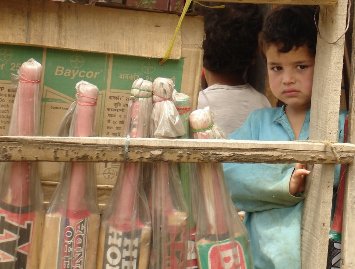
Cricket bats this side, guns on the other: Why he too may turn his back (Image Courtesy: Himalayan Trails)

Amitava Kumar has this post on the letter written by Mohammd Afzal's wife in 2004 and published in Outlook magazine. Though it does not state to whom the letter is addressed, it seems to be written to the Supreme Court.

There is little to add to the letter, it speaks for itself.
In 1990 Afzal was attracted to the movement led by the JKLF, like thousands of other youth. He went to Pakistan for training and stayed there for a little while. However, he was disillusioned by the differences between different groups and he did not support pro-Pakistani groups. He stayed there only three months without getting any training. Afzal returned to Kashmir and he went to Delhi to pursue his studies. He always wanted to study and before he joined the movement he was doing his MBBS.

My husband wanted to return to normal life and with that intention he surrendered to the BSF. The BSF Commandant refused to give him his certificate till he had motivated two others to surrender. And Afzal motivated two other militants to surrender. He was given a certificate stating that he was a surrendered militant. You will not perhaps realise that it is very difficult to live as a surrendered militant in Kashmir but he decided to live with his family in Kashmir. In 1997 he started a small business of medicines and surgical instruments in Kashmir. The next year we were married. He was 28 years old and I was 18 years.

Throughout the period that we lived in Kashmir the Indian security forces continuously harassed Afzal and told him to spy on people they suspected of being militants. One Major Ram Mohan Roy of 22 Rashtriya Rifles tortured Afzal and gave him electric shocks in his private parts. He was humiliated and abused.

...

Some days later they took him to the Humhama STF camp. In that camp the officers, DSP Vinay Gupta and DSP Darinder Singh demanded Rs one lakh. We are not a rich family and we had to sell everything, including the little gold I got on my marriage to save Afzal from the torture.

Afzal was kept in freezing water and petrol was put into his anus. One officer Shanti Singh hanged my husband upside down for hours naked and in the cold. They gave electric shocks in his penis and he had to have treatment for days.

You will think that Afzal must be involved in some militant activities that is why the security forces were torturing him to extract information. But you must understand the situation in Kashmir, every man, woman and child has some information on the movement even if they are not involved. By making people into informers they turn brother against brother, wife against husband and children against parents. Afzal wanted to live quietly with his family but the STF would not allow him.

...

There was no one to represent Afzal in the lower court. The court appointed a lawyer who never took instructions from Afzal, or cross examined the prosecution witnesses. That lawyer was communal and showed his hatred for my husband. When my husband told Judge Dhingra that he did not want that lawyer the judge ignored him. In fact my husband went totally undefended in the trial court. When ever my husband wished to say something the judge would not hear him out and the judge showed his communal bias in open court.

In the High Court one human rights lawyer offered to represent Afzal and my husband accepted. But instead of defending Afzal the lawyer began by asking the court not to hang Afzal but to kill him by a lethal injection.
To sign a petition on behalf of Afzal Guru, go here.

Related article: Not an 'eye' for an 'eye'

Tags: , ,

Wednesday, September 27, 2006

Jis marne te jag dare, mere man anand

Jis marne te jag dare, mere man anand, Marne te hi paiye puran parmanand

(Death, that terrifies most in this world, is what brings me happiness
it is in Death alone that one finds eternal bliss.)

- Kabir doha recited by Bhagat Singh when conveyed the judgement on his death sentence

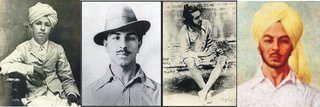
27 September is the birth centenary of Shaheed Bhagat Singh


Picture acknowledgement: Punjab Panorama

It is may not be a false statement to assert that one hundred years after his birth, Bhagat Singh is at best a name to be remembered ritually. His brief life indeed finds a mention every year, generally on his death anniversary- 23 March, but his ideas are conveniently forgotten.

In the age of trickle down economics and when youngsters learn to balance college studies with a job in the BPO around the corner, his message is perhaps irrelevant to many of those who are in the same age group as he was when he climbed the gallows.

Bhagat Singh was 23 years 5 months and 25 days when he was hanged by the British government.

Despite Mahatma Gandhi's pacifism and opposition to capital punishment he made no attempts to stop the hanging. Some consider it to be one of the political mistakes that he made.

But it is a tribute to the young man that his pictures are the only ones, along with Dr Ambedkar, that can be found in all parts of the country today. He is owned up by the Arya Samajis as well as the Communists, by the Bollywood mucksters as well as Dalit organizations. By the Khalistanis as well as the Hindutva brigade.

It may be difficult to fully understand why Bhagat Singh, and why not Chandrasekar Azad or many of those from other movements like the Chittagong Armoury raid participants, is still given an honour that is denied to many other participants in the less pacifist strands of the Indian freedom movement.

One of these reasons is undoubtedly that Bhagat Singh personified the thinking terrorist. It is amazing to see the maturity that he brings to the table in his Why I am an Athiest? He was a vociferous reader and perhaps one of the few revolutionary leaders who read so profusely till the end.

His passionate embrace of death was underlined by a deep social commitment that envisaged an egalitarian society that went beyond the struggle for independence from British colonialism. Freedom may have come to some, but for many it is still a distant dream.

Which is why Bhagat Singh and Dr. Ambedkar can still be seen on dilapidated walls and off colour posters across the country.

A tribute to the restles revolutionary.

A previous related post.


Cross posted at: Desicritics


Tags: , ,

Tuesday, September 19, 2006

What Chavez Reads

Simon Romero investigates the Bolivarian Revolution leader's reading list:

Often, as he talks on, Chávez drops the names of books he is reading or has grown to love, giving insight into the various intellectual and literary influences on his thinking and what he calls his Bolivarian Revolution, an amalgam of socialist-inspired and anti-American policies.

Favorite authors include Victor Hugo, with "Les Misérables" at the top of his must-read list, with its description of passion amid revolutionary barricades. At the swearing-in of ministers for nutrition and the people's economy, Chávez recited a passage from the introduction about the need to stamp out ignorance and poverty.

"Don Quixote" by Miguel de Cervantes also features prominently in his speeches, with Chávez identifying with the eccentric knight-errant fighting injustice. To celebrate the 400th anniversary of the book's publication, the government paid for a million copies to be distributed free last year. Venezuela also paid for 70,000 copies in English for Caribbean neighbors and 5,000 in French for Haiti.
Link via Literary Saloon

Related Post

Tags: , ,

Saturday, July 29, 2006

Ayodhya 6 December 1992 by PV Narasimha Rao

Barring Jawaharlal Nehru, it is unusual for Indian Prime Ministers to have authored books giving their political perspectives. P.V. Narasimha Rao was an exception. He authored a novel, The Insider during his own lifetime. The book under review Ayodhya 6 December 1992 appears posthumously.


The author's objective for writing the book is stated unambiguously in the Introduction:
...this book attempts to examine the broad factual, Constitutional, judicial, legal and political aspects of the events that culminated in the tragedy of 6 December 1992. It is not intended as an exercise in self- righteousness or justification of anything done or not done.
It is a tribue to PV as a writer that he has distilled from a vast amount of material to put together a racy, 188 page book without compromising the seriousness of the topic. There are less than a dozen pages that are tedious- mainly because of the long quotes from judicial and other reports whose complete text has been incorporated in the appendices.

PV does a meticulous job in the first six chapters recounting the history of the dispute, interspersing what could have become a dry narrative with perceptive insights. He points out, for example, that the RJM was already gathering significant momentum at the time of Indira Gandhi's assassination that brought the DCM Toyota yatra to a grinding halt inflcting a temporary setback to the movement.

He is also fair enough to credit Mulayam Singh Yadav's firm handling of the Ayodhya crisis in 1989 when he effectively used Central forces to halt Advani's jaggernaut.

It is in the later chapters, specially, " Ayodhya 6 December 1992" and "Why was Article 356 not invoked" that PV's book is at its weakest as it loses its initial promise of not being a self justification on the inaction of the Central government to thwart the destruction of the Babri Masjid on the fateful day.

Paragraph after paragraph, PV gets into hair splitting details as a defence for his and his government's inaction. The objectivity of the initial chapters gives way here to repetitive citing of facts, rhetorical questions and labyrinthine arguments.

In not too subtle a language, he indicates that he was "betrayed" by the Kalyan Singh government, that there were insincere machinations by leaders of his own party, the unique and unprecedented situation that 6 December presented in the history of the Republic, the dubious role played by the non Congress, non BJP parties and the perceived lapses on part of the Supreme court.

In other words, all the stars conspired to paralyse the government into inaction.

Even as PV swings from one argument to another, sometimes contradicting himself (for example, on the "crucial" role of logistics on page 174 only to point out, a few pages later, that it was not the crucial factor), he slips in a sentence that this reviewer feels is central to understanding the reasons for the paralysis of his government. PV here lets the cat out of the bag as it were.

He indicates that the BJP leaders stepped up the aggressiveness of the movement when they felt that PV was getting too close to the sants and the sadhus, in the four months before 6 December. These sants and sandhus consitituted the vast and dispersed middle leadership that expanded the reach of the previously urban based party.

This "subtle aspect of the RJM", as PV terms it, not only indicates that PV was hobnobbing with these elements, but in the very next sentence shows his own susceptibilities to the Hindutva cause: " ... the undeniable fact that while Hindu masses were swayed by their devotion to Ram and their intense desire for the temple, the political forces behind the issue could not care less for the temple."

Earlier, he had promised to construct a Ram temple in his Independence Day speech.

In other words, he was trying to display a holier than thou attitude with the BJP and hijack its agenda. He clearly failed in his calculations or machinations, the BJP trumped him in any case. He evidently had no workable backup plan.

This political failure lies at the heart of the problem- the beginning of the 1980s was marked by Indira Gandhi's tilt away from the Left, if not to the Right, progressing during the years of Rajiv Gandhi to a confused dalliance with both Hindu and Muslim communalism.

PV's era marked a consolidation of this swing towards Hindutva- culminating in the destruction of the Babri Masjid. Interestingly, PV does not use the word "Babri Masjid" anywhere in the book (though he does in his speeches in the appendices)- it is referred to as a "structure" or as the "Babri structure".

Despite the scholarly collection of facts, that well document the main events culminating on the single biggest attack on Indian secularism after Partition, PV’s defence is unconvincing and one cannot but help recall Shakespeare:

The fault, dear Brutus, is not in our stars,
But in ourselves, that we are underlings.

***

Related posts: review of "The Anatomy of a Confrontation: The Babri masjid- Ram Janmabhumi Controversy"

Cross posted at Desicritics.

Tags: , , ,

Technorati Tags: , , ,

Saturday, July 08, 2006

America's Oil Addiction

Michael Dawson on what President Bush recent statement that "America is addicted to oil".
Speculate all you want about ordinary Americans' "love affair with the car," but the institutional fact stands that the triumph and perpetuation of an automobile-intensive way of getting around town in the United States has long been, in the words of the National Association of Manufacturers, the "lifeblood" of capitalism in the United States and around the globe.

And the most important reason for this institutional fact resides in the automobile itself, which is as close as anybody could realistically imagine to the ideal capitalist commodity. Consider the mundane reality: Cars are fantastically large and complicated machines. To manufacture, deliver, maintain, make roads for, insure, store, and fuel them in the United States alone requires a trillion-plus-dollar-a-year mega-industrial complex, almost all elements of which are provided by exploited/profitable business employees. And this is all before mentioning the huge secondary economic spending on doctors and lawyers necessitated by another great capitalist virtue of cars: their tendency to collide with one another. read on...
Tags: , , ,

Saturday, July 01, 2006

Fact and Fiction behind Chávezspeak

Greg Grandin on the fiction that informs Hugo Chávez's speeches and the facts of the transformations that he has forced through Venzuela:
There is something quaint—flattering, even—about the way Venezuelan President Hugo Chávez insists on calling George W. Bush “Mr. Danger.” The taunt, which Chávez delivers in English with rolled-out vowels and pinched consonants, evokes an earlier era of cloak-and-dagger politics and lends Bush a certain mystery that he is generally denied in these shrill times of stateless terrorism. Mr. Danger, it turns out, is a minor character in Rómulo Gallegos’s 1929 novel Doña Barbara, a landmark in Venezuelan literature and before the fiction boom of the 1970s one of the most widely read Latin American novels in the world. A “great mass of muscles under red skin, with a pair of very blue eyes,” he is one of many unsympathetic misters who populate 20th-century Latin American social and magical realist prose, beginning in 1904 with the Chilean writer Baldomero Lillo’s abusive mine foreman Mr. Davis and continuing through Mr. Brown, the manager of a U.S. banana company in Gabriel García Márquez’s One Hundred Years of Solitude.

In Doña Barbara, the inhabitants of Venezuela’s untamed southern plains at first welcome the arrival of Mr. Danger, believing that he will bring “new ideas” to help modernize the region’s agricultural production. Their hopes are quickly dashed as the “scornful foreigner” loafs in his hammock, smoking his pipe and living off rustled cattle, stirring only to shoot alligators and ply his neighbor with liquor to steal his property and despoil his daughter. Mr. Danger is a “humorist in his own way” who, when introducing himself, repeats his surname in Spanish— peligro—“to emphasize its disconcerting translation.” It’s a trick Chávez, also easy with a joke, likewise enjoys: “The greatest peligro in the world,” he warns, “is Mr. Danger.”

Link via 3Quarkdaily

Technorati Tags: , , ,

Saturday, June 10, 2006

Pramod Mahajan's Legacy

His "legacy" turns out to be more dubious than I thought, but still kind of feel vindicated with all the news of sleaze and muck coming out barely a month of Mahajan's death.

India Shining is now being called India Snorting—in BJP circles.

Asked how the party of Ram bhakts had produced coke/ heroin-snorting party animals, spokesman Prakash Javadekar kept a straight face and his sense of humour—"it shows we are now appealing to all sections of society". But by the time an SMS went out suggesting that the BJP's name be changed to Bharatiya Janata Let's Party, the joke was beginning to fall flat.
...

But now that Pramod is gone and his son been found doped out, the BJP is re-examining what is being called the Pramod Mahajan legacy. Much of what has happened is being blamed on the fact that Pramod virtually ran a parallel financial empire within the BJP. Suggestions of murder by coke/heroin have been doing the rounds since it was known that, in the weeks after Pramod's death, Vivek had been complaining about former cronies refusing to return funds parked with them.
See my obituary then termed "misplaced".

Update: Source: Rediff 12 June 06

During Rahul's interrogation for drug use many details of the late Bharatiya Janata Party leader Pramod Mahajan's wealth have tumbled out, say the police.

Inspector Madanjit Singh Randhawa claimed that during his interrogation, Rahul allegedly told the police that he is capable of spending "anything between Rs 60,000 and Rs 70,000 every day."

...

Interestingly, interrogators said Rahul's cell phone buzzed all the time. Various filmmakers, politicians and industrialists call him, he told police officers.

Rahul told the police he spends money mostly on taking his friends to clubs, parties, pubs and discotheques.

Tags: , ,

Saturday, March 25, 2006

Review of Hugo Chávez and the Bolivarian Revolution by Richard Gott


I came upon Bolívar, one long morning
in Madrid, at the entrance to the Fifth Regiment
Father, I said to him, are you, or are you not, or who are you?
And, looking at the Mountain Barrak, he said:
'I awake every hundred years when the people awake'
- excerpt from the poem a Song for Bolívar by Pablo Neruda, quoted in the book

As the coup to topple Hugo Chávez gathered pace on the night of 11 APril 2002, Fidel Castro heard about it and called up Chávez at midnight. The veteran warrior from Cuba provided distilled wisdom to the young socialist crusader:
'Save your people and save yourself. Do what you have to do. Negotiate with dignity. Do not sacrifice yourself, Chávez, because this is not going to end. You must not sacrifice yourself.'

Chavez was too important a figure for the future of Latin America, Castro argued, for him to allow himself to be killed off in a coup. The advise was timely and wise.
Castro evidently had the experience of the 1973 sacrifice of Salvador Allende and his government- and the long dark years that followed the coup.

Chávez turned out to be a sharp learner who not only survived the coup but also emerged as an astute politician who is poised to succeed Fidel Castro as the leading voice of dissent against neo- imperialism and globalization as defined by the West.

Richard Gott brings such quotes- like the telephonic message from Castro- and many a historical insight to explain the phenomenon of Hugo Chávez.

Chávez is an advocate of New Socialism for the 21st century and has initiated a number of changes in his country to translate that vision into reality.

Having said this, it is important to remember, as Gott points out in this extremely necessary book- that Chávez and his concept of Socialism is derived much more from the Latin American experience of the last three centuries than from the Marxist- Leninist or Stalin- Maoist models.

Simón Bolívar has often been derided by Marxist writers as bourgeois- even Garcia Marquez ruffled a few feathers by his implicit criticism of 'The Liberator' in his The General in his Labyrinth. But Chavez considers Bolívar as an important part of the Left wing tradition in South America.

Left scholarship has traditionally seen Bolívar as securing liberation from Spain but with the help of the British- having subsequently handed over the continent over for exploitation by English capitalism.

Chávez, on the other hand has incorporated Simón Bolívar into the Left tradition and thereby brought in a heavier dose of nationalism into the ideology of the Left.

However, he does not share the pessimism of even the Liberator who is said to have remarked on his deathbed: 'America is ungovernable. Those in the service of the revolution have ploughed the sea.'

'The contradictions in Bolívar's thought are not the determining factor', argues Chávez, 'What we can see in the period of history between 1810 and 1830, are the outlines of a national project for Spanish America'. Chávez evidently plans to pursue that project with renewed energy.

Another historical personality that Chávez looks upto is Simón Rodríguez, sometimes called the Robinson Crusoe of Spanish America.
Rodríguez was a schoolteacher with unorthodox views on education and commerce far in advance of his time. he also had a passionate belief in the need to integrate the indigenous people's of Latin America, and the black slaves brought from outside, into the societies of the future independent states.
Rodríguez's ideas about education for the indigenous population of South America and the role of the underclass are crucial for Chávez- himself a mestizo.

The third major influence on Chávez has been the revolutionary soldier Ezequiel Zamora, a provincial radical who became a soldier and strategist. He advocated far reaching land reforms for the peasants and was passionately hostile against the land owning oligarchy. But more than that, the crucial element from his thought that Hugo Chávez has internalized and that has become the axis of the Chávezista phenomenon is his advocacy of the combined role of the soldiers and civilians in his struggle and the Bolivarian dream of combining with like- minded forces across South America.

Having traced the idelogolical roots of Chávez, Gott goes on to give us an extremely well crafted narrative of the rise of Chávez, his failed coup and subsequent rise as a democrat. The new constitution that the National Assembly in Venezuela wrote under his leadership has to be read in the context of these influences on the progress of the Venezuelian revolution led by Chávez.

Another distinguishing feature of this revolution- which marks it out from previous socialist projects in Europe and Asia is the lack of an organized political party- the Movement for Socialism that Chávez leads is an amalgamation of various Left wing groups and patriotic elements from the military, the latter is explained well by Gott:
For many people outside Latin America, particularly in the quarter of a century since General Pinochet overthrew Salvador Allende in September 1973, it has been almost impossible to think of a military leader without conjuring up the image of the gorila, the general and his military junta in dark glasses presiding over an authoritarian and repressive regime. Few recall the handful of leftist military rulers to have taken the side of the poor and the peasants, and pushed through radical reforms in the teeth of fierce opposition from local oligarchs and the United States. Few remember that Allende recruited progressive officers to serve in his government.
The extent of the opposition that he has invited from the previous ruling circles in his own country and the repeated coup attempts against his government are explained in the context of far reaching changes that he has brought about in nationalizing specially the oil industry, providing rights to indigenous people and in his efforts to decentralize development works.

He has repeatedly invited the wrath of the United States as his policies place him in the anti- globalization league.

Revolutionaries in every age are threatended by twin forces. On the one hand, every revolution spawns a counter- revolution as Marx observed somewhere, on the other, as the experience of the socialist revolutions of the 20th century have demonstrated, every revolution devours its own children.

The Bolivarian revolution in Venezuela is threatened more from the former at the moment, though the latter may soon be a threat too.

For all those who wear of a patch of red on their heart, the success of socialism in Venezuela and in rest of South America is extremely important.

Its continuous progress opens up new vistas for the revival of the socialist project that suffered a dramatic, if temporary, defeat after the fall of 'existing' socialism in the Soviet Union.

An interview with Richard Gott here.

Hugo Chávez and the Bolivarian Revolution by Richard Gott
Publisher: Verso
Edition: 2005
Pages 315


Tags: , , , ,

Sunday, October 10, 1999

Review of: The Sena Story by Vaibhav Purandare

Authorised Biography of the Shiv Sena
The Sena Story
By Vaibhav Purandare
Business Publications Inc, Mumbai 1999 Pages 462, Price Rs. 250


The Shiv Sena's emergence is a specific instance of a worldwide trend- the swamping and infringing of the metropolitan core by people from outside and the organised resistance to the immigrants. In case of the Shiv Sena, especially during its formative years, its championing of the Marathi manoos was rooted in the fact that most of the white- collar and even blue- collar jobs were denied to the local populace.

This is the focus of the early part of the book where the author has relied on two rigorously academic studies done by Mary Katzenstein (1979) and Dipankar Gupta (1982). Besides there are a number of interviews with aging socialist and communist leaders who once strode the city and who provide a number of incisive though critical insights into the early years of the Shiv Sena.

The Shiv Sena filled the vacuum created by the dismantling of the Left- led Samyukta Maharashtra movement after the main demands were met and a separate state of Maharashtra with Bombay as the capital was created and nobody was left to speak for the Marathi manoos. Later, according to the author, the city centric Sena struck a responsive chord in rural Maharashtra because of Sharad Pawar's joining the Congress in 1986. Pawar's co- option into the Congress left the traditionally anti- Congress backward castes with no choice but to support the Sena, which had been trying to make inroads under Chaggan Bhujbal.

Mrinal Gore, the veteran socialist leader from Bombay, however contends that the Shiv Sena and Bal Thackeray have, despite their aggressive advocacy of jobs for the Maharashtrians, actually restricted their vision and have duped the working class Marathi youth.

She observes: "(Thackeray's) appeal was to youngsters whose reasoning faculty wasn't fully developed. He told them outsiders were taking away their jobs and suggested quick fix solution...another reason he caught the fancy of youngsters was that he told them not to read and increase their corpus of knowledge. He pooh- poohed all social, political and economic theories and told the youth these were useless. Thus, he kept the vision of the youngsters confined to the Marathi issue...he stunted the intellectual and cultural growth of Marathi youth".

As the book progresses, the author chooses to increasingly rely on newspaper reports and journalistic flamboyance that he possesses in abundance.

The result is a book that, after the first few chapters, reads something between a racy potboiler and an American corporate success story. It could have been a good study of the Shiv Sena. That it is not so is indeed regrettable since there have been few studies of the Sena in recent years unlike that of the Sangh Parivar. Purandare has missed a chance to step into this void, since at a number of places he is incisive and there are flashes of serious journalism. Instead he has turned it into what is at best a narrative of the rise of the Sena (as the word "story" in the title indicates) and at worst into a hagiographic account of the Sena and its supremo Bal Thackeray.

He asserts: "The Left wing critics of the Sena always maintained that class exploitation and not ethnic competition deprived the Maharashtrians of economic strength, but the middle class Maharashtrian found the Sena's position more convincing." And what was the Sena' position? Its position was to drive out the non- Maharashtrians by advocating reservation for the local Marathi speaking populace- so far, so good.

But it went beyond that. It resorted to strong- arm tactics and street smart justice. It resorted to intimidation, murder and outright terror, first against the South Indians, then the Communists, then Muslims and, by way of variety, against liberal individuals like AK Hangal and Dilip Kumar. Purandare recounts a number of such incidents, yet, all this does not diminish his enthusiasm either for the Sena or for Raman Fielding (as Rushdie characterized Bal Thackeray in The Moor's Last Sigh).

The author's celebration of what should actually have been a lament for the de- cosmopolitanization of Bombay is misplaced. That indeed is sad and a cause for concern.

Published: The Tribune 10 Oct 1999