Showing posts with label Latin American Literature. Show all posts

Tuesday, February 06, 2007

With Borges by Alberto Manguel

More knowledgeable friends have often expressed consternation, if not contempt, for the fact that I have never quite 'taken to' Borges.


Silly as it may sound, but the fact is that I could not proceed beyond a few (well, actually just a couple) of his stories that I don't even remember.

My reasoning is that I am a reader of the novel, not the short story, and then also novels in the tradition of the 19th century novel at least in their concern for social and political issues.

Borges does neither.

In fact, I was surprised by a statement attributed to him- that the novel is an unnecessary form since a good writer can express the same in a short story (or words to that effect) .

Jorge Luis Borges himself was a master of the short form.

His genre is also the fantasy, something that does not appeal to me for similar reasons.

It turns out that my views are not exactly original. In his early years, Borges was criticized on these very grounds (which makes me feel ancient.)

This and much else comes to light in Alberto Manguel's slim, almost Borgesian volume, With Borges whose English translation came out last October.

Manguel read to the great Spanish writer when the latter was fifty eight years and had turned blind, and Manguel himself was sixteen years old. He was one of the many people who had the privilege of reading to Borges and it is very clear that these four years at that impressionable age left a lifelong imprint on his mind and his style of writing.

With Borges is part recollection and part an insightful literary excursion into the writings of Borges.

He brings out in one breathless sweep, the great man's wide reading, his ability to correlate different works and ideas, his love for 'inventive memories', his disdain for convention when it came to writing, or reading for that matter, and his belief that the universe is a book.
There are writers who attempt to put the world in a book. There are others, rarer, for whom the world is a book, a book that they attempt to read for themselves and for others. Borges was one of those writers. He believed, against all odds, that our moral duty was to be happy, and he believed that happiness could be found in book, even though he was unable to explain why this was so.
Elsewhere he remarks:
For Borges, the core of reality lay in books; reading books, writing books, talking about books. In a visceral way, he was conscious of continuing a dialogs begun thousands of years before and which he believed would never end. Books restored the past.
Borges considered himself to be, above all, to be a reader.
...reading is, for Borges, a way to be all those men he knows he'll never be: men of action, great lovers, great warriors. For him reading is a form of pantheism.
For anyone who is a fan of Borges already, this is a delightful book with incisive insights into their favorite writer's mind and for those still not converted to the cult, it is a gentle reminder to go and read him carefully, and more generously.


Technorati Tags: , , , ,

Monday, February 05, 2007

An Interview with the Tango Singer

Maya Jaggi interviews Tomás Eloy Martínez, whose The Tango Singer, was one my own best reads last year.
...the novel aims to "draw a map of the city of Buenos Aires that can't be seen, an urban topography of the unknown", though the labyrinth he depicts is one in time, not space. "A large part of Argentinian history concludes with an act of violence," he says in London. "The dictatorship ended with a war - the Malvinas - with 30,000 desaparecidos in the concentration camps. All stories are contaminated with violence."

He had been asked to write a factual book about the capital, but it came to him as a novel, in a dream. Set in late 2001, the story unfolds amid Argentina's financial crash, with spiralling inflation, a bizarre succession of five presidents within 15 days, and 30 people killed in rioting in Buenos Aires. Bruno, who leaves Manhattan just before September 11, finds Argentina's meltdown more urgent and astonishing than the terrorist strike on the twin towers. For Martínez, too, who was visiting as "the country was on the verge of collapse", it was a "more absorbing reality that a whole country was disappearing from the map. Why must what happens in the US be more important than the terrible things that happen in Buenos Aires or Baghdad?"
Related links:

Review of Santa Evita by Tomas Eloy Martinez
Review of The Peron Novel by Tomas Eloy Martinez
A review of The Tango Singer (from Independent)


Link via Literary Saloon

Tuesday, January 30, 2007

A Literary Journey to Brazil

Jorge Amado, Brazil's most celebrated novelist, was, like the country, larger than life. His novels ("Gabriela, Clove and Cinnamon" and "Dona Flor and Her Two Husbands" were reissued this past fall by Vintage; "Tent of Miracles" and "Tieta" in 2003 by University of Wisconsin Press) burst with energy -- rollicking, robust, earthy tales from the northeast port cities of Ilheus and Salvador, of worker strikes, rubber booms and busts, and mulatto beauties. (The film versions of "Dona Flor" and "Gabriela," incidentally, are classic '70s softcore fare, starring the sumptuous Sonia Braga.) Amado, embraced in the U.S. during the Latin boom era of the '60s and '70s, had been pumping out hardy, proletarian-style novels since the '30s, though by the '50s they had turned more comic, lighthearted and bawdy.
Over at Salon, Anderson Tepper writes about the literary journey to Brazil. My own reading of literature from Brazil is limited to Jorge Amado's Dona Flor and Her Two Husbands (that I did not quite catch), Twelve Fingers by Jo Soares and The Silence of the Rain by Luiz Alfredo Garcia-Rozaa, a detective novel which was left incomplete.

The best reading on Brazil, however, was Mario Vargas Llosa's The War of the End of the World.

Related Post

link via Splatlit

Wednesday, January 10, 2007

A Literary Thaw in South America

Gabriel Garcia Marquez and Mario Vargas Llosa make up after a brawl thirty years ago. I am personally very delighted since both are my favorites.
A special edition of García Marquez's One Hundred Years of Solitude, to mark this year's 40th anniversary of its publication, is to include a prologue by Vargas Llosa. "Both men are in agreement over this," a spokesman for Spain's Royal Academy, which is publishing the edition, told the Guardian yesterday.

The agreement comes despite the fact the two have not spoken since they came to blows in a Mexican cinema in 1976. The book is to be published in March, when it will be presented to a meeting of national Spanish language academies from around the world at Medellín in Colombia.

The introduction is reported to be an excerpt from Vargas Llosa's laudatory book on García Marquez, published when the two were friends in 1971, called History of a Deicide. The Peruvian writer had apparently refused to allow the book to be republished after his falling out with García Marquez. He finally relented last year, adding it to a collection of his complete works in Spain. "There is no point in censoring a part of your life," he said at the time. Both writers have remained silent about the reasons for their brawl, except to say it was about something personal.
Technorati Tags: ,

Link via Literary Saloon

Sunday, December 24, 2006

An Episode in the Life of a Landscape Painter by Cesar Aira

César Aira is one of the most prolific contemporary Argentinian writers. His "An Episode in the Life of a Landscape Painter" recounts the transformation of Johann Moritz Rugendas (1802-1858), a German painter who is deformed during one of his travels across South America. This 'deformation' in reality is a transformation as well, as Rugendas begins to look beyond the beautiful landscapes of South America and into the faces of the native Indians. This change in perspective happens when Rugendas is struck by a lightening bolt.

It has certainly been one of the more unexpectedly wonderful books I came across this year, elegant with a dense story that is most poignant when the bolt of lightening strikes Rugendas and transforms him even while deforming his face forever.
The storm broke suddenly with a spectacular lightening bolt that traced a zig- zag arc clear across the sky. It came so close that Rugenda's upturned face, frozen in an expression of idiotic stupor, was completely bathed in white light. He thought he could feel its sinister heat on his skin, and his pupils contraced to pin- points... From that moment on, like all victims of personlized catastrophes, he saw himself as if from outside, wondering. Why did it have to happen to me?
The introduction to the 87 page novella is by Roberto Bolaño who remarks in his preface:
Aira is an eccentric, but he is also one of the three or four best writers working in Spanish today.
The novel reminded me of Raj Kapoor's early film Aag which investigates the same dialectic of Beauty and the Beast, but this book is far more spectacular in its meditation on the relationship between reality and art, as well as an encounter, or clash, if you like, of civilizations.

A more detailed review.

Sunday, December 17, 2006

'Il Postino', Pablo Neruda and Makhdoom


"And it was at that age...Poetry arrived
in search of me. I don't know, I don't know where
it came from, from winter or a river.
I don't know how or when,
no, they were not voices, they were not
words, nor silence,
but from a street I was summoned,
from the branches of night,
abruptly from the others,
among violent fires
or returning alone,
there I was without a face
and it touched me."
- Pablo Neruda


'Il Postino' (The Postman) is a movie about a fumbling postman whose job is to deliver mail to Pablo Neruda while the latter is in exile on an island in Italy. This is partly fictitious. I don't have his autobiography with me so I cannot verify about this incident if at all it is mentioned in the book, I don't remember reading about it.

Mario watches a documentary news item in a cinema recounting the journey of Neruda to Italy. When he is asked to deliver mail to him, he gets interested in Neruda's poetry so that he too, like Neruda, can "impress the girls".

Starting with this rather innocuous motive, he begins to understand the art of writing poetry and imbibes ideas from Neruda himself. The dialogues are wonderful and the interactions between the postman and the Poet are a delight every time Mario goes to deliver mail to Neruda. The rustic intelligence of Mario is pitted against the wisdom of the Neruda and the brilliance comes through despite the translation.

There area couple of sentences that I particularly liked. Mario takes a poem from Neruda to impress a girl he likes (called Beatrice). When Neruda castigates him for doing so, he responds with the following, leaving the poet speechless:

Poetry doesn't belong to those who write it, it belongs to those who need it
Later, his friendship with Neruda evolves and he starts understanding "complex" words like "metaphors" and starts writing poetry himself. Neruda also helps him in convincing Beatrice to marry him. When the priest discovers that Mario wants Neruda, a well known communist, as his best man, he is outraged:
Priest: Find yourself a person who isn't a communist. If Neruda doesn't believe in God, why should God believe in Neruda. What sort of a witness would he be?

Mario: God never said a communist can't witness at a wedding
The movie is peppered with snippets from Neruda's poetry. Here is a short (abou 9 minutes) clip available at youtube where Neruda composes a poem, and Mario begins to interpret it. At the end he makes a powerful comment:

Is it that the whole world is a metaphor for something else?
The clip:


A spoiler here, so don't proceed if you intend to watch the movie yourself), Mario is invited to attend a communist demonstration and dies there. At the end of the movie, Pablo Neruda returns and finds that Mario's son, born after he has died, is named Pablito.

Mario also records the sounds of his islands to send them on tape to Neruda. This clip captures that recording.


Needless to say, it has been one of the best movies that I have seen for a long time (not that I watch much), it is perhaps also the only movie I was able to watch without any break- and it was twice in two days.

Incidentally, the role of Mario was played by the actor- writer Massimo Troisi who died one day before the movie was released. He had deferred his heart treatment so that he could complete the movie (from Wikipedia)

'Il Postino' reminded me of a similar episode in the life of Makhdoom Mohiuddin, the communist poet from Hyderabad. It was recounted in the TV serial Kahkashan, and what I recollect is recounted here.

When the CPI was banned in 1948, Makhdoom was incarcerated in a jail where his cellmate was a young man who had been jailed in trumped up charges by the family of a girl he was in love with. Makhdoom leads him via his poetry to become politically educated. The young man is somehow released and Makhdoom as well, after a gap. Years later, while passing by a town he is informed of the sacrifice of a young man and a woman during the Telengana struggle. Makkhdoom finds the graves of the young man who had been his cellmate and beside his grave, that of that of the girl he had loved.

Makhdoom wrote a very moving nazm when he saw this.

The Kahkashan version is here, it has also been used in a Bollywood film Cha Cha Cha.

Thanks to HD for recommending the movie.

Sunday, December 10, 2006

Augusto Pinochet and India


Salvador Allende (right) and Augusto Pinochet

Augusto Pinochet, the former Chilean dictator who overthrew the first democratically elected Marxist government in history and who died today at the age of 91, may have been little known in India but he cast a short but eventful shadow on recent Indian history.

The overthrow of Salvador Allende's government in the Pinochet- led coup on 11 September 1973 sparked off rumors of similar events happening in India. Those were the years of the Cold War, and Mrs Indira Gandhi was in her early phase of a swing towards the Left in order to defeat the Syndicate within the Congress Party. JP's "Total Revolution" was seen as a movement to upset her regime, even as the CIA was thought to be in the process of dislodging her regime.

It was in this background that the CPI supported her when she clamped down the Emergency in 1975. The coup in Chile had led the Dange faction within the CPI to strengthen their support of what was perceived as a Center- Left Congress government headed by Indira Gandhi.

Salvador Allende's brief tenure became well known in India as an example of a socialist government taking power by democratic means, his death during the coup made him a hero in the eyes of the intelligentsia in the country.

However, in the last two decades as India moved towards the United States economically and politically, even this memory became hazy. A recent news story even had a headline that made me wrench: Former Chilean dictator's health improves as if this was something to be celebrated.To me, it only illustrated the chasm that had come over in India in the intervening years and the ignorance of contemporary history.

The novels of Ariel Dorfman (The Last Song of Manuel Sendero) and more recently Roberto Bolaño made one aware of the brutality of Pinochet's regime and today, the news his death came just as I finished reading Bolaño collection of short stories Last Evenings on Earth.

This particular collection of short stories is somewhat uneven and a bit of a disappointment compared to his very excellent novels By Night in Chile and Distant Stars. There is one story in the collection, however, that has India in its backdrop. I found it strange that Bolaño used India as a backdrop to illustrate the brutality of the Pinochet years. Reading it, I felt while India may have forgotten Allende and Chile, Chile had remembered India, even if it was in its nightmares.

I quote excerpts from the story Mauricio ("The Eye") Silva:
It is customary in some parts of India, said The Eye, looking to the ground, to offer a young boy to a deity whose name I can't remember... outwardly, the ceremony is like a Latin American pilgrimage, but perhaps more joyful, more turbulent, and for the participants, those who know what they are participating in, the experience is probably more intense. But there is one major difference. A few days before the festivities begin, they castrate the boy. The god whose incarnation he is to be during the festival requires a male body- although the boys usually no more than seven years old- purified of male sexual organs. So the parents hand him over to the festivals doctors or barbers, or priests, and they emasculate him. And when the boy has recovered from the operation, the festival begins. Weeks or months later, when it is all over, the boy goes home, by now he is an eunuch and his parents reject him. So he ends up a brothel. These brothels vary; there are all sorts, said The Eye with a sigh. That night, they took me to the worst one of all.

...

That night, when he ("The Eye") went back to his hotel, he wept for his dead children, and all the castrated boys, for his own lost youth, for those who fought for Salvador Allende and those who were too scared to fight. Unable to stop crying, he called his French friend, who was now living with a former Bulgarian weightlifter, and asked him to send him an airplane ticket and some money for the hotel.

And his friend said Yes, of course, he would, right away and then: What's that sound? Are you crying? And The Eye said Yes, he couldn't stop crying, he didn't know what was happening to him, he had been crying for hours. His French friend had told him to calm down. At this The Eye, still crying, laughed said he would do that and hung up. But he went on crying, on and on.
As Augusto Pinochet is laid to rest- something that he denied to many of his compatriots during his years in power, one remembers, nay salutes, all those who disappeared, or were silenced and whose silence lies buried in the sea or in lime pits.

An evaluation of his legacy by Marc Cooper: Pinochet Cheats Justice, even in his death

Related Post: Torturing People so that Prices can be Free
Image Acknowledgment ( more images of Salvador Allende)

Friday, November 24, 2006

A Literary Guide to the World


The Salon has a great collection on literary destinations of the world. Some of those that interested me appear below.

Russia: Ken Kalfus provides a backdrop to the contemporary Russia and goes on a nostalgic trip to the past when great literature was written. A couple of remarkable insights:
Alienation, the struggle for a decent life, really bad weather -- the universal themes of this vast nation's literature make us all feel Russian at one point or another...

During the Soviet era, literature was an occupation slightly less dangerous than coal mining
And also this one from Nobokov:
In his notes to "Anna Karenina," collected in his "Lectures on Russian Literature," Nabokov recalls that one day when he was a small boy, he and his father encountered an old man on a street in St. Petersburg. The elder Nabokov knew the man, chatted briefly with him and then, after they parted, told his son, "That was Tolstoy." We don't know which St. Petersburg street so briefly channeled this confluence of talent.
Unfortunately, Kalfus does not discuss the contemporary literature coming out of Russia, nor some of the recent discoveries from the past, most notably Andrei Platonov.

Chile: A very comprehensive introduction to the literature from Chile, but leaving out, for some reason, one writer who has been making waves in the last decade, Roberto Bolano.

The crazy character of this wondrous land shines in the poems of Pablo Neruda, while its strife under Pinochet is captured best by José Donoso and Patricia Verdugo...

A country not quite like any other: thousands of miles long and never more than a few hundred miles wide, isolated from the outside world by the cordillera de los Andes to the east and the most turbulent ocean on this planet, ironically called the Pacific, roaring to the west. As if Norway and the Gobi, Oregon and Italy, the Alps and Nantucket, had been compressed into one small nation, a land that doesn't fit into a novel, a land that demands the delirium of poetry. No wonder Chile is known as "un país de poetas."

A land of poets.

Argentina:

Benjamin Kunkel discusses Borges, Bruce Chatwin, Cortázar, César Aira, Manuel Puig, Marguerite Feitlowitz's "A Lexicon of Terror" and Edwin Williamson's "Borges: A Life".

That he misses out Tomás Eloy Martínez is rather unfair.

From Borges to Bruce Chatwin, the rich and moody literature of South America's most European nation reflects its homeland's squandered potential...

And this sense of an Argentina constantly delivered, against its will, into the desolation of reality may also do something to explain why the most moving lines in Borges' poetry are always those uncharacteristic ones in which the imagination fails and the elaborate structures collapse. To a would-be lover he writes: "I can give you my loneliness, my darkness, the hunger of my heart; I am trying to bribe you with uncertainty, with danger, with defeat." To himself he says: "And I don't know how time can pass/ I who am time, and blood, and pain." And when at last he goes blind, as his father before him did, he says: "Soon I will know who I am."

Mexico:
In this place where the bizarre is banal and nothing is quite what it seems, it's no surprise that the literature will blow your mind...

In front of tourists, Mexicans become consummate actors. They'll say just about anything to enchant you, to make you lose your mind. This, after all, is a country where the bizarre becomes routine. Not surprisingly, foreigners return again and again as if hypnotized. Their account of life en el México profundo is as captivating as it is untrustworthy.
Ilan Stavan decides to focus less on the literature from Mexico, and more on the writing by Europeans including Graham Greene's "The Power and the Glory". This is rather unfortunate since there is so much of literature from Mexico that is of international stature. Mariano Azuela's" The Underdogs" manages to find a passing reference, as does Juan Rulfo's "The Burning Plain", though not his more famous "Pedro Paramo".

China: "To understand the last century of this vast Far Eastern country, look to the moving stories of Lu Xun, a celebrated memoir of the Cultural Revolution and an engaging, concise history."

Rest of the World (nothing on South Asia except for Afganisation. Though in the "Middle East" category)

Image Source

Link via Spatlit

Saturday, September 16, 2006

The Underdogs- A Novel of the Mexican Revolution by Mariano Azuela

Few novelists have managed to create a successful short novel- some that instantly spring to mind are Turgenev (Father and Sons, Rudin), Juan Rulfo (Pedro Paramo), Kurt Vonnegut (Slaughterhouse Fiftyfive Five ), even Flaubert (Madame Bovary) and perhaps a few more complete the list.

To this short list also belongs Mariano Azuela's classic novel about the Mexican Revolution: The Underdogs. In a mere 150 pages, Azuelo captures the tribulations of an Indian peasant leader- Demetrio Marcías and through him, the tribulations of the Mexican Revolution. Suffice would be to quote a a few lines from the novel that also serves as the summary of the novel:

Villa? Obregon? Carranza? Who do I care? I love the Revolution like I love the volcano that's erupting! The volcano because it is a volcano; the Revolution because it's the Revolution!... But the stones left above or below after the cataclysm? What are they to me?

...

"Why do you keep on fighting, Demetrio?"

Demetrio, frowning deeply, absentmindedly picks up a small stone and throws it to the bottom of the canyon. He stares pensively over the precipice and says:

"Look at the stone, how it keeps going..."
The stone falling into a bottomless precipice is allegorical about the fate of the Mexican Revolution itself.

Tags: , ,


Saturday, August 12, 2006

Santa Evita by Tomas Eloy Martinez

In an apparent attempt to reduce the popularity of her own blog, Bhaswati Ghosh invited me to guest- post at her blog "At Home, Writing".

My thanks to her. After all, the risk is all her's :-)

***
In the short span of six years between 1946 to 1952, Eva Perón, the wife of the Argentinian dictaror and founder of the Perónist party, Juan Perón, won over the Argentinian people so much so that her popularity was said to rival, if not exceed, that of Juan Perón himself. Having risen from obscurity, the youngest daugher of an unwed mother, her rise had been all the more spectacular.

Tomás Eloy Martínez's Santa Evita could have been termed as a biographical account Eva Perón's life had the author chosen to write about her short but eventful life.

Instead, he has chosen to write about her corpse.

Eva Perón's body, like Lenin's, was embalmed after she died of cancer at the age of 33, at the height of her popularity. However, before the corpse could be housed in a mausoleum for public display, Juan Perón was overthrown in a military coup, and thus began the after- life journey of Eva Perón, as the incumbent military government wondered what to do with the embalmed body.

To bury the corpse could have, they feared, incited the loyal Perónists and even the masses. And Eva dead was perceived as more dangerous than the living one.

Even a few replicas were created to mislead any followers, and attempts were made to bury them. For over a decade, the corpse and the replicas changed hands and locations, traversing within Argentina and to Europe- one replica was buried in Bonn and the actual corpse in Milan, Italy from where it was finally recovered and returned to Juan Perón after his return from exile in Spain.

Martínez recounts the stories of all those that came in contact with the corpse, and the often calamitous ends that they came to. Insidious accidents wait those entrusted with the corpse.

Some were haunted till death, some met with unexplicable accidents and others were relentlessly followed by a mysterious person called the 'Commander of Vengeance'.

It is characteristic of Martínez to write a novel that takes the after- life of Eva Perón rather than her not less eventful life as its theme. He does show us slices of her life too but often as flashbacks and in recollections of those that he meets with.

In a sense, therefore, he underlines the persona that outlived Eva Perón herself.

This is akin to his previous novel, the redoubtable The Perón Novel, where he focussed not so much on Peron's politically active years, but the seemingly innocuous journey of an exiled dictator returning to his home country in old age.

Santa Evita is a novel within a non- fictional account where Martínez goes out in serach of information about Eva Perón's corpse- the story emerges as he interviews people associated with Eva or later with her restless corpse.

He makes the reader an accomplice in this journey of discovery- it becomes very much like a mystery in which the reader has as many, and more often as few, clues as the writer. This makes the novel extremely readable, if not racy.

Santa Evita turned out to be unputdownable, and I finished it within a week. Along with The Perón Novel , it has been one of my best reads from Latin America in the last one year.

[Cross posted at Bhaswati Ghosh's blog: At Home, Writing]


Tags: , , , , ,

Tuesday, July 25, 2006

The Time of the Hero by Mario Vargas Llosa

The Time of the Hero was published in 1961 when Llosa was 25- it was immediately burned by the authorities for exposing the perversities of the Military Academy that was supposed to churn out candidates who would then hopefully join the military.

The novel is tedious in the first half, and begins to make better sense after the first 250 pages. The patience is worth it- all the elements of the future Llosa are there, even as the impact of William Faulker is very much evident.

There are multiple narratives, shifts in time and space, and in the battle between the reader and the writer, the initial incursive strides of the reader in the first 250 pages are shortlived.

The triumph of the writer thereafter is rapid, and unassailable.


Tags: , , ,

Technorati Tags: , , ,

Saturday, July 01, 2006

Fact and Fiction behind Chávezspeak

Greg Grandin on the fiction that informs Hugo Chávez's speeches and the facts of the transformations that he has forced through Venzuela:
There is something quaint—flattering, even—about the way Venezuelan President Hugo Chávez insists on calling George W. Bush “Mr. Danger.” The taunt, which Chávez delivers in English with rolled-out vowels and pinched consonants, evokes an earlier era of cloak-and-dagger politics and lends Bush a certain mystery that he is generally denied in these shrill times of stateless terrorism. Mr. Danger, it turns out, is a minor character in Rómulo Gallegos’s 1929 novel Doña Barbara, a landmark in Venezuelan literature and before the fiction boom of the 1970s one of the most widely read Latin American novels in the world. A “great mass of muscles under red skin, with a pair of very blue eyes,” he is one of many unsympathetic misters who populate 20th-century Latin American social and magical realist prose, beginning in 1904 with the Chilean writer Baldomero Lillo’s abusive mine foreman Mr. Davis and continuing through Mr. Brown, the manager of a U.S. banana company in Gabriel García Márquez’s One Hundred Years of Solitude.

In Doña Barbara, the inhabitants of Venezuela’s untamed southern plains at first welcome the arrival of Mr. Danger, believing that he will bring “new ideas” to help modernize the region’s agricultural production. Their hopes are quickly dashed as the “scornful foreigner” loafs in his hammock, smoking his pipe and living off rustled cattle, stirring only to shoot alligators and ply his neighbor with liquor to steal his property and despoil his daughter. Mr. Danger is a “humorist in his own way” who, when introducing himself, repeats his surname in Spanish— peligro—“to emphasize its disconcerting translation.” It’s a trick Chávez, also easy with a joke, likewise enjoys: “The greatest peligro in the world,” he warns, “is Mr. Danger.”

Link via 3Quarkdaily

Technorati Tags: , , ,

Saturday, June 24, 2006

Distant Stars by Roberto Bolano

Roberto Bolaño died three years ago at the relatively young age of 50 , at the pinnacle of his career as a writer and before he could be better known in the English knowing world.

The translation into English of his By Night in Chile a few years ago marked his arrival in the English world. Distant Stars is the next book translated into English. His collection of short stories Last Evenings on Earth has been published recently and the translation of his most ambitious posthumus work 2666 is eagerly awaited.


The theme of Distant Stars is the same as the By Night in Chile, the over two decades of unbridled exercise of power by the dictatorship of Augusto Pinochet after the violent overthrow of the socialist government of Salvador Allende on that other, less remembered, 9/11 of 1973.

The theme has been attempted by other writers, notably by Ariel Dorfman in The Last Song of Manuel Sendero, who made a vastly more experimental attempt at capturing the brutality of those years. In contrast, Distant Stars is a relatively simpler novel, closer to Dr Faustus by Thomas Mann, but less verbose and less tedious.

Mann had taken the analogy of the folk legend of Faust and Mephistopheles where a musician signs a pact with the devil (in this case Nazi Germany), to illustrate the immorality of those who had been accomplices of the Nazi regime. Bolaño, in this work, takes the case of an avant garde poet, Carlos Wieder. In the process he also offers insights into the lives of that generation of poets that was torn apart by the dictatorship: "Madness was not exceptional at that time," he remarks, when Carlos Wieder inaugurates a new form of poetry by writing one and two liners poems in the sky on an airplane.

While Carlos wins accolades from the regime, other poets meet with a different fate. "The good news was that we had been expelled from the university, the bad was that almost all of our friends have disappered", the narrator's friend Bibiano observes. There are many incidents that recount the "melancholy folklore of exile- made up of stories that are fabrications or pale copies of what really happened".

Carlos meanwhile goes on to experiment with other forms of 'literature' till it becomes so grotesque that even the supportive regime finds it difficult to continue to stand by him. Bolaño unmasks the gory details, and Wieder's participation in the brutalization of the Chilean soceity during the dictatorship. Wieder's unwritten pact with the devil becomes evident.

Bolaño scores with the fact that he is able to evoke a series of sub texts that are pregnant with possiblities. The following narration, for example, by the Indian maid of one the victims of the Wieder's murderous crimes indicates a new trajectory that deserves a different treatment altogether.

The maid makes an appearance in the court against the defendent Carlos Weider when his crimes are discovered.
Over the years her Spanish had dwindled. When she spoke every second word was in Mapuche... in her memory the night of the crime was one in the long history of killing and injustice. Her account of the event was swept up in a cyclical, epic poem, which, as her dumbfounded listeners came to realize, was partly her story, the story of the Chilean citizen Amalia Maluenda, who used to work for the Garmendias, and partly the story of the Chilean nation. A story of terror.... Remembering the dark of the crime, she said she had heard the music of the Spanish. When asked to clarify what she meant by "the music of the Spanish," she replied: " Sheer rage, sir, sheer, futile rage".
Cross posted here.

Tags: , , , ,

Monday, May 29, 2006

The Writer who wanted to play Football

With the World Cup round the corner, one cannot but help think of Eduardo Galeano, the Uruguayan writer who wanted to be a football player and is the author of classic The Open Veins of South America and also, Soccer in Sun and Shadow.

At the beginning of Soccer in Sun and Shadow, Eduardo Galeano despairs the professionalization of soccer: what he calls the "voyage from beauty to duty" (2). In this "voyage" he sees the suppression of the beauty, creativity, and freedom of play in favour of winning and profit. Professional soccer "imposes a soccer of lightning speed and brute strength, a soccer that negates joy, kills fantasy and outlaws daring" (2). The same can be said of professional hockey, where playmakers become the targets of bruisers with cement hands, and are forced out of the game through injury. But getting back to soccer, as Galeano says:

Luckily, on the field you can still see, even if only once in a long while, some insolent rascal who sets aside the script and commits the blunder of dribbling past the entire opposing side, the referee and the crowd in the stands, all for the carnal delight of embracing the forbidden adventure of freedom. (2)

It is this "adventure of freedom" that Galeano looks for in soccer, the aptly nicknamed 'beautiful game.'

From: Shakespeare's World Cup.

A recent interview at DemocracyNow.
AMY GOODMAN: How does soccer and politics intertwine?

EDUARDO GALEANO: Everywhere, every day, soccer is a source of power nowadays. Silvio Berlusconi is the result of the success of the Milan club in Italy. And almost all politicians in the Latin countries have close relationships to not only president or politicians, but even military dictators. One of the first acts of General Pinochet in Chile was to become president of a very popular soccer team, Colo-Colo, because he knew perfectly well that soccer is a source of prestige and power.
Excerpts from his book Soccer in Sun and Shadow.

A review of his book Upside Down.

Tags: , , , , , ,

Thursday, April 20, 2006

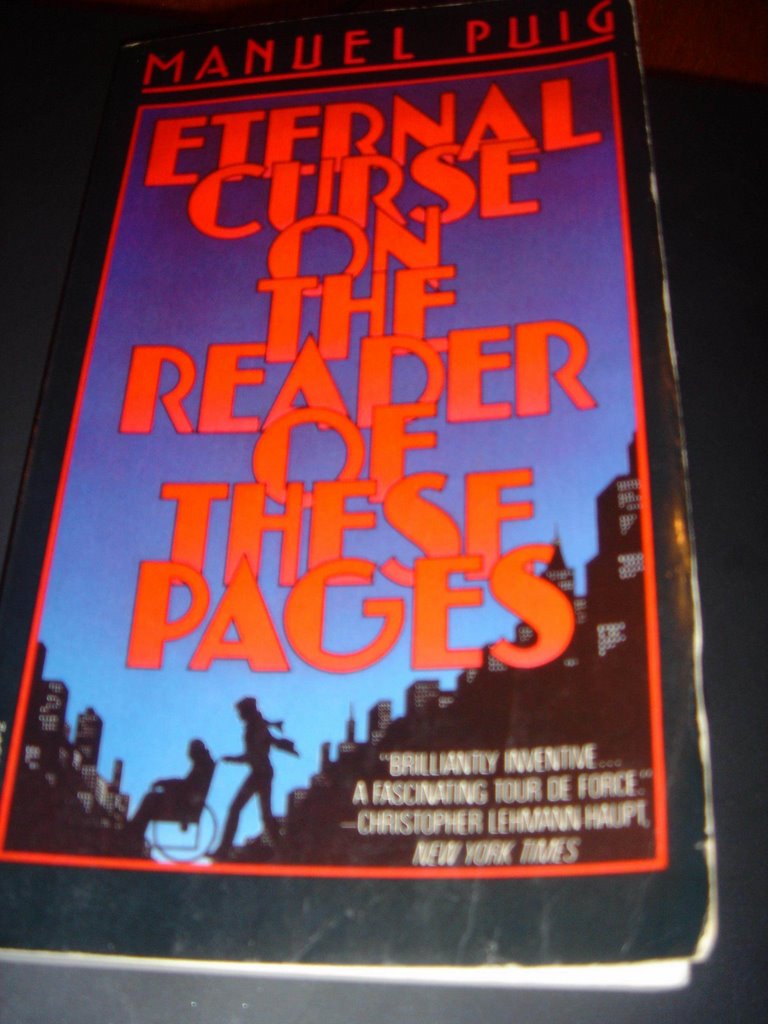
Eternal Curse on the Reader of These Pages

Best known for the novel Kiss of the Spider Woman, and about whom the Peruvian writer Mario Vargas Llosa once said : "Of all the writers I have known, the one who seemed least interested in literature was Manuel Puig (1932-90)."


The plot of Manuel's novel (the first one that he wrote in English) Eternal Curse on the Reader of These Pages is seemingly staightforward.

An Argentenian revolutionary, a trade union- organizer actually, is tortured after the military coup in 1976. He manages to find his way to a sanatorium in the United States via a human rights organization. Here he is allotted an attendant who takes him around in his wheelchair. The novel is little more than a series of conversations, a continuous dialogue between the two as the attendant Larry takes Ramirez around New York.

But as the novel progressed, I found the plot somewhat convoluted and the novel crashing to an uncertain end- the reader is urged on not so much by the plot but by the layers of reality and unreality that are unsheathed between the dialogues.

The novel has no other text except 223 pages of dialogue, five letters, one will and one job application.

The plot is rendered meaningless in the web of psychological trajectories that Puig weaves for the reader.

There is nothing sinister about the novel itself despite the title. But it has dark undertones throughout, peppered and enlivened with deep insights that make one aware of the sensitivities of this writer "least interested in literature."

I found the novel stylistically very innovative and confirmed the view that Latin American Literature is not all about magical realism. It is enriched by a galaxy of writers with very distinctive styles.

Tags: , , , ,

Monday, March 13, 2006

Tagore and Latin America

In school, I was initially exposed to Charles Dickens and Jules Verne, as I grew up the literature that really enraptured and then shaped my thinking was from Russia and later from Eastern Europe but above all from Latin America, a continent I knew neither as part of my education nor did I know the languages- Spanish and Portuguese. Yet, I took to Garcia Marquez and Mario Llosa, amongst others, as fish to water.

In a reversal of historical fact, it was the Latin American writers that lead me to some of the Anglo- Americans- Faulker, for example was via Carlos Fuentes. Still I have to state, with all due respect to Anglo- American literature, that the Anglo- Americans do not touch a raw nerve in me as do the Latin Americans.

Perhaps I will one day try and rationalize the natural affinity. Till then, see two interesting links below.

An interesting essay on the fascination for Tagore in Latin America. Link via SPATLIT.
How did Rabindranath Tagore come to be so well known and beloved in Latin America, a continent so different from India? Well, maybe because they are not so different.
And another interesting report from India from the same site .
While Akademi secretary K. Satchidanandan championed against the 'monolithic, stereotypical concept of the Latin American novel', Chilean critic Jaime Collyer asserted: 'The myth and the hoax, this magic-religious interpretation of the world are as much a part of Spanish America as its actual discovery.'

The Sahitya Akademi, which is publishing Spanish-Hindi bilingual editions of Gabriela Mistral, Pablo Neruda, Octavio Paz and contemporary poets, has sought help from other publishers in this mammoth task.

Saturday, March 11, 2006

The Perón Novel by Tomás Eloy Martínez

The joys of being a dictator are immense!

One enjoys an almost god- like stature while weilding power, and subsequently a writer comes along and writes a novel on the dictator- forcing him to live through not so much the god- like side of the story but much more intensely the other side of the Janus face- the one that is dark and clumsy and often remains under a cloak during the lifetime of the dictator.

In the poem The Novelist Auden writes on how the novelist must live through the existences of his characters:
Encased in talent like a uniform,
The rank of every poet is well known;
They can amaze us like a thunderstorm,
Or die so young, or live for years alone.
They can dash forward like hussars: but he
Must struggle out of his boyish gift and learn
How to be plain and awkward, how to be
One after whom none think it worth to turn.

For, to achieve his lightest wish, he must
Become the whole of boredom, subject to
Vulgar complaints like love, among the Just

Be just, among the Filthy filthy too,
And in his own weak person, if he can,
Must suffer dully all the wrongs of Man.
Stalin had Solzhenitsyn's The First Circle that captured the pyschological portrait of the man, and we have had Garcia Marquez's The Autumn of the Patriach based on the archetypal Latin American dictator and more recently Mario Vargas Llosa's The Feast of the Goat on the Dominican Republic's Trujilo.

Tomás Eloy Martínez, author of Santa Evita and more recently, The Tango Singer, traces the life of the Argentinian strongman and founder of Peronism and the Peronist Party, Juan Perón, and layer by layer unravels a man who is little more than a scheming demagogue.

In his recent brilliant work Hugo Chavez and the Bolivarian Revolution, Richard Gott makes the following observation:
The history of Latin America in the 1970s and 1980s was so dominated by the eruption of military dictatorships of the right that it is easy to forget the existence of another tradition. For on many occasions, in the nineteenth as well as the twentieth century, radical officers have appeared with the interests of the people at heart, ready to do battle on their behalf with local landlords or foreign capitalists.
It is to one of these eclectic traditions that Perón belonged. His inspiration came from the National Socialism of Hitler in Germany but more than that of Mussolini in Italy- that is a form of national socialism without the concentration camps.

Martínez does well to dig out this and other such influences on the mind of the military captain Perón who went on to become the President of the republic via a military coup and whom was himself overthrown subsequently in another one. While the formative years of Perón are well dwelt on, and so are the moments soon after his return in 1971, the actual years of his rule and the long 18 years of his exile do not get the same attention.

Still the novel is a fascinating read and Martínez's mastery of his subject and on the craft of the novel are evident, making for a pleasant reading. It has certainly been my best read from Latin America in the last few months.


Technorati Tags: , , , ,

Monday, February 13, 2006

The Tango Singer by Tomas Eloy Martinez

A review of The Tango Singer by Tomas Eloy Martinez, author of The Peron Novel and Evita.
But the year now is 2001, when the Argentine economy collapsed. Graphic descriptions abound of a city under siege by the migratory poor, camped on the streets, desperately attempting to find food or beg a living - a city of ragged shadows and bonfires on corners, of a political structure in crisis. The city that Martel maps out for Cadogan is an even bleaker one, superimposed on an even blacker past. It is this recent history that Cadogan explores through a variety of subplots.
Link via SPALIT.

An interview with Martinez here. An excerpt:
I ask him about what the limit is for the manipulation of the historical reality into fiction, and he shoots me back my own question, eruditely mentioning Tolstoy and Victor Hugo: "What historical reality are you talking about? I don’t think there is any historical manipulation in Tolstoy’s Napoleon in War and peace or in Victor Hugo’s in his Les Miserables, neither is there in the Julien Sorel [character in The Red and the Black] of Stendhal, who is based, as is well known, on a real person. Writing novels is the freest act of the human spirit and it is up to the reader to discern novels from history books."

Technorati Tags: , , ,

Friday, November 11, 2005

In Love with Latin America- Essays by Mario Vargas Llosa

A review of the new collection of essays by Mario Vargas Llosa (google translation in English, original in French link via the Literary Saloon). The book is not available in English. It is a pity that the English language world is bereft of many of the writings of this great Peruvian storyteller.

Marquez, his rival of sorts, finds mention in the collection:
Marquez is treated for what he is: a writer able ... to realise in memory, the imagination or the control of the men a "multiple and oceanic" world.
Even in bad, machine translation, the words ("multiple and oceanic") are mesmerizing.

a previous post,here.

technorati tags:

Saturday, November 05, 2005

Mario Vargas Llosa- an interview with LePoint

Mario Vargas Llosa's google translated interview in LePoint (original in French). He is as lively as ever ! (minimally edited, italics mine):

[Answering a question on where he actually lives, as he travels often between Lima, London, Paris, Madrid]:
Essentially, I live where I am... And let us say that I am especially in four places where I carry out the same life: Lima, Madrid, London, Paris... Lima, it is for the memories of my youth. Paris or Madrid, it is to feel the pulse of Europe which moves.
But London, it is the ideal to work, because the writers, over there, are not socially very significant and nobody thinks of disturbing them... Borges, very anglophile, adored these British conversations "which start by abolishing the confidence and which end up removing the dialogue"... He was right: it is in London that I write most easily. In does Paris, one speak too much, you do not find?
[On the observation that his room is clinically neat and clean, resembling a dentist's office]:

Yes, I am very organized: alarm clock, walk, reading of the newspapers, shower, writing, public library or coffee, then writing. Always the same thing, the same rate/rhythm. I do not have the choice..., I become claustrophobic and, then, I transform myself into a special correspondent here or there... A writer should not be locked up too a long time with his phantoms. It would be unhealthy...
[On Flaubert]:
Ah, Flaubert! I place his work above all, but I would not have liked to live his life.
[On his visit to Gaza during the recent withdrawl]:

... What I saw was atrocious... Worse than the worst of the shantytowns of Latin America... And the future is announced badly for the poor people which stagnate there. Sharon had reason to get rid of Gaza, but any remainder to be made for the Palestinians. The misfortune of these people, it is not to have known to give a leader to Mandela, an undeniable and enough charismatic man to force to them his to rise at a certain ethical altitude, as it was the case, in Israel, in the Seventies.
[On Iraq]:

I am always at the same point: on a moral level, I delighted by the fall of a dictatorship, this at the price of a war was; on a practical level, I deplore the amateurism of the Americans in their management of this post-war period. As for the position of France, I immediately had the intuition that it was less "pure" that its leaders did not claim it.

In France admittedly Vargas Llosa would pass for a man of the right - though he was on the Left once. Like all the intellectuals coming from Sartrism and become Camu-ists. Previously, in another life, he believed himself to be a Marxist- and then, with the turning of the Seventies, had very slowly inflected (to the Right).

My eyes started to open in 1966, when I discovered the treatment that Fidel Castro held to the homosexual Cubans. The "UMAP", where one locked up these alleged "social patients", were true concentration camps. From only one blow, reality moved away from the ideal landscape which I had imagined. Then, all went very quickly: Castro supported the Soviet intervention in Czechoslovakia and, finding me myself in Moscow little before the event, I understood that if I had then been Russian or Cuban, they would have thrown me in prison, or killed, or exiled... Not easy, you will agree, to believe durably in a system which holds this kind of thing to the intellectual who still believes himself "of left"...

[On why he continues to live the life of an intellectual on the Left, despite his right- wing politics]:

You know, an intellectual, in general, it is somebody who aspires to a perfect world, and the perfection meets better in the Utopia that in reality. From where its instinctive mistrust at the place of the democracy - or the market economy -, which organizes, precisely, a company of the least evil, therefore of the imperfection. Earlier, let us say that I was utopian. Today, I am still one, in all, except in policy...

This renouncement of the totalitarian perfection of the Utopias, or this resignation with "less the democratic evil", did it affect your work of novelist?

Yes, of course: literature always prefers the ideal and chaos with any social contract founded on wisdom. It prefers, if I then to say, sublimates it with prose! Usually, the "ordered" companies produce a very poor literature - especially if one compares it with the literatures given birth to by the dictatorships. Look at the Latin America of the caudillos or Russia of the goulags: the writers were more interesting there than in Switzerland or Sweden! For what concerns to me, let us say that I tried to confine my are delirious of man and novelist to the only space of my books. As soon as I become again citizen, I endeavour to forget what excites me when I imagine or when I dream...
[The final parting words do not lack in punch either]:
The sun inhabitant of Madrid declines now on the plaza which leaves its torpor. The "movida", alive, is enjouée always there. And Vargas Llosa undoubtedly will walk in the feverish streets of the evening. On the threshold, we still have time to specify two or three things. Did it read the last novel of Houellebecq? "Yes, it is more picturesque than deep..." the Nobel? "let us not even think of it..." the erotism? "a proof of civilization" Sarkozy? "a small hope for France". Islamism? "the major danger of our time" Günter Grass? "the author of only one chief-of work" On Garcia Marquez, finally, it will be as laconic as with his practice - "it is a very great writer" - by making silence, once more, on the reasons (not policies) of their fachery.
technorati Tags: