Showing posts with label Dalit. Show all posts

Wednesday, January 24, 2007

The Left, Caste and Dalits: A Troubled Relationship

(This post appeared at Jack Stephen's blog, The Mustard Seed. My thanks to Jack for having invited me for writing the post).

The Indian Left has had a troubled association with the caste question.

The major reason, in case of the Left has been the over arching importance that Marxism has attached to class and class conciousness. This has been true of the Marxist Left which includes the original and later CPI, the CPM and even most of the Maoist formations. The socialist parties, specially under Ram Manohar Lohia and to a lesser extent Acharya Narendra Dev acknowledged the issue of caste since the fifties though from the backward caste, and not a Dalit perspective.

This post, however, focuses on the relationship between the Marxist Left and Dalit politics.

The class based approach of the Marxist Left gave little importance to caste, and even saw it as an impediment for growth of class consciousness. It's mass fronts consisted of the trade unions, the peasant associations, landless agricultural workers. Outside these class based fronts were those for women, students and the cultural wing (the famous Indian People's Theater Association).

No scope was seen for a Dalit or any other caste based association. In fact, when the DS4 of Kanshi Ram began to grow in the 1980s, it was seen, even by those cadres in the existing communist parties who came from a Dalit background, as reactionary and dangerous- since these threatened to break the unity of the class based fronts along casteist lines. At no time, till the Mandal Commission forced it to take a firm stand, did the Indian Left see centrality of the caste question in India.

Within the CPI and the CPM, the leadership has been, even till recently, primarily drawn from the Brahmins or the local dominant castes, with very few exceptions. Neither have these parties made any conscious attempt to bring cadre from the Dalit strata into leadership positions. Instead, they have recreated in their internal structures the imbalances of society.

This is not to deny the fact that they have also been relatively less susceptible to casteism, and many among their cadre continue to be within these parties because of the relative absence of casteism within these parties in comparison with others. This is especially so where Dalit movement has been weak or non- existent.

In comparison with some other countries, the Indian communists' participation and acceptance of parliamentary politics has been long and unquestionable. However the stress of political action also blunted the social and mass based actions that these parties should have been involved in.

This came out very clearly when, after the CPI(M) Congress in 1998, in reply to a question as to why the Left had failed to strike roots in Uttar Pradesh, the then party General Secretary H.S. Surjeet explained the reasons thus:
"There has been no social reform movement in the state".
This surely is a case of putting the cart before the horse, since for those on left of the political spectrum, reforms are only a part of a much more comprehensive radical agenda. The task of the left is to carry out changes that go beyond reforms and not wait for others to carry out the job. Surjeet's words raise an existential question for the CPI(M).

Another reason of this dichotomy between the Left and the Dalit movement has been that Dr. Ambedkar, by far the most towering leader of the Dalit movement if not its only one till the rise of Kanshi Ram, had been an opponent of Marxism. His focus remained the social upliftment of the Dalits and as a politician his sensibilities honed in English liberalism restricted his view. W.N. Kuber puts it thus:
In 1937, (Ambedkar) founded the Independent Labour Party, for sometime joined hands with the communists in the labor field but did not take consistent attitude and fight class battles. Though his community was downtrodden and landless and mostly wage- earners, still he could not make them class- conscious, because of the weakness in his inherent thinking. After the Poona Pact he tried to lead the working class, but failed and left the field forever, and chose to become the leader of his community.
(source: Ambedkar: A Critical Study by W.N. Kuber, 1973. Page 304)

His insistence on Buddhism as an alternative to Marxism also did not help to build bridges.
Buddhistic countries that have gone over to communism do not understand what communism is. Communism of the Russian type aims at bringing it about by a bloody revolution. The Buddhist communism brings it about by a bloodless revolution. The South East Asians should give a political form to Buddha's teaching.... Poverty cannot be an excuse for sacrificing human freedom.

(Source: Ambedkar, Life and Mission, page 487, quoted in Kuber).

To the over arching importance that Dr. Ambedkar gave to conversion as a salvation for the Dalits (then called the Depressed Classes), the scholarly CPI leader Hiren Mukerjee commented:
But merely by changing one's religion, one cannot bring a solution, particularly to the kind of problem that we have in our country. That is why I say the conversion to Buddhism was a gesture, a moral gesture, with certain conceptual connotations of its own. Buddhism is a magnificent religion, but somehow it was eased out of India. If by some miracle, Buddhism is brought back again, well and good. But things do not happen in real life like that.
(source: Hiren Mukerjee: Gandhi, Ambedkar and the Extirpation of Untouchability, page 46, quoted in Kuber)

If the Left parties are more sensitive to the caste question in recent years, it is because of the battle lines that were drawn in the aftermath of the Mandal Commission and also because of the political base that caste based parties, especially the Bahujan Samaj Party have been to create for themselves. While these made a dent in the following of all existing parties, the ones specially impacted were the Congress and the Left.

The second reason is the recognition of near absolute identity of the Dalits as one of the more oppressed sections in the country. Earlier observers, even among the most radicals ones, disdained this. Groomed in the modernist, Nehruvian framework in the backdrop of global appeal of Marxism, the caste factor was pushed under the carpet. It was even seen as an obstacle in establishing class-consciousness.

This has now changed, and rightly so. The communists and the Dalit movement share a complementary role. While the Dalit movement has articulated the social and political aspirations of the oppressed community, it has lacked a firm economic program, with the result that once power is gained (in Uttar Pradesh, for example), the lack of a class based theoretical perspective restricts it to either parliamentary politics or the perspective, often narrow, of a single leader. A Marxist understanding and placing the Dalit movement within a larger national and world wide struggle for emancipation complements this social and political approach.

It is not that this has not been attempted, it was there during the brief existence of the Dalit Panthers Movement in the 1970s before its disintegration. It was also there in the approach of Sharad Patil who broke away from the CPM to form the Satyashodak Communist Party in Maharastra in the 1980s.

Given the ossification in the dominant Left, however, this dialogue will have to be initiated by the cadre of the Dalit movement and independent Marxists.

(This post owes much to Raghbir Singh, with whom I've had numerous discussions on the topic. He had first "warned" me about the "threat" from DS4 way back in 1987. Needless to say, we have both substantially revised our understanding since then.)

Saturday, December 30, 2006

Sewer Divers of Mumbai, Dalits and Technology

Technology is rarely seen as liberating for Dalits, most discussions are around social distinctions, and of late, around reservations and violence against Dalits.

Mulk Raj Anand, in his novel 'Untouchable' written in 1935 had opined the use of technology- like the usage of water closets and a drainage system to do away with many of the jobs that Dalits do. 70 years on, the situation has not changed dramatically.

While people will discuss about the 100 dollar laptop, no one will talk about simple technologies that impact those doing the most unproductive, if not filthy jobs.

It was this post by KA Muston writing at Daily Kos that led me to this observation- looking at technology from the point of view of the Dalit is something that is matter of fact for an American, not so for those writing on Dalits in India, from whatever perspective.
Each year about one hundred Dalit men across India die from breathing methane or drowning in filthy water. (There are no figures collected on the Dalit women who empty the thousands of village cesspits.) Worse, there is no count of the workers who die from respiratory diseases, urinary tract, skin and eye infections, gastrointestinal ailments and lung cancer. Fewer than 14% of them live to the age of 50. What a backward people the Indian people are. George Bush is right. We have a moral responsibility to deliver these people out of ignorance and into the enlightened path of democracy.

When they first built the London sewer (in the 1860’s) large metal balls just a few millimeters narrower than the diameter of the sewers were periodically fed through the brick tubes, driven by water current and driving all blockages before them. These balls are still used to maintain the sewers in London and Paris. Why couldn’t the people of New Deli (sic) (now Mumbai) have come up with a similar system? The answer is that in India people have always been cheaper than technology.

Technorati Tags: , ,

Saturday, December 09, 2006

Wadali Brothers: Sufism as Emancipation

This summary is not available. Please click here to view the post.

Friday, December 01, 2006

The Rage against the Dalit Rage

In 1990, as the Mandal Comission Report (MCR) implementation was announced, I instinctively opposed it. Nurtured in the ideas of classical Marxism, I believed that caste consciousness was something that impeded the formation of class consciousness and hence the formation of a socialist/ revolutionary outlook.

My thought conformed, too, to the widely prevalent notions of the Nehruvian approach to the caste question- a belief that caste discrimination was a subjective issue, not an objective one (that is, mainly a question of consciousness and not based on reality.) Education was a major means of eliminating caste prejudice, while economic development would do away with the economic or objective basis of caste.

I even started writing an article on opposing the Mandal Commision Report.

Two things, however, changed my attitude towards the question of reservations but more particularly towards the caste question. By the time, I finished writing the article, I was supporting the MCR.

One was the hordes of "educated" upper caste young boys and girls coming out on the street and using the most offensive language against reservations and the beneficiaries. It destroyed my faith in the notion that mere education would eliminate caste discrimination. This was not the path that one had expected educated young people to take: strikes in colleges, bandhs, stopping of trains, burning of vehicles, self- immolation and slurs on our classmates who were believed to have benefited from reservations.

I also saw the silent anger that my Dalit classmates endured in the face of such humiliation. One of them remained inside his hostel for weeks, and rarely ventured out of his room. When I went to see him, I found a massive pencil sketch on the wall of his tiny hostel room: of people standing with their fists raised, of eyes that spoke of silent, simmering anger and my friend himself in a state of psychological collapse.

These incidents and observations led me to support both reservations and the struggle of the suppressed castes, the only bone of contention with my Marxist teacher.

I am reminded of this today when I read on various blogs people getting appalled at the riots in Mumbai and elsewhere in Maharashtra. I too dislike the burning of the trains and destruction of public property.

No one likes such violence on the streets of any town or city in the country

But I do not find myself raging against expression of this anger. The violence is bad, but it is the violence of the poor, of people who continue to be discriminated against- the riots come in the wake of a court order barring Dalits to enter a temple in Orissa. They also come in the backdrop of the Khairlanji incident and the recent commemoration of Dr. Ambedkar's conversion to Buddhism.

Once again, it is the rage against the Dalit rage that makes me side with those who are at the receiving end of society. There are dozens of blog posts expressing anger against the riots, very few that introspect or distinguish between the violence of the powerful and the violence of the dispossessed.

The Dalit rage expressed in violence in Maharashtra is not just violence, it is the violence of the poor, the last resort of a silent, oppressed people.

All violence is not just violence.


Sunday, November 05, 2006

Imagining Punjab in the Age of Globalization


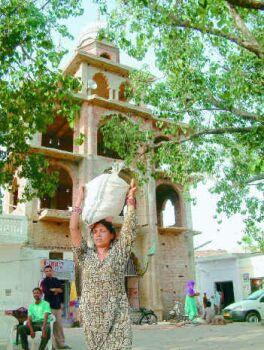
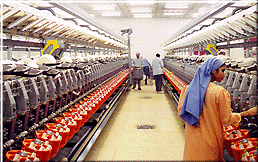
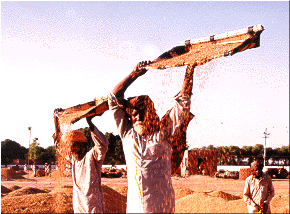
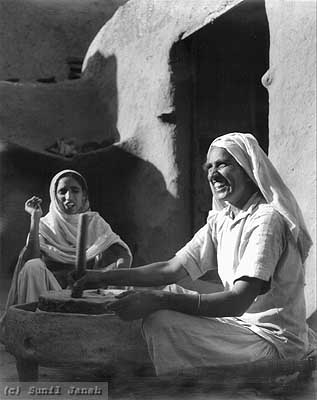
(a) Sikh Women grinding grain, 1945 (b) A gurudwara of Dalit Sikhs, 2004 (c) A modern agro industry


Guest post by Surinder S. Jodhka


Regions and regional identities are inherently fluid categories, constantly changing and being constructed by the people in given social, political and historical contexts.

The history of Punjab or Punjabiyat during the 20th century offers a good example of such a process. Though the Indian Punjab was reorganized as a separate state of independent India on the basis of language, it is often seen as a land of the Sikhs, despite the fact that Hindus and Muslims were in larger numbers in the region.

While dominant Hindu elites geared towards de- regionalizing themselves and claim opportunities opened up by the new nation, the Muslims elites of Western Punjab veered towards Urdu and legitimizing their dominance over the new nation- state of Pakistan.

Post- independence, Punjab also came to be identified as mainly a state with prosperous agriculture, the success of the agriculture also consolidated the position of the land owning classes/castes, the Jutt Sikhs.

The success of canal colonies in West Punjab had motivated the British colonial rulers to lay an extensive network of canals in the region. The Bhakra Nangal dam, one of the first major irrigation projects launched by the government of independent India, was also located in Punjab.

The Jutt Sikhs were also the ones who constituted the armies of the British Raj, and were the pioneers of the migration to Western countries a century ago.

Apart from the long tradition of migrations and global contact, the Indian Punjab also had a vibrant urban economy. Until recently the industrial growth rate of Punjab was higher than the average for India. Punjab continues to be among the more urbanized states of India and ranked fourth in terms of the proportion of urban population among the major states of the country during the 2001 Census. Against the national average of less than 28 per cent, the urban population of Punjab in 2001 was 34 per cent.

Of all the states of India, Punjab's growth rate in agriculture was the highest from the 1960s to the middle of 1980s. The annual rate of increase in production of food grains during the period 1961-62 to 1985-86 for the state was more than double the figure for the country as a whole.

While Punjab had 17,459 tractors per hundred thousand holdings, the all India figure was only 714. The same holds true for most other such indicators. These achievements have also been widely recognized.

At the sociological and political level, this growth of rural capitalism during the 1960s and 1970s imparted a new sense of confidence and visibility to the agrarian castes in different parts of India. Institutionalization of electoral democracy helped them dislodge the so-called upper caste elites from the regional and national political arena.

In the case of Punjab, the landowning Jutts had already been the ruling elite of the region. The success of green revolution and institutionalization of democracy helped them further consolidate their position. Even Sikh religious institutions came under their sway.

The triumph of agrarianism and the rise of the dominant caste farmers in the 1970s also set in motion a phase of populist politics at the regional and national levels in India. The newly emergent agrarian elite not only spoke for their own caste or class but on behalf of the entire village and the region. Their identification was not just political or interest-based and sectarian, as they saw themselves representing everyone, encompassing all conflicts and differences of caste, class or communities.

The rise of the Khalistan movement, a secessionist demand by a section of the Sikh community during the early 1980s, was a somewhat unexpected development since apart from its economic success, socially and politically too the border-state of Punjab had been a well-integrated part of India, having been at the forefront of the national freedom movement.

Not surprisingly, therefore, the rise of a secessionist movement in the state was for many a puzzle.

Contrary to much of the academic speculation that employed every known school of thought- from modernization theory to psychoanalysis, after some fifteen years of violence and bloodshed, Sikh militancy began to decline.

By the mid 1990s, the Khalistan movement was virtually over without having achieved anything in political terms. The end of the Khalistan movement, however, did not mean an end of 'crises' for Punjab. It was now the turn of economics and agriculture.

The green revolution had already begun to lose its charm by the early 1980s. Several scholars had in fact attributed the rise of militancy directly to the crisis of Punjab agriculture. By the early 1990s, there were clear signs of economic stagnation. Unlike some other parts of India, Punjab had lost out on the opportunities opened-up by the 'new economy' and investments of foreign capital that had begun to come to India with the introduction of economic liberaliztion.

The discourse of crisis found more ammunition during the post-reforms period when Punjab and some other parts of India saw a sudden spurt in the incidence of suicides by cultivating farmers.

By the turn of the century, agriculture in Punjab had lost nearly all its sheen, the emblematic Punjabi farmer seen nowhere in the new imageries of a globalizing India.

The changes that came about in the countryside with the success of the green revolution also produced a new class of rural rich who had experienced economic mobility through their active involvement with the larger capitalist market.

The new technology gave them tractors, took them to the mandi towns and integrated them with the market for buying not only fertilizers and pesticides but also white goods and an urban lifestyle.

Most agricultural households in Punjab today have become or are trying to become pluri-active, 'standing between farming and other activities whether as seasonal labourers or small-scale entrepreneurs in the local economy... Agriculture and farming is no more an all-encompassing way of life and identity.'

The available official data on employment patterns in Punjab has begun to reflect this quite clearly. For example, the proportion of cultivators in the total number of main workers in Punjab declined from 46.56 in 1971 to 31.44 in 1991, and further to 22.60 by 2001. While the share of cultivators has been consistently falling, that of the agricultural labourers had been rising until the 1991 Census. However, over the last decade, viz. from 1991 to 2001, even their proportion declined significantly, from 23.82 to 16.30. In other words, though two-third of Punjab's population still lives in rural areas, only around 39% of the main workers in the state are directly employed in agriculture. The comparable figure for the country as a whole is still above 58%.

The trend of moving out of agriculture is perhaps not confined to any specific class or category. While marginal and small cultivators seem to be moving out of agriculture, the bigger farmer is moving out of the village itself. The big farmers of Punjab invariably have a part of their family living in the town. Their children go to urban schools/colleges, and they invest their surplus in non-agricultural activities.

The rural social structure has also undergone a near complete transformation over the last three or four decades.

Over the last twenty years or so a large proportion of dalits in Punjab have consciously dissociated themselves from their traditional occupations as also distanced from everyday engagement with the agrarian economy and even investing in building their own cultural resources in the village, in gurudwaras and dharamshalas.

The growing autonomy of the dalits from the 'traditional' rural economy and structures of patronage and loyalty has created a rather piquant situation in the countryside with potentially far-reaching political implications.

In the emerging scenario, local dalits have begun to assert for equal rights and a share from the resources that belong commonly to the village and had so far been in the exclusive control of the locally dominant caste groups or individual households.

Seen purely through economic data, Indian Punjab continues to be an agriculturally developed region of the country, producing much more than what it requires for its own consumption. Even though occupying merely 1.53% of the total land area of India, Punjab farmers produce nearly 13% of the total food grains (22.6% of wheat and 10.8% of rice) of the country.

Interestingly, in terms of objective indicators, Punjab has been a 'progressive' state otherwise also. For example, in terms of the Human Development Index, Punjab is second only to Kerala.

The growth rates of Punjab – agriculture or industry – are no longer negative. Notwithstanding the frequent reports of corruption and scandals, the urban centres of Punjab seem to be picking-up in terms of growth of infrastructure and real-estate.

However, the Indian Punjab today needs to be re-imagined in more than economic terms alone. The canvas of its change is much larger and broader.

Given that Punjab has a large proportion of Scheduled Caste population, the newly acquired agency among the dalits can also have serious implications for regional politics.

The earlier hegemony of the rural Jutt culture is fast disintegrating and this will change the manner in which the larger interests of Punjab are articulated politically.

Globally, the Punjabi/ Sikh diaspora has been investing in building its cultural resources and participating in local political processes, getting elected to local and national political bodies, more than any other component of the Indian diaspora.

At home, the fast changing geopolitics of the world during the opening decade of the 21st century has important implications for the Punjabs and their futures.

Though the hostile visa regimes of India and Pakistan continue to be an obstacle, traffic of common citizens across the Indo-Pak border has been steadily increasing. The opening up the border between Indian and Pakistan has produced a sense of excitement and opened a window of hope for all shades and sections of Punjabis .

What implications would these new processes have for the manner in which we have imagined Punjab and Punjabiyat – within the national and global contexts? Will the processes of globalization and the new technologies enable the two Punjabs to rediscover their common cultural heritage? How would a loosening of the border and opening of trade routes influence the economies of the two Punjabs? Would the decline of agriculture and rapid urbanization of the state develop a new middle class imagery of the state?

Though it is not easy to answer these questions, some of these processes are sure to bring positive and enriching outcomes.

Surinder S Jodhka is Professor of Sociology, Jawaharlal Nehru University. He has done pioneering work on Dalits in Punjab and authored a number of works on the subject.

This guest post is further elaborated in 'The Problem' statement in this month's edition of The Seminar magazine "Reimagining Punjab" which he has edited. (online next month)

Image acknowledgements:

Comrade Sunil Janah's Site
Punjab govt Official Site
The Hindu

Thursday, November 02, 2006

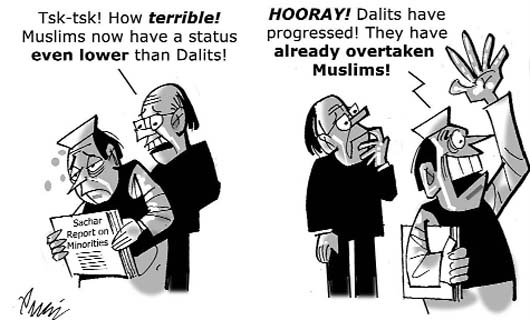
Hooray ! Dalits have progressed !

(Click on image to enlarge)

Update: Though this post is labelled under 'Humour', let it not distract the very serious issue at hand.

Siddharta Varadrajan remarks in The Hindu:

Based on the data leaked so far, it is evident there are entry barriers Muslims — who account for 17 per cent of India's population — are unable to cross in virtually all walks of life. From the administration and the police to the judiciary and the private sector, the invisible hands of prejudice, economic and educational inequality seem to have frozen the `quota' for Muslims at three to five per cent. Thanks to a hysterical campaign run by the Bharatiya Janata Party and some media houses, the Sachar committee was denied data on the presence of Muslims in the armed forces. But even there it is apparent that the three per cent formula applies.

This gross under-presence of Muslims in virtually every sector is presaged by substantial inequalities in education. Muslim enrolment and retention rates at the primary and secondary levels are lower than the national average and this further magnifies existing inequalities at the college level as well as in the labour market. For virtually every socio-economic marker of well being, the Muslim is well below the national norm — not to speak of the level commensurate with her or his share of the national population — and the evidence suggests these inequalities are not decreasing over time.

This bleak statistical picture is rendered drearier still by new trends visible in many cities. Muslims, for example, find it extremely difficult to rent and buy property outside of "Muslim areas" in some metros.
Thanks to Krish for the link to Siddharta Varadrajan's article.

Image Source: The Tribune

Saturday, October 14, 2006

Dr. Ambedkar and Sikhism


Kanshi Ram's last rites were performed last week as per Buddhist rites. His family has apparently not approved of this. What is interesting in this episode is that Kanshi Ram was born in a Sikh family, and as far as I can recollect, he hasn't ever said anything on the issue of Dalits and Sikhism- whose tenets deny casteism. Nor did he convert to Buddhism.
Kanshi Ram's family said they suspected foul play in Kanshi Ram's death and would file a case against Mayawati. They sought a probe into the circumstances leading to Kanshi Ram's death and objected to the last rites being performed according to Buddhist traditions.
(news report)

However, there is more to the relationship between Dalits and Sikhism. The founder of the Dalit movement Dr. Ambedkar had once himself seriously considered conversion to Sikhism at one point. His interest then waned, though the reasons are not known, and he finally converted to Buddhism with half a million of his followers.

***

By 1935, Dr. BR Ambedkar’ s disgust with Hinduism and its caste system was complete. His patience at reforming Hinduism from within by securing for the untouchable castes the right to drinking water from public places, using metal utencils and receive education, was wearing thin. Earlier in 1929, he had advised his followers to embrace any religion that would give them respectability. Following this advice, some of his followers took to Islam.

Referring to his own personal decision in the matter, Ambedkar said that unfortunately for him, he was born a Hindu Untouchable. It was beyond his power to prevent that, but he declared that it was within his power to refuse to live under humiliating and ignoble conditions.
“ I solemnly assure you that I will not die a Hindu”, he thundered.
He called for an end to the decade long struggles he had led for temple entry and which was brutally opposed by caste Hindus. Ambedkar’s call to the Untouchables to stop frittering away their energies over fruitless attempts and to devote themselves to carve out an honorable alternative for themselves shocked the nation, especially the caste Hindus.

As to conversion, he said it will be done in five years and he would reconsider his decision if caste Hindus assured him by positive results. He added that he wanted to absorb his community into some powerful community and was thinking of embracing Sikhism.

On April 13-14 1936, Dr. Ambedkar addressed the Sikh Mission Conference at Amritsar. He had earlier indicated that this would be his last speech he would deliver as a Hindu. The main feature of the conference, however, turned out to be the conversion of five prominent Depressed Class leaders of the Thiyya community of Kerala headed by Dr. Kuttir and 50 others from UP and Central Provinces to Sikhism.

In May 1936, he called a conference of the Mahar community to which he belonged, and his abominations and the condemnation of Hinduism was biting, coarse and yet smashing and dissecting. He ended his speech with a quotation from the lips of the dying Buddha- he asked his people to seek refuge in Buddhism. This quotation from the Buddha led to speculations that Bhimrao was veering towards Buddhism. He himself, however, avoided a straight answer. A few days before, however, he had sent his son and nephew to Harminder Sahib as a gesture of goodwill towards Sikhism. They stayed there for over one and half months.

By June of that year, Ambedkar after consulting his colleagues decided to embrace Sikhism- his friends and colleagues felt that he should seek the support of the Hindu Mahasabha leaders in their conversion to Sikhism, for the Mahasabha leaders believed that Sikhism was not an alien religion. It was an offspring of Hinduism and therefore the Sikhs and Hindus were allowed to intermarry and the Sikhs were allowed to be members of the Mahasabha. In his proposal, Dr. Moonje agreed to the inclusion of these neo- Sikhs in the list of Scheduled Classes and enjoy the benefits under the Poona Pact, if Ambedkar preferred to embrace Sikhism in preference to Islam and Christianity and that he agreed to counteract the Muslim movement to draw the Depressed Classes into the Islamic fold.

Ambedkar said that he preferred to embrace Sikhism which offered less than social, political and economic power than Islam and less material attractions than Christianity (western nations). He favoured Sikhism in the “interests of Hindus”.

Dr. Moonje and Dr. Kurtakoti (the Shankracharya) in giving their blessings obvioulsy chose the “least evil”. In choosing thus, they also showed their belief that Sikhism is another branch of Hinduism and that it owed the same culture and principles.

Gandhi voiced concern over the proposed conversion, but Ambedkar continued to increase his contacts with the Sikh Mission. There was even a proposal to start a college in Bombay for the proposed neo- Sikhs. 13 of his followers who were asked to study the Sikh religion at Amritsar actually converted to Sikhism and returned to Bombay, where, writes Ambedkar’s biographer Dhananjay Keer, they were coldly received as they had only been asked by Ambedkar to study and not to convert.

Soon, Bhimrao went on a tour of Europe. It seems after returning in 1937 his love for Sikhism had evaporated. He continued to talk of his proposed conversion though, and in 1955 along with half a million adherents went over to Buddhism.

(Much of the above I had written in 1997, and as far as I recollect is mainly based on the notes I took from the wonderful biography of Dr. Ambedkar written by Dhananjay Keer.)

Update: The Story of Kerala's first Sikh Convert
(Thanks to Bajinder for pulling the story out of his archives)

a story by Ramesh Babu
in hindustan times(cannot get exact date)

Nintyone-year old Sardar Bhupinder Singh from Kadakarapally is the only living Malayalee Sikh in Kerala. People call him "Sikh Chettan", that is, elder brother.

On Baisakhi day in 1936, fed up of caste barriers, Bhaskaran embraced Sikhism and became Bhupinder Singh. he was not alone. Around 300 families, mostly from backward castes, converted at that time.

There is a historical background to this conversion. During Vaikkom Satyagraha in 1922, at the instance of Mahatma Gandhi, a few Akalis came to Vaikkom to make langar for satyagrahis. After successful completion of satyagraha and the Temple Entry Proclamation, some of the Akalis stayed back. Some youth were attracted by the discliplined life and joined Sikhism.

Bhupinder has a different story to tell: "After Vaikkom Satyagraha, backward castes basked in a renewed vigour. At that time, Ambedkar exhorted people that if you don't get self-respect and dignity in your own religion, you should get out of it. This prompted many of us to join Sikhism.

Initially it was tough. "My father was liberal enough but his brother opposed my conversion tooth and nail. But I stuck to my belief."

After becoming a Sikh, Bhupinder went to Gujaranwallah and Lahore for theological studies. He worked some time in Khalsa College. But the returns were inadequate. So he joined the British Royal Army as a technician in 1940. He retired in 1968 as Subedar.

Though he married a Sikh, his daughters and sons are Hindus and married under Hindu Ezhava customs. "When the community shrank we found it very difficult to find matches. So none of us insisted the second generation to follow our example. Many families later re-converted to Hinduism. It is one of the reasons for our decline in Kerala."

Bhupinder complains that when numbers became dwindled, the Sikh Committee stopped showing any interest in them.

Every Sunday Bhupinder visits the only gurdwara in the State of Elamakkara in Kochi. Recently the Kochi Gurdwara Committee honoured him with a saropa.

The nonagenarian always keeps a low profile. "Once S S Barnala came here. He was eager to know more about Malayalee Sikhs. He asked me so many things and wanted me to write a book, but I politely refused.:

Leading a solitary life after his wife's death, Sardar Bhupinder has only one wish: "Till thee last breath I want to be a true follower of the Panth."


Picture Acknowledgement


Tags: , , , , ,

Monday, October 09, 2006

The Signifinace of being Kanshi Ram: An Obituary

Kanshi Ram (1934-2006): There is more to his legacy than meets the eye

It is not difficult to downplay the role of Kanshi Ram- he inspired little intellectual appeal, he has left no worthwhile writings on the cause that he is linked with and his political legacy consists of a one- woman dominated Bahujan Samaj Party that is as opportunist and as mired in corruption as any other political party.

Unlike Dr. Ambedkar, with whom he stands in poor contrast, he did not convert to Buddhism or give any other broad direction to his followers. Unlike Jotiba Phule he did not argue for social reform or made any case to further it. Unlike Periyar, he did not stand for Rationalism and launch an attack on the religious basis of caste based oppression.

Instead he directed all his energies to launch a monotone assault on political power and create political mobilisation among the Dalits and others under the broader sweep of what he called, after Jotiba Phule, the "Bahujan Samaj", bothering himself little with more onerous and long term endeavours of social reform.

Yet, Kanshi Ram is significant for a number of reasons and one has to acknowledge the singular, if not stellar role that he played in the Indian political stage in general and Dalit politics in particular.

From a little known outfit called DS4, he created a political party that rose to rule the most populous state of India- Uttar Pradesh, a state that determined the power equations in the Centre- every Indian Prime Minister who has lasted a 5 year term has come from Uttar Pradesh- and has been a Brahmin, one may add (Jawaharlal Nehru, Indira Gandhi, Rajiv Gandhi, Atal Bihari Vajpayee).

It would be difficult to ascertain whether Kanshi Ram came in at the right moment when identity based politics was asserting itself, or whether he helped to create that politics.

If it is former, then one has to credit him with having done the ground work and be prepared to seize that opportunity when it arrived. If it is the latter, then he needs to be understood better and not contrased with Dr. Ambedkar or Periyar.

For one, Kanshi Ram created, for the first time in history, a resurgence of the Dalit community in those states where little or no reform movements have taken place.

In the North, the state of Punjab, where incidentally he was born in a Sikh family, had the reform movements in Sikhism as well as the Arya Samaj, besides the Sufi influence. On the Eastern side, Bengal had Brahmo Samaj, in South, in Tamil Nadu, the Self Respect Movement and in Maharashta on the West, the non- Brahmin movement under Jotiba Phule and later Dr Ambedkar.

It is central India, the so- called Hindi heartland or also, more derisively, the BIMARU states that did not undergo a social reform movement within Hinduism. In most of those places social reform movements evolved into radical political movements- Communist in some places but also the Justice Party (and later the Dravida Kahzagam) in Tamil Nadu and the Republican Party of India in Maharashtra.

Kanshi Ram bypassed the social reform thus catapulting political assertion in the Hindi heartland.

Some may aver that this short cut is fraught with danger- it is hoisted on a fragile base and is the reason why the Bahujan Samaj Party has degenerated so quickly.

To do so would be to ignore the mammoth task that lies in the Hindi heartland states. The upper caste population is relatively large, and has never tried to reform itself in a major way. There has been an absence of any efforts to democratise education. Notably Uttar Pradesh and Bihar have historically been politically volatile and provided the fulcrum on which the Indian National Freedom movement hinged and where it became a truly mass movement.

Kanshi Ram merely extended that political mobilisation to the Dalits specially in Uttar Pradesh and Madhya Pradesh.

In doing so, did he put the cart before the horse?

There is little reason to think so.

For one, there really was neither a cart nor a horse in the Hindi heartland before the BSP stepped in.

For another, any emancipation movement needs not only the dreamers and theorists but also the organisers and the builders. Marx needed a Lenin to make the world even aware of his writings.

Kanshi Ram was no Lenin. His legacy is flawed in many ways and fraught with dangers, indeed its fragility became evident within his own lifetime.

But it also has ensured that the word Dalit has become part of the vocabulary in some of the most socially regressive areas in the country. It poses one of the few ideological challenges to Hindutva and one of the ways that emancipation of bulk of Indians can be attempted.

Kanshi Ram's BSP has taken Ambedkar from Maharashtra to all over the country and specially where it is needed more. Nearly every party- from the Congress to the BJP to the communists today carry a picture of Ambedkar in their posters and hoardings.

It has cast the net of possibilities of Dalit resurgence, wider.

It is for that reason alone that it would be an exercise in deception to overlook the importance and significance of being Kanshi Ram.

Related Post: Biography of a Poor Dalit Family

Picture Courtesy: ambedkar.org

Update: A comprehensive collection of links on Kanshi Ram 'saheb's passing away. Harish Khare's somewhat tangential take on the debt that we owe to Kanshi Ram (Link via Great Indian Mutiny)


Tags: , , , , ,

Sunday, September 10, 2006

Tamil Dalit Poetry

The State of Tamil Nadu in South India is ubiquitous in many ways- perhaps the most important being that in the 1920s it gave rise to a powerful non- Brahmin movement called the Self- Respect Movement led by social reformer Periyar. It later led to the formation of the Dravidar Kazhagam (DK) party.

Tamil Nadu politics is today dominated by two Dravidian parties- the DMK that morphed out of the DK and its off- shoot, the AIADMK, the former led by Karunanidhi and his family, the latter, by the temperamental Jayalalitha.

Periyar's social reform movement was largely rationalist and is perhaps without parallel in its expanse and intensity. Periyar's oft- quoted statement is:
"He who created god was a fool, he who spreads his name is a scoundrel, and he who worships him is a barbarian."
Unlike elsewhere in India, Tamil social structure is not in the form of a pyramid- instead it has a caste system with a very small Brahmin (less than 2%) population, a large chunk of the backward castes and a substantial Dalit population (about 20% of the total state population) - the "other upper castes" like the Kshatriyas are absent. 90% of the Dalits in Tamil Nadu own no land.

Tamil politics is dominated by some of the backward castes many of which are no longer "backward" in most ways. Periyar's movement produced a powerful assertion of the Tamil backward castes but left little or no space for the Dalits.

Even serious Dalit literature arrived only in the early 1990s.

But it is in this state that the Dalit intelligentsia can emerge as a powerful voice. Over the years, a literacy culture has taken strong roots in the state- literacy is far higher than in all states except Kerala. There is also an immediate tradition of protest and assertion albeit of the backward castes.

The fervour, the controlled but intense anger and the intellectual restlessness to understand society in order to change it among some of the young Dalit professionals and students in the state is like the one that one earlier used to observe only among the Marxist inclined youth in the sixties and seventies.

The Sep- Oct issue of Muse India, edited by the young and talented Meena Kandasamy, containing a selection of some of the Dalit poetry emerging out of Tamil Nadu offers a poignant window into these undercurrents of protest.

Rajkumar ND in the poem 'A Wish' gives an inkling of the mood:
He who desires peace
Under oppression
Is a fraud.

It is human tendency to disturb
And attain clarity in the fight
For liberation.
In "Infection", Devadevan sarcastically comments on the sacred thread that is the privilege only of the Brahmin men:
The chief doctor came,
Examined my friend
And raised his head.
In the direction of the ears
That were throbbing with worry
And concern and questions
He bent his head
And from his white-gloved hand
Held a dirty sacred thread
And said,
"This could have caused
The infection."
There are 15 poems in this issue of the magazine, most of them translated by Meena Kandasamy who also provides a short and cogent backgroud to the emergence of Dalit literature in Tamil Nadu.
Like all other Dalit literature, Tamil Dalit literature too has an excess of autobiographies. Critics condemn these literatures of lament, but they too have a central place within the creative core. Tamil Dalit literature is characterized by the call for self-identity and assertion. It tramples all conventions with its intensely personal expression; is concerned with the life of the subaltern, and deals out a stark brutality. This literature should be viewed not as a literature of vengeance or a literature of hatred, but a literature of freedom and greatness.
Link to Muse via Whitejasmine

Tags: , , , ,

Monday, September 04, 2006

'I am Dalit, how are you?'

Some 250 million people around the world were born untouchable. They live throughout South Asia, as well as in Japan and parts of West Africa. Over 160 million of them are in India, where they make up more than one-sixth of the population, and where over 580 million more people belong to other oppressed castes and tribes.

The Hindu caste system has been called a "hidden apartheid" and the single greatest existing social evil. But outside of the subcontinent few people know much about it, even among leftists.
...from the Anti- Caste Info site

A short movie on the Dalits in India.

Movie Source: International Dalit Solidarity Network

Tags: ,


Sunday, September 03, 2006

Namdeo Dhasal and the Fall of the Dalit Panther Movement


While I write this at night
it's three o' clock
Though I want to have a drink
I don't feel like drinking.
Only I want to sleep peacefully
And tomorrow morning see no varnas
- Namdeo Dhasal


Namdeo Dhasal now makes news only for moving further away from the cause he stood for, that is for moving away from Marxism to the Shiv Sena and now to the Sangh Parivar's fountainhead- the RSS- organizations that he had once bitterly opposed.

But once Namdeo Dhasal had founded the Dalit Black Panthers movement in 1972, and heralded the era of Dalit poetry, though the term Dalit Poetry had existed since 1958.

Anand Teltumbde places his poetry in the context of his times (the early seventies):
The times were just ripe for the protest movement of dalits to germinate.... The most notable example of this protest came in light in the form of Golpitha- a collection of poems by Namdeo Dhasal. Golpitha - name of a red-light district in Mumbai, depicted the tough life of a dalit there and is considered as Dhasal's most stellar work. People were shocked by the raw energy exuded by each of its word entirely unfamiliar to the established literary circles. They had never seen quite like it before. Its proletarian lingo, iconoclastic imagery, defiant idiom and terrible anger shook the establishment to its very foundation. A spate of poetry followed
Dhasal's poetry is powerful and poignant, and very raw.

Dhasal's poetry is shocking to those who have not experienced the excruciating circumstances of caste exploitation:
In one of his poems Dhasal describes how caste society and male domination deformed his mother, making her into a "machinery for the production of worms." Identifying with her spiritual butchery at the hands of a bigoted society, he tells her, "Just as I have been stripped bare, so have you." This identification with his mother, however, doesn't lead him to inner healing; instead, it hardens him and gives his despair an unpredictable edge. With a baiting bitterness, he asks her, "On the day you cut my umbilical cord, why didn't you slash my throat with your fingernail?" He then proceeds to rail at her some more, accusingly but also as an act of self-mutilating triumph over any possibility of romanticization --

You didn't even moo once from the depths.
You didn't stir the sky with a shrill cry.
The earth didn't crack.
How easily you lived, wrapped in rhinoceros hide.
In What More Than This Can Be, he wrote:
I am a common man of this contemporary history
I have put down the head guard out of self-humility
I wish to embrace deeply my innermost being
That will end up the essence,
Do not shed the innocent skin of this grammar
After all this heinous world belongs to human beings
Power is not in words but in the desire
This fever-stricken, exaggerated pretention
Will bother the deep relations
Clear away the self-chosen inhuman path
Seasons come and go
Who are you waiting for?
Dhasal has since then moved across the political spectrum from Leftist leanings to now sharing the stage with RSS leaders. It is a left handed tribute to the Dalit Panthers' movement that even the Shiv Sena, once a backward caste outfit opposed to the Dalit cause, now allies with one or the other splinter groups. Ram Puniyani explains the phenomemon well:
Dalit panthers came up as the most promising organisation for dalit rights and their path was that of alliance with the other oppressed sections of society. They broadened the definition of dalits to include workers, minorities, adivasis and women. This indicated the line of allaince to be followed. This last concerted effort fell to pieces with different leaders of dalit movement getting co-opted by one or the other political power or personality.
Though Dhasal now has his own convoluted explanation:
"But Dalits have come into political power in some places," Namdeo said. "They are accused of corruption, but they learned it from the Brahmins who ruled before them. The reservations do not work as they now stand. I believe that our people will start to make more demands and the Hindus will be forced to submit to them."
Dilip Chitre considers him to be one of the towering poets of the 20th century:
Namdeo is a big poet in the sense Whitman, Mayakovsky and Neruda are big. But unlike them, his poetry contains large chunks of a real and dirty world peopled by have-nots and their slang. Henry Miller once said, “I am not creating values; I defecate and nourish.” Namdeo did precisely this for Marathi poetry. He restored its soil-cycle by feeding it the very excrement and garbage that could fertilise it for the future.
The interview with Namdeo Dhasal alone makes VS Naipaul's India: A Million Mutinies Now worth a read.

Poetry is politics, he once stated. Undoubtedly, his current politics will not cast a shadow on his poetry and Dhasal's poetry will live long after his current politics is dead.

***
More on Namdeo Dhasal, his poetry and his political drift from Marxism to the Sangh Parivar.

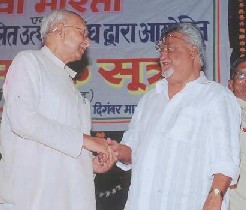
Picture: Dalit poet and leader Namdeo Dhasal shakes hands with RSS chief K Sudarshan at a book release function in New Delhi on Wednesday (Acknowledgement: ToI)

Tags: , , , , ,


Wednesday, July 05, 2006

Lal Singh Dil

Lal Singh Dil one of the few poets in Punjabi who had instictively appealed to the restless teenager in me.

His collections of poems were published by some of the Naxalite publishers (usually a one- man publishing house) in those little pocket book size booklets of thirty or forty pages, with a gray or brown cover that gave them the deceptive look of a bygone age, even when the booklets were printed recently. The inside pages were generally whiter, and smelled fresh.


In the mid- eighties, there was still awe of the Naxalite movement among some of the more socially sensitive students. Its aura had not yet dimmed, though the embers flickered very little, and news of a Nagabhushan Pattanaik being released from incarceration, was of little interest to the major newspapers, then the main source of news. Even though newspapers then were newspapers, and not yet printed television.

Lal Singh Dil's poems that I read then were generally short, and I knew little of his background. It was even rumoured that he had died and that a news item had been published regarding his death. There was one particular poem that invoked Guru Gobind Singh. I had then wondered why Guru Gobind, and why not Baba Nanak.

Slowly, as I turned away from my armchair fascination for the movement and got embroiled with the 'softer' versions of the Left, Lal Singh Dil became another forgotten recess in the labyrinthine passages of growing up.

Paash, a contemporary of Dil, and a poet with much wider appeal, somehow did not appeal initially, though later, when my reading expanded, I could appreciate a poem here and a metaphor there. I found his poetry to be very raw- so was Dil's in some ways- but I felt more detached from Paash than from Dil. Surjit Pattar was suave compared to any of them.

It was much later that I became aware of the Dalit element in his persona and poetry. I had myself arrived by then at a better appreciation of the need and significance of the Dalit movement, after an long drawn "ideological struggle" with my friends- and a particular father- figure of a teacher- who emphasized the class nature of conflcit denying caste and other factors, but specially caste.

It came as news to me that Dil had fled to Uttar Pradesh after the police reprisals in the seventies, and that he had converted to Islam. And that he was Dalit.

Rahul's write up therefore invoked a certain personal poignance for me. (Link via Krishworld)

His writings may have been inspired in the heat of the times, in the shadow of the flames of the Naxalbari uprising, but the light from his, and those of others of the "Naxalite trend" in Punjabi poetry continues to remind us of the struggles that have not yet ended.

When the labourer woman
Roasts her heart on the tawa
The moon laughs from behind the tree
The father amuses the younger one
Making music with bowl and plate
The older one tinkles the bells
Tied to his waist
And he dances
These songs do not die
Nor either the dance...

***

Lal Singh Dil has an insightful observation on the relevance of Sufism for the Dalits in Punjab.
The impact of Sufism in Punjab, as it exists now, is highly debated. Lal Singh `Dil', a noted writer, said: "Sufism doesn't solve anything. It favours Dalits, though, because of their need for a place of refuge." He added: "Sufism can be defined as a critique of society. That was the root. Although Sufi songs are nice to bond over, they must not be de-contextualised. The logic of this Sufi tradition lies in non-Brahmanical culture, and not in secularism."

More on Lal Singh Dil here, and here.

An article on Dil in Punjabi.

Technorati Tags: , , , , ,

Monday, April 10, 2006

Ambedkar on Higher Education and OBCs

I ran into a very interesting quote by Dr. Ambedkar, specially in the context of the recent debates (generally opposing it though) on reservations in institutes of higher education IITs and IIMs (besides other institutes under the Central government):

Higher education, in my opinion, means that education, which can enable you to occupy the strategically important places in State administration. Brahmins had to face a lot of opposition and obstacles, but they are overcoming these and progressing ahead."

"I can not forget, rather I am sad, that many people do not realize that the Caste system is existing in India for centuries because of inequality and a wide gulf of difference in education, and they have forgotten that it is likely to continue for some centuries to come. This gulf between the education of Brahmins and non-Brahmins will not end just by primary and secondary education. The difference in status between these can only be reduced by higher education. Some non-Brahmins must get highly educated and occupy the strategically important places, which has remained the monopoly of Brahmins since long. I think this is the duty of the State. If the Govt. can not do it, institutions like "Maratha Mandir" must undertake this task."
The statement "I think it is the duty of the State" is very interesting and can be interpreted in different ways, including advocating reservations.

The moot point, however, that Dr. Ambedkar makes, a la Gramsci, is the importance of capturing places of strategic importance. In our times, this need not only be in the State Administration.

In the era of a globalized marketplace, it also means providing a foothold in that marketplace.

Tags: , , ,

Saturday, February 04, 2006

‘They’ve only got my limbs, I’ve still got my voice – I can still sing!’


Hindu mythology tells the story of Ekalavya – the tribal youth who cut off his thumb on the demand of Dronacharya so that Ekalavya would not be a better archer than the kshatriya boys. Ekalavya, being a tribal, must have been a natural archer – but he was mutilated and robbed of his traditional skill and his right to self-defence and survival. Today, one gets the feeling that the story of Ekalavya is being played out again and again.

...

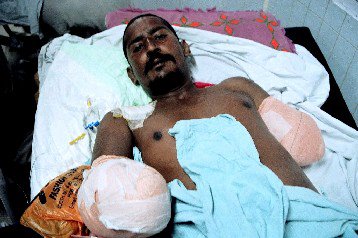
Two hands and a leg amputated. The remaining limb yet to heal, has turned gangrenous and may also have to be removed. His kidneys have been damaged due to excessive bleeding and he can hardly eat and digest any food.

And yet defiance still sparkles in the eyes of Bant Singh, a Dalit agricultural labour activist, as he lies in the trauma ward of a state-run hospital in Chandigarh where doctors are battling to save his only remaining leg and even his life.

It is precisely for this defiance, coming from a ‘lower caste’ Dalit, that Bant Singh from Jhabhar village of Mansa district in Punjab was beaten to pulp and left for dead by armed upper caste men around a fortnight ago.

Bant Singh is known in his village and among his comrades as a singer of rousing protest songs.

...

When his comrades met Bant Singh in hospital, they broke down – but Bant Singh told them, ‘They’ve only got my limbs, I’ve still got my voice – I can still sing!’
Full account here.

Link via Mahmood Farooki.

Technorati Tags: ,

Wednesday, July 06, 2005

The BSP turns a Full Circle?

Is the BSP turning full circle by trying to woo the Brahmins in the UP and shifting its objective from 'bahujan samaj' to 'sarvjan samaj'?

The rise of the BSP in the last two decades and its achievements cannot be berated- the resurrection of B.R Ambedkar, the installation of a Dalit woman as the chief minister of the largest state in the country, the dislodging of the Congress upper caste + Dalit combine are historic events in independent India.

At the same time, the BSP has also demonstrated the pitfalls and the limitations of its ideological premises as well as that of personality cult politics. Its collaboration with the BJP was its lowest ebb, if a term like that can be used in the context of UP politics.

However, even if the current shift to incorporate the Brahmins into its fold sounds revisionist given the BSP's past rhetoric, the net result would still be, as AK Verma concludes, an overall strenghthening of the Dalit voice in UP politics.

Sunday, January 10, 1999

Words Like Freedom: The Memoirs of an Impoverished Indian Family 1947-1997
By Siddharth Dube
Harper Collins Publishers India Rs. 395, Pp. 297, 1998

After the recent CPI(M) Congress, in reply to a question as to why the Left had failed to strike roots in Uttar Pradesh, the party General Secretary H.S. Surjeet explained the reasons thus: "There has been no social reform movement in the state". This surely is a case of putting the cart before the horse, since for those on left of the political spectrum, reforms are only a part of a much more comprehensive radical agenda. The task of the left is to carry out changes that go beyond reforms and not wait for others to carry out the job. Surjeet's words raise an existential question for the CPI(M).

However, even this recognition of the specificity of the state of Uttar Pradesh is a recent phenomenon. For a long time, its endemic poverty was perceived as not very fundamentally different in nature from that prevailing in the rest of the country. It is only very recently that attention has been drawn to the abysmally poor performance of the state in the key areas of literacy and health- care and the large- scale prevalence of casteism and traditionalism.

Jean Dreze has termed the state as India's "burden of inertia".

The book under review is an attempt by the young writer Siddharth Dube to understand the vertical implications of this inertia by relating the broader political economy of the state to the actual life experiences of a marginal family. It recounts the memoirs of three generations of a Dalit family from Pratapgarh district. Its narrative is an interweaving of the family's recollections of their life stories and the writer's own scholarly interjections. Surprisingly, the result is a stirring jugalbandi and not a cacophony of illiterate voices and noisy economic jargon, which is what it may have become in the hands of a less skilful chronicler.

The central character of the family is Ram Dass (aged about 65) of Baba Ka Gaon village in Pratapgarh district. This district has been the focus of much interest since the publication of Gyan Pandey's impressive study on the Awadh peasant revolt (published in the first volume of the Subaltern Studies). Zamindari in this district had existed here in its extreme form. It was buttressed by a rigid caste system in which the untouchables were treated as "neither fully Hindu nor fully human". The upper caste zamindars on the other hand, enjoying the patronage of the British colonial state, extracted many types of taxes and dues from the tenants and labourers, who without exception were untouchables or belonged to the intermediate castes.

Says Ram Dass, " (when I was a child) If our family got a letter, we had to go and plead with the Thakur or Brahmin to read it for us. We had to wait till they were free. Or we would work extra hard and finish all their work and then beg them. Even then, they would read it if they felt like it or otherwise they would shout, 'Get out, go away!'"

"The upper castes would treat us untouchables worse than dogs. They would at least accept water served by the middle castes, but from us they would not accept water, nor would they ever sit with us. If by mistake we touched any of their eating vessels they would throw them away, but if a dog licked the vessels they would just wash them".

Ram Dass's son today is a primary school teacher, the first scheduled caste teacher from his village. His grandson now faces an uncertain future because though he is the first of the three scheduled caste graduates from his village, he finds that he has to compete in a highly difficult job market. His degree is not of much help in the face of the demand of the few jobs that are available.

Blatant casteism over the years has slowly became less pointed- though even Ram Dass' son Shrinath had to sit separately from high caste students in school. Nowadays, scheduled caste children even play with upper caste children", observes Shrinath.

Ram Dass and his family are at a barely sustainable level, they are an example of a family that has risen from the lowest of the lowest to a family that is now hovering around the poverty line. Land reforms over the years have enabled the family to own 2.5 acres. It is only because of his son's government job which pays Rs.4000/- a month, that the family of 17 manages to eek out an existence, keep hunger at bay and afford two sets of clothes. The next generation faces an uncertain future again. The gains of the seventies have not progressed linearly.

The most prosperous families in the village are, as during Ram Dass's childhood years, still the 20 Thakur families that own most of the village land and orchards. Besides, most of them have a family member in a job- army, police or the university. Of the land that has been sold by the Thakurs over the last 50 years, the bulk was bought by the intermediate castes, with only a small amount purchased by the scheduled castes. The rest of the families in the village have been too impoverished to purchase any land at all.

The author's prescription is what may nowadays be termed as Sen- ism (after Amartya Sen): the government should carry out land reforms, promote good health-care, foster social equity and encourage local democracy. Mulayam Singh Yadav' s 1995 act on the reservation of posts of the village pradhan for intermediate and scheduled castes is an example of empowerment of these castes. Hitherto, Baba Ka Gaon had the same Thakur pradhan since 1952 till 1995.

"The 1995 elections irrevocably changed caste equations in Baba Ka Gaon. The village Thakurs threatened to kill the former army sergeant from the Maurya middle caste who, with the backing of the scheduled castes, decided to stand for the pradhans's post. They then burnt the crops of a particularly militant scheduled caste man. A week before the elections, in mid afternoon, a group of Thakurs entered the hut of a middle caste family and started thrashing the wife with their staffs while others pinned her down. But for the first time in the history of Baba Ka Gaon, the scheduled castes- including Prayaga Devi (Ram Dass's wife)- and the middle castes hit back at the Thakurs and chased them away".

The memoir is a testament against the notion that the illiterate are not capable of participating in electoral politics. The perceptive awareness that Ram Das and his family members have about the reasons responsible for their poverty is amazing.

Besides this, there are two major points that the book establishes.

First, that serious debate in the era of liberalisation is turning towards what Marxists have traditionally termed as the tasks of the bourgeois revolution. The hair splitting debates that dominated the seventies searching for that elusive algebraic equation of the balance of class forces, which in turn would decide the stage of the revolution, now belong to a bygone age. Similarly the euphoria of the liberalizers in the early nineties is giving way to more introspective studies.

The second is the recognition of near absolute identity of the Dalits as the most oppressed sections in the country. Earlier observers, even among the most radicals ones, disdained this. Groomed in the modernist, Nehruvian framework in the backdrop of global appeal of Marxism, the caste factor was pushed under the carpet. It was even seen as an obstacle in establishing class-consciousness. This has now changed, and rightly so. This was evident in another recent and comparable work that comes to mind: Everyone Loves a Good Drought by P. Sainath.

Dube's misgiving that the Congress represented the interests of the propertied classes only both before and after independence betrays a direct influence of the subaltern school of historians and indirectly that of R.P.Dutt. This is not only contestable but is the result of too narrow a perspective that students of peasant studies have usually held. The only other problem that mars the text is the author's straight- jacket perspective that sometimes reads like the CPI(M) party programme. That towards the end of the book Ram Dass turns out to be a Communist (if not a CPI(M)) sympathiser is perhaps indicative of this bias.

December 04, 1998

Published: The Tribune 10 Jan 1999

Thursday, July 31, 1997

Review of Everyone Loves a Good Drought by P Sainath

Everyone Loves A Good Drought
By P.Sainath
Penguin India 1996, Price : Rs 295/- Pages: 470
ISBN: 0-14-025984-8

Palagummi Sainath is a bitter man.

On a Times of India fellowship in the year 1992, Sainath has toured some of the poorest districts in the country to know how the poorest of the poor citizens of free India live.

Exist might be a better word.

The book under review is a collection of reports that the author filed during his tours. Some of the reports kicked up controversies and in a few cases even led to some action on the part of the authorities. It is another matter that these were a drop in the ocean, and provide only an academic satisfaction in the otherwise grim scenario.

Sainath's main findings can be summarized in one word- apathy. Apathy towards the victims of rural poverty in the country. Around this core, he weaves the stories about real people who generally lie hidden in the great piles of statistical data. In a way, he has given names to poverty. His stories are provocative, jarring and shocking to the point of being macabre.

The selection of the districts which the author chose to study were the 2 poorest districts each in the 5 poorest states of the country- Orissa, Bihar, Madhya Pradesh, Uttar Pradesh and Tamil Nadu. According to the author, there was near unanimity among the experts regarding their dubious status. Seeing the problem of poverty as a process rather than an event (in the form of outbreaks of epidemics or the infamous 'sale' of children in Orissa in the mid- eighties), formed the bigger challenge. The process, it turns out is a ruthless, grinding one and one that is full of amazing contradictions.

There is a story of the farmer who earns more money by selling water than by agriculture. A super hi- tech project in one of the most backward regions- Godda in Bihar, creates jobs for not more than 1300 people- many of them from outside the region, at the cost of Rs. 65 lakhs per job ! Meanwhile, the foreign consultant has been involved in transactions worth Rs. 645 crores, out of the total outlay of Rs. 966 crores. In the same district, loans have been given to members of a tribe to purchase cows, in some cases two cows per family, little realizing that the tribe does not consume milk products at all, and instead consumes beef in large quantity. At the end of the benign exercise, the cows ended up in the dinner plates of the lucky recipients, and the latter in a life long debt trap.

Sainath discovers that while there are schools without buildings and teachers, there are schools with buildings and teachers too. Except that while the 'buildings' are used for storing fodder and tendu leaves and the teachers teach non- existent students. There is a teacher who has not visited the school where he is 'teaching' for years, while drawing his salary all the time.

Then there is the case of the residents of a village called Chikpaar. The village was first acquired in 1968 for the MiG jet fighter project for Hindustan Aeronautics Limited (HAL) in 1968, the 400- 500 families were evicted on an "angry monsoon night" . They moved to another location (on the land they owned themselves) and resettled there. Nostalgically, they named the new village as Chikpaar.

In 1987, the families were evicted again for the Kolab multi- purpose project. The villagers again resettled at another place.

However, 'development' has chased them to their new place of residence and the residents have received eviction notices for the third time. Needless to say, the displaced persons were either paid a pittance as compensation and in many cases, the money took years to come by.

On the state of the Sekupani village in Gumla, Bihar, a government official himself demands from the author: "What if residents of Malabar Hill in Bombay have to evacuate each time the navy has an exercise ? And are paid Rs. 1.50 a day for their pains ? This is happening here because the people are adivasis. Since this is a backward, cut- off region."

An adivasi artist, Pema Fatiah is discovered by a bureaucrat and goes on to win laurels for his murals. But that is about all that he earns, after his recognition, come the hordes of SPs, DSPs , SDMs and tehsildars who force paintings out of him free of cost, with a flunky or a havaldar looking over his shoulders all the while he paints.

There are stories upon stories like these- Sainath has captured an entire landscape of people for whom everyone from global agencies downwards to the mohalla politician and bureaucrat has a concern. Often this concern either gets diverted to the pockets of the local strongmen or lands up for the wrong cause, like in the case of the tribes gifted cow in a loan mela. Sainath has, in a fabulous sweep, captured this entire net of linkages in his stories, often peppered with ironic insights.

The book under review can be seen to be operating at a number of levels.

First and foremost is the actual state of affairs in which the poorest in India survive. These are tales of poignant misery, and at the same time of admirable courage. At another level, it is about the needs and aspirations of the "insulted and the humiliated", to borrow a phase from Dostoyvesky. It is about policies, schemes and programs launched with great fanfare and soon left to take their own wayward course, making a mockery of the intended aims.

At another level, these are stories about the idocity of what has been termed as development. There are dams that have displaced people who will never benefits from the dams anyway. There are dams that are under perpetual construction, with the contractors assured of a perpetual source of income. There are missile ranges which displace village after village like Chikpaar, with the villagers and adivasis losing not only their land but also the very world they belong to. They form the multitudes migrating to big cities, ending up as virtual slaves of contractors in an alien world.

Finally the book is a scathing indictment of the elite in this country. What Dr. K.N. Raj termed as the "two Indias" pithily and epigrammatically comes out in the present work. No debates on the pros and cons of liberalization or Nehruism can substitute for the reasons for such grueling poverty. If the tales in the book sound other- worldly or chillingly macabre, it is because the Indian elite, specially the middle class, which has been reared on this very 'development', or in other words on the heads and shoulders of the poor in India, has come a long way from the victims of this 'development'.

Sainath has given words to the adivasi in Govind Nihalani's film Aakrosh (the role was played by Om Puri), whose tongue has been cut off and despite being the victim, is actually hauled up in jail.

Palagummi Sainath has reasons to be bitter.

NTC, 15 Aug 1997