Showing posts with label Globalization. Show all posts

Sunday, November 05, 2006

Imagining Punjab in the Age of Globalization
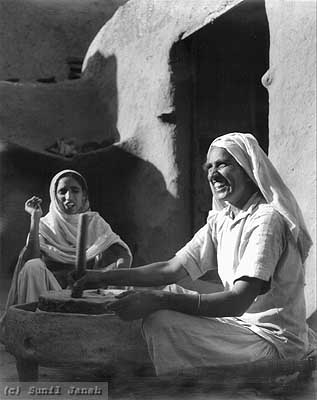
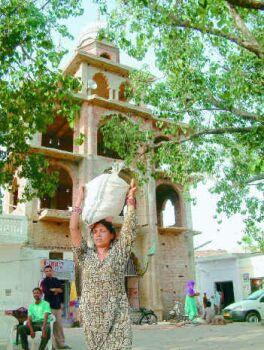
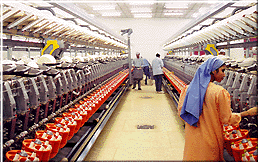
(a) Sikh Women grinding grain, 1945 (b) A gurudwara of Dalit Sikhs, 2004 (c) A modern agro industry


Guest post by Surinder S. Jodhka


Regions and regional identities are inherently fluid categories, constantly changing and being constructed by the people in given social, political and historical contexts.

The history of Punjab or Punjabiyat during the 20th century offers a good example of such a process. Though the Indian Punjab was reorganized as a separate state of independent India on the basis of language, it is often seen as a land of the Sikhs, despite the fact that Hindus and Muslims were in larger numbers in the region.

While dominant Hindu elites geared towards de- regionalizing themselves and claim opportunities opened up by the new nation, the Muslims elites of Western Punjab veered towards Urdu and legitimizing their dominance over the new nation- state of Pakistan.

Post- independence, Punjab also came to be identified as mainly a state with prosperous agriculture, the success of the agriculture also consolidated the position of the land owning classes/castes, the Jutt Sikhs.

The success of canal colonies in West Punjab had motivated the British colonial rulers to lay an extensive network of canals in the region. The Bhakra Nangal dam, one of the first major irrigation projects launched by the government of independent India, was also located in Punjab.

The Jutt Sikhs were also the ones who constituted the armies of the British Raj, and were the pioneers of the migration to Western countries a century ago.

Apart from the long tradition of migrations and global contact, the Indian Punjab also had a vibrant urban economy. Until recently the industrial growth rate of Punjab was higher than the average for India. Punjab continues to be among the more urbanized states of India and ranked fourth in terms of the proportion of urban population among the major states of the country during the 2001 Census. Against the national average of less than 28 per cent, the urban population of Punjab in 2001 was 34 per cent.

Of all the states of India, Punjab's growth rate in agriculture was the highest from the 1960s to the middle of 1980s. The annual rate of increase in production of food grains during the period 1961-62 to 1985-86 for the state was more than double the figure for the country as a whole.

While Punjab had 17,459 tractors per hundred thousand holdings, the all India figure was only 714. The same holds true for most other such indicators. These achievements have also been widely recognized.

At the sociological and political level, this growth of rural capitalism during the 1960s and 1970s imparted a new sense of confidence and visibility to the agrarian castes in different parts of India. Institutionalization of electoral democracy helped them dislodge the so-called upper caste elites from the regional and national political arena.

In the case of Punjab, the landowning Jutts had already been the ruling elite of the region. The success of green revolution and institutionalization of democracy helped them further consolidate their position. Even Sikh religious institutions came under their sway.

The triumph of agrarianism and the rise of the dominant caste farmers in the 1970s also set in motion a phase of populist politics at the regional and national levels in India. The newly emergent agrarian elite not only spoke for their own caste or class but on behalf of the entire village and the region. Their identification was not just political or interest-based and sectarian, as they saw themselves representing everyone, encompassing all conflicts and differences of caste, class or communities.

The rise of the Khalistan movement, a secessionist demand by a section of the Sikh community during the early 1980s, was a somewhat unexpected development since apart from its economic success, socially and politically too the border-state of Punjab had been a well-integrated part of India, having been at the forefront of the national freedom movement.

Not surprisingly, therefore, the rise of a secessionist movement in the state was for many a puzzle.

Contrary to much of the academic speculation that employed every known school of thought- from modernization theory to psychoanalysis, after some fifteen years of violence and bloodshed, Sikh militancy began to decline.

By the mid 1990s, the Khalistan movement was virtually over without having achieved anything in political terms. The end of the Khalistan movement, however, did not mean an end of 'crises' for Punjab. It was now the turn of economics and agriculture.

The green revolution had already begun to lose its charm by the early 1980s. Several scholars had in fact attributed the rise of militancy directly to the crisis of Punjab agriculture. By the early 1990s, there were clear signs of economic stagnation. Unlike some other parts of India, Punjab had lost out on the opportunities opened-up by the 'new economy' and investments of foreign capital that had begun to come to India with the introduction of economic liberaliztion.

The discourse of crisis found more ammunition during the post-reforms period when Punjab and some other parts of India saw a sudden spurt in the incidence of suicides by cultivating farmers.

By the turn of the century, agriculture in Punjab had lost nearly all its sheen, the emblematic Punjabi farmer seen nowhere in the new imageries of a globalizing India.

The changes that came about in the countryside with the success of the green revolution also produced a new class of rural rich who had experienced economic mobility through their active involvement with the larger capitalist market.

The new technology gave them tractors, took them to the mandi towns and integrated them with the market for buying not only fertilizers and pesticides but also white goods and an urban lifestyle.

Most agricultural households in Punjab today have become or are trying to become pluri-active, 'standing between farming and other activities whether as seasonal labourers or small-scale entrepreneurs in the local economy... Agriculture and farming is no more an all-encompassing way of life and identity.'

The available official data on employment patterns in Punjab has begun to reflect this quite clearly. For example, the proportion of cultivators in the total number of main workers in Punjab declined from 46.56 in 1971 to 31.44 in 1991, and further to 22.60 by 2001. While the share of cultivators has been consistently falling, that of the agricultural labourers had been rising until the 1991 Census. However, over the last decade, viz. from 1991 to 2001, even their proportion declined significantly, from 23.82 to 16.30. In other words, though two-third of Punjab's population still lives in rural areas, only around 39% of the main workers in the state are directly employed in agriculture. The comparable figure for the country as a whole is still above 58%.

The trend of moving out of agriculture is perhaps not confined to any specific class or category. While marginal and small cultivators seem to be moving out of agriculture, the bigger farmer is moving out of the village itself. The big farmers of Punjab invariably have a part of their family living in the town. Their children go to urban schools/colleges, and they invest their surplus in non-agricultural activities.
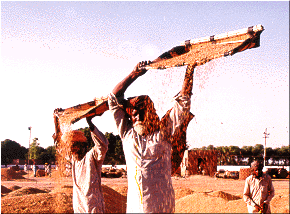
The rural social structure has also undergone a near complete transformation over the last three or four decades.

Over the last twenty years or so a large proportion of dalits in Punjab have consciously dissociated themselves from their traditional occupations as also distanced from everyday engagement with the agrarian economy and even investing in building their own cultural resources in the village, in gurudwaras and dharamshalas.

The growing autonomy of the dalits from the 'traditional' rural economy and structures of patronage and loyalty has created a rather piquant situation in the countryside with potentially far-reaching political implications.

In the emerging scenario, local dalits have begun to assert for equal rights and a share from the resources that belong commonly to the village and had so far been in the exclusive control of the locally dominant caste groups or individual households.

Seen purely through economic data, Indian Punjab continues to be an agriculturally developed region of the country, producing much more than what it requires for its own consumption. Even though occupying merely 1.53% of the total land area of India, Punjab farmers produce nearly 13% of the total food grains (22.6% of wheat and 10.8% of rice) of the country.

Interestingly, in terms of objective indicators, Punjab has been a 'progressive' state otherwise also. For example, in terms of the Human Development Index, Punjab is second only to Kerala.

The growth rates of Punjab – agriculture or industry – are no longer negative. Notwithstanding the frequent reports of corruption and scandals, the urban centres of Punjab seem to be picking-up in terms of growth of infrastructure and real-estate.

However, the Indian Punjab today needs to be re-imagined in more than economic terms alone. The canvas of its change is much larger and broader.

Given that Punjab has a large proportion of Scheduled Caste population, the newly acquired agency among the dalits can also have serious implications for regional politics.

The earlier hegemony of the rural Jutt culture is fast disintegrating and this will change the manner in which the larger interests of Punjab are articulated politically.

Globally, the Punjabi/ Sikh diaspora has been investing in building its cultural resources and participating in local political processes, getting elected to local and national political bodies, more than any other component of the Indian diaspora.

At home, the fast changing geopolitics of the world during the opening decade of the 21st century has important implications for the Punjabs and their futures.

Though the hostile visa regimes of India and Pakistan continue to be an obstacle, traffic of common citizens across the Indo-Pak border has been steadily increasing. The opening up the border between Indian and Pakistan has produced a sense of excitement and opened a window of hope for all shades and sections of Punjabis .

What implications would these new processes have for the manner in which we have imagined Punjab and Punjabiyat – within the national and global contexts? Will the processes of globalization and the new technologies enable the two Punjabs to rediscover their common cultural heritage? How would a loosening of the border and opening of trade routes influence the economies of the two Punjabs? Would the decline of agriculture and rapid urbanization of the state develop a new middle class imagery of the state?

Though it is not easy to answer these questions, some of these processes are sure to bring positive and enriching outcomes.

Surinder S Jodhka is Professor of Sociology, Jawaharlal Nehru University. He has done pioneering work on Dalits in Punjab and authored a number of works on the subject.

This guest post is further elaborated in 'The Problem' statement in this month's edition of The Seminar magazine "Reimagining Punjab" which he has edited. (online next month)

Image acknowledgements:

Comrade Sunil Janah's Site
Punjab govt Official Site
The Hindu

Saturday, November 04, 2006

Why the Left lost the battle of Globalization

Perry Anderson in an interview by Harry Keisler (see video)
Harry Keisler: One of the concerns in your Elberg Lecture is that internationalism, which we've talked about as being a guiding theme in the way you've looked at problems, is now the perspective of international capitalism. Whereas the opposition, the protests, tend not to have the same capacity to think and act globally.

Perry Anderson: For the century between, shall we say, the 1840s and the 1940s, the capacity to transcend one's own national limitations and national interests for a much wider set of interests, and to translate this transcendence into actually organized actions, belonged on the whole to the labor movement and to the left. The capacity didn't belong to businessmen, capitalists, and so on. Since the 1950s, that has very dramatically changed. We have seen in the postwar order a higher degree of coordination, the ability to make a more than national viewpoint on the interests of the system, for the interest of the system, on the part of the privileged. Whereas, those who are less privileged are more and more confined to a local region and at best a national framework of action, and that's partly to do with the destruction in some of the traditions of the Communist International, and the withering away of many of the traditions of the alternative Socialist International as well.

Thursday, October 26, 2006

Globalization and the Lumpenproletariat

Gabor Steingart on the changing nature of the European lumpenproletariat.

Rather, what stand out are the symptoms of intellectual neglect. The poor of today watch television for half the day. These days, television producers even refer to what they call "Underclass TV." The new proletariat eats a lot of fatty foods and he enjoys smoking and drinking -- a lot. About 8 percent of Germans consume 40 percent of all the alcohol sold in the country. While he may be a family man, his families are often broken. And on Election Day, he casts a protest vote for the extreme left or right wing party, sometimes switching quickly from one to the other.

But the main thing that sets the modern poor apart from the industrial age pauper is a sheer lack of interest in education. Today's proletariat has little education and no interest in obtaining more. Back in the early days of industrialization, the poor joined worker associations that often doubled as educational associations. The modern member of the underclass, by contrast, has completely shunned personal betterment.
Marx and Engels on the nature of the lumpenproletariat:
The “dangerous class”, [lumpenproletariat] the social scum, that passively rotting mass thrown off by the lowest layers of the old society, may, here and there, be swept into the movement by a proletarian revolution; its conditions of life, however, prepare it far more for the part of a bribed tool of reactionary intrigue.
and here is a reference to this class in Grundrisse that I found interesting and needs to be kept in mind when looking for the modern lumpenproletariat- since there has been a significant rise in the services sector since Marx's time- note the interesting reference to the 'honest' and 'working' lumpenproletariat that stands in marked contrast to his comments on the class elsewhere (in the Manifesto, quoted above, and elsewhere)
The same relation holds for all services which workers exchange directly for the money of other persons, and which are consumed by these persons. This is consumption of revenue, which, as such, always falls within simple circulation; it is not consumption of capital. Since one of the contracting parties does not confront the other as a capitalist, this performance of a service cannot fall under the category of productive labour. From whore to pope, there is a mass of such rabble. But the honest and 'working' lumpenproletariat belongs here as well; e.g. the great mob of porters etc. who render service in seaport cities etc. He who represents money in this relation demands the service only for its use value, which immediately vanishes for him; but the porter demands money, and since the party with money is concerned with the commodity and the party with the commodity, with money, it follows that they represent to one another no more than the two sides of simple circulation; goes without saying that the porter, as the party concerned with money, hence directly with the general form of wealth, tries to enrich himself at the expense of his improvised friend, thus injuring the latter's self-esteem, all the more so because he, a hard calculator, has need of the service not qua capitalist but as a result of his ordinary human frailty.
See also the Wikipedia entry for the term.

Link to Der Spiegel article via Eugene Plawiuk's Le Revue Gauche.
Image Source

Friday, September 29, 2006

Contradictions of Globalization- the strange case of India


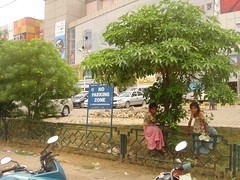
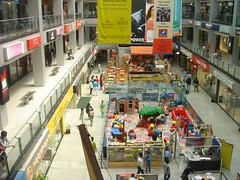
Left: Inside a mall in Gurgaon: all that glitters is not gold
Right: Outside, familiar scenes of child
beggars

Two news reports on the same day and at the same site show the contradictions in the neo- liberal model that currently holds sway in India.

Here are two short extracts from the two reports:

Indian economy registered this decade's highest first quarter growth during the current financial year at 8.9 per cent on impressive showing by manufacturing and services sectors....Agriculture grew by a flat 3.4 per cent, chipping in 19.1 per cent to overall GDP growth.
(Indian economy booms; Q1 GDP growth at 8.9%)

On the other hand:
According to the National Sample Survey Organisation data, about 42 per cent of the population was employed during fiscal 2004-05, which meant that the remaining 58 per cent of the country's employable population was without jobs...Rural areas accounted for 44 per cent of the employed while urban India had 37 per cent of its population employed.
(More than 50% jobless in India in 2004-05)

In other words, the gains of the booming economy are impacting a small percentage of the urban population leaving a majority sweating outside.

The impact of this "boom" is manifested even in something as insignificant as the sale of books published in English in India with non- fiction books like Thomas Friedman's flawed The World is Flat and Amartya Sen's grossly insufficient The Argumentative Indian appealing to a "new class" of readers:
"There is a whole new class of readers emerging out of the Indian economic boom. This genre strikes a chord with their concerns," said Thomas Abraham, Penguin's president and chief executive officer.
(Fact more engaging than fiction for Indian readers)

There is some truth in Joseph Stiglitz's "prescription" in making globalization "work":
The prescription for making globalisation work is what is generally called "the Scandinavian model." That means high levels of investment in education, research, and technology plus a strong safety net. That of course also entails, as in the Scandinavian countries, a highly progressive income tax.
However, the proponents of the Narasimha Rao- Manmohan Singh neo- liberal economic model that has been the ruling paradigm since 1991 have little to show in terms of either trickle down effects of the policies or any semblance of following the Scandinavian model, a decade and half later after the sudden change of gear in the backdrop of a financial failure (though not an economic one).

The truth of the Manmohanomics model is glaring in the face with agricultural land being up for grabs, the suicides in the countryside unabating and the FDI, export lead model overly reliant on the assumption of a growing US economy.

However, it is unfair to compare India with the Scandinavian First World countries.

In the context of the rest of the Third World countries forging their their way into a globalized 21st century,
rather than comparing India's economic model with the Scandinavian countries, it is instructive to see this comparative essay on South Africa and Venezuela- the former following the neo- liberal diktat and Hugo Chavez taking a different path, it is clear that India's direction is more akin to that of South Africa.
I can compare two countries taking two radically different approaches to their social development -- Venezuela trying to redistribute social services and opportunities, and South Africa trying to hold on to the failed economic policies of the past, in efforts that benefit the small elite of both whites and blacks but come at the direct expense of 60% or more of the population of all racial groupings. In Venezuela, I saw hope among the poor; in South Africa, dejection and dissatisfaction.
In terms of a political fallout, it is very easy to predict a defeat of the UPA by any ramshackle conglomeration in the next elections if the UPA government continues to follow its lop sided policies.

It is in the terms of social contradictions that this galloping but unequally distributed economic growth poses that is more difficult and scarier to imagine.


(Link to interview with Joseph Stiglitz via Abi and Krishworld)


Tags: , ,

Thursday, September 14, 2006

"What the heart does not feel, the eye can never see"


Farm suicides have also been on for several years in Punjab, Haryana, Rajasthan, Karnataka, Kerala, Madhya Pradesh and elsewhere. To imply they are only happening in Vidarbha is false. The agrarian problem is nationwide. So are many of the policies driving it. But all regions are not the same. Some crops are more subject to price shocks. Some communities more vulnerable than others. Some cultivation practices more destructive than others. And some governments are far worse at handling distress than others.

P. Sainath, author of Why Everyone Loves a Good Drought, on the myths surrounding the farmer suicides.

Related Post

Tags: , , ,

Saturday, April 08, 2006

Macondo in India, China

The Chinese writer Wang Anyi, describes Panhuang, a small rural town in Jiangsu province with the rivetting imagery from Garcia Marquez's fictional place of Macondo (in One Hundred Years of Solitude):

Evening after evening would seem to be filled with revelry, yet this is also a lonely place. One might think of Macondo, and the tumult in its seclusion. Modernity hovers over the town like an iridescent cloud, but its life remains unaltered.
I felt the last sentence describes very well the kind of 'development' and 'modernity' that is today shaping India as well. Between the less than a dozen cities booming with call centers, BPOs and software companies are endless number of small towns and villages that resemble Panhuang.

From "For Whom the Bells Toll", reprinted in One China Many Paths.

A previous post with another quote by Wang Anyi in the same book here.

Tags: , , , ,

Saturday, January 07, 2006

Meghnad Desai on India and Globalization

A critical review in The Hindu:

East Asia achieved high growth rates without significant foreign direct investment (FDI). They chose instead to acquire modern technology by purchase or imitation, improve it indigenously and use it to produce a wide range of manufactures at a cost and of a quality capable of competing in world markets. China no doubt got huge FDIs, but mostly from expatriate Chinese entrepreneurs who had acquired modern know-how, skills and organisational capacity in manufacturing.

Indian model

By contrast, the model currently being pursued by India relies heavily on imported technology, designs and equipment through foreign collaborations and FDI with far too little attention and effort at building indigenous capability.

Technorati Tags: , , ,

Sunday, July 02, 2000

Review of: On the Edge of the New Century by Eric Hobsbawm

On the Edge of the New Century by Eric Hobsbawm
In conversation with Antonio Polito

The New Press, New York
$21, Pages 176, April 2000


If Eric Hobsbawm's 'Age of Extremes' was an anguished, even if intellectually stimulating reflection on the 20th century from the vantage point of the early nineties, the present book is marked by a renewed exuberance. There are numerous questions that Hobsbawm is still vague on or treads hesitantly, but the change in mood is evident. The historian par excellence, now in his eighties, is back with perceptive insights and his characteristic ability to question accepted wisdom.

This is most evident in his treatment of the globalization phenomenon. While most people believe that it is not only unstoppable but is increasingly gaining ground, Hobsbawm questions both these views.

He observes: "Globalization is primarily based on the elimination of technical obstacles rather than economic ones. It is the abolition of distance and time. For example, it would have been impossible to consider the world as a single unit before it had been circumnavigated at the end of the fifteenth century… the turning point (for the enormous acceleration and global spread of good transport) was the appearance of modern air freight… Until the seventies, a company that wanted to produce motor cars in a country other than the country of origin would have to build an entire production process on the spot."

" Now it is possible to decentralize the production of engines and other components, and then have them brought together wherever the company wants. For practical purposes, production is no longer organized within the political confines of the state where the parent company resides… thus while the global division of labor was once confined to the exchange of products within the particular regions today it is possible to produce across the frontiers of states and continents. This is what the process is founded on."

"The abolition of trade barriers is, in my opinion, a secondary phenomenon. This is the real difference between the global economy before 1914 and today. Before the Great War, there was pan- global movement of capital goods and labor. But the emancipation of manufacturing and occasionally agricultural products from the territory in which they were produced was not yet possible".

The drive for globalization requires that ideally the world be seen not as a globe with national boundaries but as a map of the major corporations of the world.

And this, Hobsbawm avers, is not only an impossible but a very dangerous ideal. For one, it considers only the production aspect leaving out the distribution aspect altogether. Another, for the ideal to be realized necessitates standardization and homogenization. The point that Hobsbawm raises is that there are bound to be physical limitations and resistance to these attempts. That is the real Y2K problem that will determine the limitations to globalization however omnipotent it may seem today.

Some indications to these limits are borne out by developments in the European Union itself, where it has become "extremely difficult to determine a common foreign and defense policy and this proves that there aren't the necessary conditions for an effective and total political integration, whereas there are for social and economic matters. The enlargement of the European Union will make the situation even more difficult".

The only two important fields in which Europeans have come close is the recognition by governments that European jurisprudence takes precedence over their national laws. The other aspect that unites Europeans is protectionism in order to resist competition from the United States and mass immigration from the Third World.

Hobsbawm is equally emphatic regarding the failure of the free market. "When historians in fifty years time look back on our era, they will probably say that the last part of the short twentieth century ended with two things: the collapse of the Soviet Union and also the bankruptcy of free market fundamentalism that dominated government policies from the end of the Golden Age " (1970s). The global crisis of 1997- 98 may very well be taken as the turning point".

The other is of course the implementation of the purest free market policies in the former Soviet Union whose tragedy has still not been well understood.

"The scale of the human catastrophe that has struck Russia is something we simply don't understand in the West. It is the complete reversal of historical trends: the life expectancy of men has dropped by ten years over the last decade and a large part of the economy has been reduced to subsistence agriculture. I don't believe there has been anything comparable in the twentieth century… I believe it is (entirely due to the application of free market rules) if for no other reason than that free market rules, even if adapted, require a certain kind of society. If that kind of society does not exist, the result is a disaster".

That globalization is not unstoppable is controverted by historical experience- control of immigration (humans being a necessary, even if an "evil" part of the production process) is an example.

The author regards Pope John Paul to be the last great ideologue to criticize capitalism for what it is, though it is "eccentric" in relation to Western conformist thought and the dominant political and intellectual consensus". This, of course, implicitly underlines the ineffectiveness of the Left to articulate this criticism- indeed the Left itself has been divided as the European socialists who are in government in most of Western Europe have demonstrated. Tony Blair and his guru Anthony Giddens term it the "Third Way". Hobsbawm expresses his disagreement, rather brutally one feels, by terming Blair as the "Thatcher in trousers".

Neither does Francis Fukuyama escape his acerbic taunt- he is branded as the Dr. Plongloss of the 20th century (Dr. Plongloss is a character in Voltaire's Candide).

Hobsbawm feels that it is also incorrect to consider the liberal and left traditions as unrelated if not divergent. It was only with the Bolshevik revolution that the Left came to be identified with the specific form of Soviet socialism that ultimately failed to sustain itself and collapsed. On the other hand the liberals too did not exactly manage to change the nature of the state. The welfare state always operated within the capitalist framework.

Some of Hobsbawm's comments are personal in nature- for example he comments that he deliberately chose to study 19th century history so as to remain above the debates regarding contemporary issues.

"I… have to admit that while I hope I have never written or said anything about the Soviet Union that I should feel guilty about, I have tended to avoid dealing with it directly, because I knew that if I had, I would have had to have written things that would have been difficult for a communist to say without affecting my political activity and the feelings of my comrades".

Some of Hobsbawm’s comments are disconcerting, for example, when he notes that ethnic cleansing can actually solve problems. Others are subtler, for example his observation that modern nationalism is generally top down. "Human beings were not created for capitalism", Hobsbawm remarks tongue in cheek elsewhere in the book.

As a reversal of a centuries long process, the long historical wave which moved toward the construction and gradual strengthening of territorial states or nation- states comes to an end (the end itself starting around 1960s and deeply accelerating after 1989), Hobsbawm notes that it has become increasingly difficult to mobilize people on collective lines specially in the West. This underlines the crisis of class based action today and also the reason why Hobsbawm considers the most appropriate symbol for the 20th century not to be the working class or the peasantry but a mother with her children.

"The people who have most in common are mothers, wherever they live on the face of the earth and inspite of their different cultures, civilizations and languages. In some ways, a mother's experience reflects what has happened to a large part of humanity in the 20th century".

These intensely humanistic insights remind one of what Antonio Gramsci in another era termed as the optimism of the will overcoming the pessimism of the mind. From the "Age of Extremes" to the present book, Hobsbawm has displayed tremendous optimism of the will and fired a salvo that may not completely overcome the pessimism of the mind, but somewhat lights up the darkness that has characterized the last decade. Alas! There is none of his caliber and perseverance after him in sight.

June 15, 2000
Published: The Tribune 02 July 2000

Sunday, January 10, 1999

Words Like Freedom: The Memoirs of an Impoverished Indian Family 1947-1997
By Siddharth Dube
Harper Collins Publishers India Rs. 395, Pp. 297, 1998

After the recent CPI(M) Congress, in reply to a question as to why the Left had failed to strike roots in Uttar Pradesh, the party General Secretary H.S. Surjeet explained the reasons thus: "There has been no social reform movement in the state". This surely is a case of putting the cart before the horse, since for those on left of the political spectrum, reforms are only a part of a much more comprehensive radical agenda. The task of the left is to carry out changes that go beyond reforms and not wait for others to carry out the job. Surjeet's words raise an existential question for the CPI(M).

However, even this recognition of the specificity of the state of Uttar Pradesh is a recent phenomenon. For a long time, its endemic poverty was perceived as not very fundamentally different in nature from that prevailing in the rest of the country. It is only very recently that attention has been drawn to the abysmally poor performance of the state in the key areas of literacy and health- care and the large- scale prevalence of casteism and traditionalism.

Jean Dreze has termed the state as India's "burden of inertia".

The book under review is an attempt by the young writer Siddharth Dube to understand the vertical implications of this inertia by relating the broader political economy of the state to the actual life experiences of a marginal family. It recounts the memoirs of three generations of a Dalit family from Pratapgarh district. Its narrative is an interweaving of the family's recollections of their life stories and the writer's own scholarly interjections. Surprisingly, the result is a stirring jugalbandi and not a cacophony of illiterate voices and noisy economic jargon, which is what it may have become in the hands of a less skilful chronicler.

The central character of the family is Ram Dass (aged about 65) of Baba Ka Gaon village in Pratapgarh district. This district has been the focus of much interest since the publication of Gyan Pandey's impressive study on the Awadh peasant revolt (published in the first volume of the Subaltern Studies). Zamindari in this district had existed here in its extreme form. It was buttressed by a rigid caste system in which the untouchables were treated as "neither fully Hindu nor fully human". The upper caste zamindars on the other hand, enjoying the patronage of the British colonial state, extracted many types of taxes and dues from the tenants and labourers, who without exception were untouchables or belonged to the intermediate castes.

Says Ram Dass, " (when I was a child) If our family got a letter, we had to go and plead with the Thakur or Brahmin to read it for us. We had to wait till they were free. Or we would work extra hard and finish all their work and then beg them. Even then, they would read it if they felt like it or otherwise they would shout, 'Get out, go away!'"

"The upper castes would treat us untouchables worse than dogs. They would at least accept water served by the middle castes, but from us they would not accept water, nor would they ever sit with us. If by mistake we touched any of their eating vessels they would throw them away, but if a dog licked the vessels they would just wash them".

Ram Dass's son today is a primary school teacher, the first scheduled caste teacher from his village. His grandson now faces an uncertain future because though he is the first of the three scheduled caste graduates from his village, he finds that he has to compete in a highly difficult job market. His degree is not of much help in the face of the demand of the few jobs that are available.

Blatant casteism over the years has slowly became less pointed- though even Ram Dass' son Shrinath had to sit separately from high caste students in school. Nowadays, scheduled caste children even play with upper caste children", observes Shrinath.

Ram Dass and his family are at a barely sustainable level, they are an example of a family that has risen from the lowest of the lowest to a family that is now hovering around the poverty line. Land reforms over the years have enabled the family to own 2.5 acres. It is only because of his son's government job which pays Rs.4000/- a month, that the family of 17 manages to eek out an existence, keep hunger at bay and afford two sets of clothes. The next generation faces an uncertain future again. The gains of the seventies have not progressed linearly.

The most prosperous families in the village are, as during Ram Dass's childhood years, still the 20 Thakur families that own most of the village land and orchards. Besides, most of them have a family member in a job- army, police or the university. Of the land that has been sold by the Thakurs over the last 50 years, the bulk was bought by the intermediate castes, with only a small amount purchased by the scheduled castes. The rest of the families in the village have been too impoverished to purchase any land at all.

The author's prescription is what may nowadays be termed as Sen- ism (after Amartya Sen): the government should carry out land reforms, promote good health-care, foster social equity and encourage local democracy. Mulayam Singh Yadav' s 1995 act on the reservation of posts of the village pradhan for intermediate and scheduled castes is an example of empowerment of these castes. Hitherto, Baba Ka Gaon had the same Thakur pradhan since 1952 till 1995.

"The 1995 elections irrevocably changed caste equations in Baba Ka Gaon. The village Thakurs threatened to kill the former army sergeant from the Maurya middle caste who, with the backing of the scheduled castes, decided to stand for the pradhans's post. They then burnt the crops of a particularly militant scheduled caste man. A week before the elections, in mid afternoon, a group of Thakurs entered the hut of a middle caste family and started thrashing the wife with their staffs while others pinned her down. But for the first time in the history of Baba Ka Gaon, the scheduled castes- including Prayaga Devi (Ram Dass's wife)- and the middle castes hit back at the Thakurs and chased them away".

The memoir is a testament against the notion that the illiterate are not capable of participating in electoral politics. The perceptive awareness that Ram Das and his family members have about the reasons responsible for their poverty is amazing.

Besides this, there are two major points that the book establishes.

First, that serious debate in the era of liberalisation is turning towards what Marxists have traditionally termed as the tasks of the bourgeois revolution. The hair splitting debates that dominated the seventies searching for that elusive algebraic equation of the balance of class forces, which in turn would decide the stage of the revolution, now belong to a bygone age. Similarly the euphoria of the liberalizers in the early nineties is giving way to more introspective studies.

The second is the recognition of near absolute identity of the Dalits as the most oppressed sections in the country. Earlier observers, even among the most radicals ones, disdained this. Groomed in the modernist, Nehruvian framework in the backdrop of global appeal of Marxism, the caste factor was pushed under the carpet. It was even seen as an obstacle in establishing class-consciousness. This has now changed, and rightly so. This was evident in another recent and comparable work that comes to mind: Everyone Loves a Good Drought by P. Sainath.

Dube's misgiving that the Congress represented the interests of the propertied classes only both before and after independence betrays a direct influence of the subaltern school of historians and indirectly that of R.P.Dutt. This is not only contestable but is the result of too narrow a perspective that students of peasant studies have usually held. The only other problem that mars the text is the author's straight- jacket perspective that sometimes reads like the CPI(M) party programme. That towards the end of the book Ram Dass turns out to be a Communist (if not a CPI(M)) sympathiser is perhaps indicative of this bias.

December 04, 1998

Published: The Tribune 10 Jan 1999