Saturday, July 02, 2005

Marching for the World's Poor

I am touched as I myself sit in a reasonably comfortable hotel on the riverfront in a Southern US coastal city as I read this story. I often wonder about a statement that a person once made, about 16 years ago, when TKR introduced me to his friend saying that this young man is a communist. His friend replied: a communist at 20, and a capitalist at 40. I am still a couple of years away from being 40...will the about turn be complete by then?

BTW, it is hot and sultry in Savannah. The waters at the Tybee island beach, brownish and muddy...I liked the walk around the old downtown yesterday and also the visit to the Pulaski Fort today morning. The River cruise for today afternoon is what I am looking forward for the evening and then a good dinner and sleep before going off to South Carolina and then to Atlanta tomorrow. And back to work.


Friday, July 01, 2005

Tomo Chi Chi


I am in Savannah today. I took a walk along the Riverfront, the statues and the parks and the evidently European flavour of the neighbourhoods near the riverfront reminded me of Pondicherry, the heat and the humidity adding to the effect.

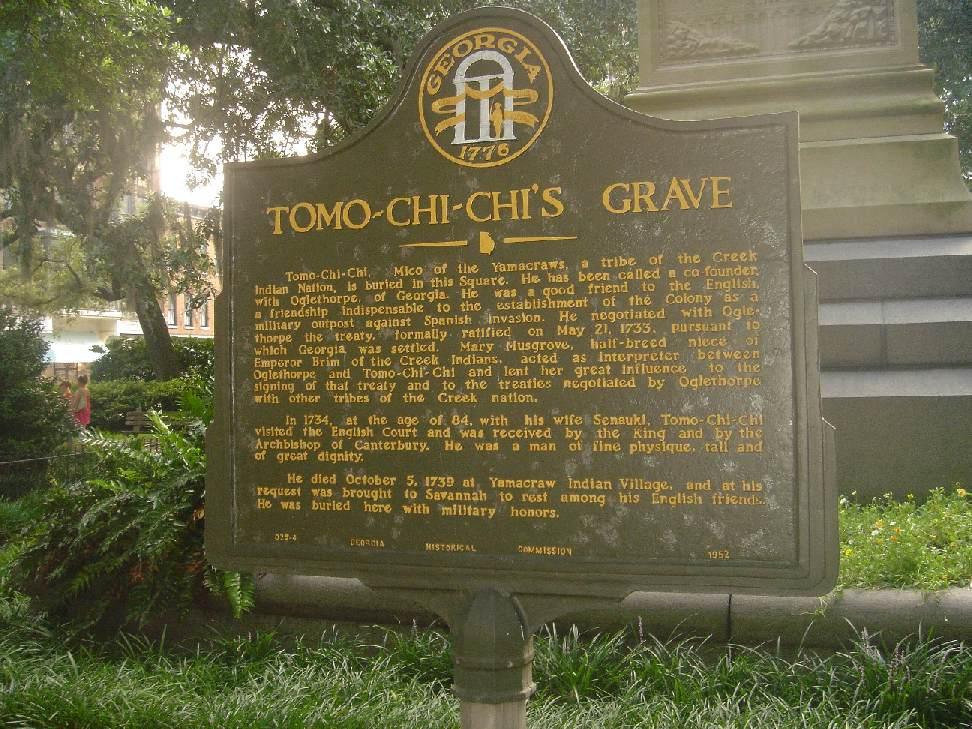
The surprise discovery was the grave of the Indian chief who practically gave away the state of Georgia to its white founder George Oglethrope (and after whom a major road in Savannah is named). The Indian chief has been praised as a 'man of fine physique, tall and of great dignity'.

All this for one who in the pre-ceeding paragraph on the same plaque has been identified as the person who negotiaged the 'treaty that ratified on May 23, 1733, pursuant to which Georgia was settled'. When it should have said annexed.

In India as well, we had terms to identify persons of such great stature. They were referred to as the running dogs of British imperialism.

Thursday, June 30, 2005

Russia- Light at the End of the Tunnel?

One of the greatest modern- day disasters has been that of the former Soviet Union. The former super power now has probably one of the poorest living standards and has seen perhaps for the first time in a century, a real decline in population- contrary to world wide trends.

Now it seems that there might be some light at the end of the tunnel- if one were to go by yet another book on the misfortunes of Russia. You will need to have a login id for the NYT to read this review of "Kremlin Rising".

Like many other observers, the writers seem to feel that Putin is the man who will deliver- he seems to be in the image of the patriarch, bringing about "managed democracy". That he happens to be in the image of the former czar, in line with the personality cults of Lenin and Stalin is a point often made about him. A man of strong and decisive actions- like the one during the Chechnya hostage crisis, he surely seems to have reined in some of the mafia operatives, though not the overall system, which is weaning towards a controlled form of capitalism. Though at least this article argues that Russia today resembles Iran, a democratic election returning a conservative dark horse to power.

A significant change has also been the decline of the voice of the left and nationalist groups during the last few years and their reduced popularity.

What is obviously missing in the review and probably also the book is the role of the IMF and the "free world" in leading the transition to near disaster. A better account is provided by a lesser known book by the historian Roy Medvedev, "Post- Soviet Russia" published a few years back. Unfortunately I did not get down to review this very impressive and the only Marxist analysis of post- Soviet Russia that I have read.

Wednesday, June 29, 2005

Andre Gunder Frank

...is no more. The Monthly review carries a short remembrance by his close associate Samir Amin. I never got around to read any of Gunder Frank's books, though I did read Wallerstein and Samir Amin, with whom I broadly agreed with their ideas on the 'world capitalist system'.

I recall that his book "R e O R I E N T: Global Economy in the Asian Age" was decisively demolished by the East Asia crisis of 1997. That created a barrier and I could never actually read any of his works.

I am also reminded me of another wonderful contemporary Marxist Slavoj Zizek. I ran into him on the LRB few months back and will probably collect more links to his articles. This particular one was a comparison between the two totalitarianisms: the Nazi and the Soviet. Needless to say, I much liked the article.

The Famished British Reader

John Carey recently expressed the view that the British reader is deprived of world literature. The Guardian carries a list of 10 writers that it feels need to be read.

Frankly I recognized only one name: Haldor Laxness, the Icelandic novelist and socialist. He made a visit to India, I think in 1957 or 1961, and attended a CPI Congress. He is little known even in India, though I have seen, and bought some of his novels in Chennai. Havent got around to read him as yet.

Stefan Heym and Dubravka Ugresic are the other two writers that seem interesting on the list.

I have my own list, as expressed elsewhere in this blog.

Sunday, June 26, 2005

Modern Adventures in the Land of Don Quixote

One of the literary characters that are probably more well known than their creators is Don Quixote. I distinctly remember the impression that the old knight stamped on my inquisitive mind when I was in class four and read a chapter on Don Quixote fighting the windmills. It interested me so much that I went on to read the complete book then, though it was the abridged version.

After that I almost forgot about it and returned to it when I was in college when borrowed a copy from the Chandigarh State Library in the eighties, probably in 1987. I dont remember what led me to the book then, perhaps it was a passing remark from someone. But I did not read it as seriously as I should have.

It was only my subsequent interest in Latin American literature that I developed in the last 3 three years that revived my interest in Don Quixote, as I began to realize that Cervantes' novel holds as pivotal a place in Spanish literature as Shakespeare does in English. Last year, about this time of the year in Chennai, I finally got around to read the new translation by Edith Grossman, the acclaimed translator of Garcia Marquez and some of the other Latin American writers, and to whom collectively belongs the Nobel Prize awarded to Garcia Marquez.

And I was fascinated by the novel when I read it last year. I am not sure how different this translation is compared to the older version. But the book really is fascinating- the novel has everything- action, romance, flashbacks, defeat- even victory- plots, plots within plots, novellas within the novel, characters as clear and concise as Dickens' characters. Much has been written about the novel, and I havent read much of that, but it is a complete modern novel- it captures human actions, motivations and the passions that drive man to go out and act, it is not only the human ego, but also the fact that Quixote, like many of us, is inspired to action by books, and ideas contained therein, and these ideas could be harmful, they could be about other times and other places, there has to be human wisdom that is still required to make sense of the world and relate them to ideas and received chronicles.

There are books within the books, the books that inspire Don Quixote to ill- fated action. Despite his noble intentions, Quixote, in a way similar to and in a way, very dissimilar to another character created in the 20th century- the Good Soldier Sjevk. They are similar as the intentions of both are noble, it is dissimilar because Quixote chose to ride out to the world to rid it of its follies, while Sjevk is more or less pulled into the world to serve his 'nation' in a war that he had no interest in. I havent read of any comparison being drawn between these two novels, though I have a feeling that there are many points of comparisons and could be delved into more deeply.

Quixote has been contrased to another famous character, though. Shakespeare's Hamlet is the opposite of Cervantes' hero and is the man who only thinks and never acts, or acts when it is too late. The famous essay by Harold Bloom on this theme immediately comes to mind.

But why am I writing on Don Quixote? I am writing on him as I read the novel last year, and wanted to let you know about it. Also that this year marks the 400th anniversary of the publication of the novel. And also that Don Quixote continues to inspire people more than 400 years on, specially some who inhabit the land of his original, if fictitious, adventures.

Saturday, June 25, 2005

Eric Hobsbawm on America's New Imperialism

Its funny I never noticed this when I lived there, but today I noticed a car from New York and on its number plate at the back it said: The Empire State.

Anyway, I was reminded of this only when I read an extract from Eric Hobsbawm's preface to a forthcoming book by VG Kiernan: "America: The New Imperialism". Kiernan has had a long association with India and recently a collection of his essays on India were published. VG Kiernan is most well known in India for his translations of Faiz Ahmed Faiz from Urdu to English and for his studies on Allama Iqbal.

Hobsbawm, the pitamah of Marxist historians mainly reiterates what he has been saying of late, including what he said when he was in India earlier this year- the United States today is in a position to win small scale wars as demonstrated by its occupation of Afganistan and Iraq but the question really is how to rule after the war.

I first read Hobsbawm's three volume work on the 19th century in the early nineties, soon after the collapse of the Soviet Union. Those were my years of intellectual disarray- and the first piecing realization was that my history of humankind started from Marx, I knew little of even extant socialist traditions, not to mention the Enlightenment and Renaissance. The second was that I knew little about India as well- and it was not till I started a more systematic study on my own that I developed some confidence about my ideas and beliefs.

Much later, in 1997-98, when I first spent a few months in the US and got to procure books that introduced me to broader thought currents in the West, that I began to recoup mentally. My confidence in Marx and Marxist thought only increased, even as I read more and more about the Russian Revolution and its aftermath by left- wing and right- wing writers. That also started my own series of books reviews on globalization and the history of 20th century Soviet socialism even as I continued to write on communalism. All this was in the background of increasing Right wing rhetoric and dominance both in India and in the US- the two countries where I have spent most of my professional life in the last decade.

I have to admit that Hobsbawm's writing formed the anchor around which I got introduced to 19th century history and also the history of socialism.

And then it was the late Mohit Sen too who stroked the fires. He had been a student of Eric Hobsbawm in the 1940s Cambridge and he recounted a number of anecdotes about him that made me feel closer to EH- his ability to rattle off statistics even when he was just about 30 or 32, his lectures that were attended by students from all over the university and his letters to Mohit Sen.

Both went to on recount those years in their respective biographies, though MS must have felt very crest fallen on discovering that EH had not even mentioned his name on his otherwise long recollection with Indian students, though Mohit himself spent considerable ink on his former teacher. That was part of Mohit's general sense of being forlorn in his last years, of not having been given his due. He had been a brilliant thinker in his own right, and a prodigy of sorts. My own feeling is that Mohit had the mind of a theoretician and the disposition of an ideologue, and the times he lived in cast him in the mould of the latter, with all its pitfalls.

To return to my teacher's teacher, Hobsbawm, his trilogy on the 19th century, I believe, forms the core his work. It was only after the fall of the Soviet Union, that the Marxist in Hobsbawm began overshadowing the historian.

I also believe that today, along with Roy Medveydev, he is probably the most articulte and clear headed Marxist analysts of the contemporary world. There are others as well, no doubt. But what lends authenticity to both these thinkers is their rooted-ness in the Marxism of the Old Left, their lifelong faith and support for Soviet socialism, warts and all, and their ability to explain the aftermath in Marxist terms. Even if they are critical of the Left or the former Soviet Union, I find it easier to accept their views than to accept the same views from anyone who was either anti- communist or anti- Soviet Union when it existed.

Unlike those on the New Left, for example, Hobsbawm and Medveydev have have shown intellectual resilience and imparted an intellectual grace- if not a defence- to the nobility of the ideas that spawned the October Revolution, even as the Revolution crumbled under it own weight.

Coming back to the current Guardian extract, I would like to read all of the preface, but I found the following lines particularly pregnant with meaning:
Even those who do not share the views of the old generals and proconsuls of the US world empire (which were those of Democratic as well as Republican administrations) will agree that there can be no rational justification of current Washington policy in terms of the interests of America's imperial ambitions or, for that matter, the global interests of US capitalism.

And then he goes to to say:
It may be that it makes sense only in terms of the calculations, electoral or otherwise, of American domestic policy. It may be a symptom of a more profound crisis within US society.

Its the last line that is particularly incisive and Hobsbawm stops short of elaborating on this. Because if this is so, then the policy may turn out to be far more resilient than if it is only the result of the megalnomania of a set of quasi- revolutionary Right wing demagogues.

Thursday, June 23, 2005

The Lesser Known Classics

Some of the best books that I feel I have ever read happen to be some of the lesser known books and I have often wondered why they are not as well known and read more extensively. Perhaps it has to do much more with the mood of the times, the acceptance of certain ideas and a host of other factors.

I have without doubt enjoyed the great classics as well- 'War and Peace', 'The Brothers Karamazov', 'Swann's Way', 'One Hundred Years of Solitude' et al. But I have been equally mesmerized by others, perhaps I will write about them in more detail later, but here is a quick list of such books:

The Real Life of Alejandra Mayta by Mario Vargas Llosa
Life and Fate by Vasili Grossman
The War of the End of the World by Mario Vargas Llosa
The Story Teller- again by MVL,
Embers by Sandor Marai
The Leopard by de Lampedusa


In my view Llosa is a writer still largely and unfairly ignored by the English reading public

There area few others too, like the recently resurrected Andrei Platonov (The Foundation Pit, Soul and Happy Moscow). However, unlike the more specialized interest that Platonov may hold, the ones listed above surely carry more universal theme and significance.

Saturday, June 18, 2005

Advani in his Labyrinth

As more or less predicted by this Reader, Mr Advani is back in the saddle, though not as firmly as he would have liked to be. His well calculated move to manufacture a moderate mask as it were, has boomeranged, and he has for the time being failed to metamorphose into a Janus faced Atal.

This places the BJP in a dilemma, if not a downward spiral. With the more diehard elements in the Hindutva family now calling the shots and the need for the Party to broadbase its acceptablity for other parties in the NDA, there is evidently a headlong conflict. There are few options left.

To expect the other NDA parties to turn right wing in the BJP's mould is difficult to believe but not an impossibility. The former socialist, George Fernandes is a case in point and there may not be a dearth of similar turncoats. In other words, the BJP's numerical strength despite its decline in Uttar Pradesh, may make many a one- man party in the NDA turn a blind eye to a hawkish BJP leadership. Another aspect to be seen is how the second rung leadership can succesfully carry out Operation Janus Face- which this Reader feels is imperative for the BJP for its 'being'.

Unless, the schisms within the Hindutva family turn out to be too irreconciliable and the party breaks into warring camps. Or develops a split personality. One still feels that things have not yet come to such a state and the contradictions are reconciliable. Because to have a split personality assumes the existence of diametrically opposite characteristics, which the BJP and the rest of the family does not carry at the leadership level, howsoever intrinsic these contradictions may be at the level of their social basis.

But the BJP continues to be a long term threat to the nation- and the decisive role for the BJP's resurgence may now be played by the Congresss Party itself- its continued pursuance of globaliztion that adversely affects the poor, its lack of a long term social perspective (including its weak kneed secularism) and lack of a charishmatic leader that can appeal to a cross section of people. These remain its critical weaknesses, and the presence of the Left may help to make up at least for the first two. To what extent is another question.

The Third Front idea has been floated as an alternative again most recently by Prakash Karat the CPM general secretary. Little needs to be said of this at this time, except that it is an idea. However, one whose time has not yet come. The CPM's dogmatism with a neo- Stalinist at the helm is evident, unfortunately it is the former die hards like Surjeet and Jyoti Basu who are more flexible and pragmatic than the newer generation of the CPM leadersip (Karat and Yechury). A case not dissimilar to the BJP's in some ways.

Thursday, June 16, 2005

The Bicycle Thief

I have never been able to watch a movie for more than 15 minutes, except for a few years in college when the parallel cinema held me in awe for some time before I returned to my first love- books. It still remains for me an adjunct to literature and the written word. And I have been able to supplement some of my reading via this medium.

My current stay in the US is not without its advantages and I have been able to watch at least half a dozen movies that I always heard or read about. Among them is The Bicycle Thief (or Thieves as it probably is titled in the original). I find the movie fascinating, and no wonder it is held as the harbinger of neo- realist cinema.

Besides the technical finesse- usage of real locations and non- real actors and hence real people, De Cica manages to make even the most unreal character in the movie- the fortune teller- a real, an almost mundane person. Much better has been written about the movie than perhaps I can write and hence would refer the interested reader to other sites.

I have watched a few others in the last couple of months- some of the works of Akira Kurasawa and a number of movies starring Anthony Hopkins. About them, perhaps later.

Sunday, June 12, 2005

Chinese Literature in 20th Century

...has largely been ignored not only outside China but perhaps also within China. While I diligently read my Mao in those exuberating days in college ('On Contradictions', 'On Guerilla Warfare', and others from the Selected Works in 5 volumes), Li Shao Chi ('How to be a Good Communist') and tracts from Lin Biao, I only vaguely remember being introduced to the short stories of Lu Xun, and frankly dont remember any of the stories.

Pearl S Buck's 'The Good Earth' was the closest that I came to associate China and literature. Besides some of the poetry of Chairman Mao. Of course.

Now Penguin has brought out the novel 'Fortress Besieged' by Qian Zhongshu, who published the novel in 1947, and subsequently spent the rest of his life translating the works of Chairman Mao and de-classing himself by labouring in the countryside during the Cultural Revolution.

Julia Lovell explains the possibilities unleashed by Penguin's republication of this novel about the 1930s' Chinese intelligentsia and terms it as a Great leap forward.

One can only agree with her and exclaim: Let a hundred flowers bloom !

Saturday, June 11, 2005

Beethoven and Mozart

I have always wondered why I like Mozart almost intuitively while being nearly deaf to Beethoven. Dylan Evans explains why while going on to claim that Beethoven was a narcissistic hooligan. I liked this part of the piece:


It's instructive to compare Beethoven's morbid self-obsession with the unselfconscious vivacity of Mozart. Like Bach's perfectly formed fugues and Vivaldi's sparkling concertos, Mozart's music epitomises the baroque and classical ideals of formal elegance and functional harmony; his compositions "unfold with every harmonic turn placed at the right moment, to leave, at the end, a sense of perfect finish and unity", as the music critic Paul Griffiths puts it. Above all, Mozart's music shares with that of Bach an exuberant commitment to the Enlightenment values of clarity, reason, optimism and wit.

Tuesday, June 07, 2005

Jinnah, Advani and the RSS

The Indian Express has a quick analysis of the Advani act, post- Karachi visit: Act of courage, it was Advani the intellectual

I am quite amused by Advani's statements and more so by his action in resigning as President of the BJP. I have little to add to what the Indian Express has to say, except that, beyond the ideological veneer to the recent RSS-BJP flak lies the fact that the different heads of the Hindutva family represent different and conflicting social basis, with the RSS relying on its traditional lower middle class, urban petite bourgeoise and trading classes with an aging leadership, the VHP a strange admixture of the first world immigrant and the sants, the Bajrang Dal with the motley urban lumpen youth and the tribal frontal organizations that have been much more active in the last two decades than previously. The BJP itself hijacked by the middle class noveau- rich basking in the sunshine of globalization and outsourcing.
It has been the heady tonic of power that made this crowd seem like an invincible 'family' barely a year back, when the Congress seemed to be almost dumped into history.

I am not sure at this point whether Advani will really resign or do an Uma Bharathi and come back with renewed support of the currently very much divided Hindutava family. Though the media reports are already propping up Rajnath Singh as the alternative leader, I wont be surprised if Advani is back in a week or so.

And in case Rajnath Singh does come in as the next chief, the most interesting aspect would be that the BJP would be lead by a non- Brahmin (I suppose that Rajnath Singh is a Thakur- hence very much from the 'reliable' upper caste stratum that the RSS may trust more than a backward caste or a Dalit).

However, I am quite convinced that it is not the 'intellectual' in Advani but the political strategist in action. The debate on Jinnah is and will be a non- starter. Nothing that Advani has spoken is factually incorrect or pathbreaking. If the RSS has been kicked out of its reverie and is reacting in a knee- jerk fashion, it is more than likely that its mercurial reaction may well turn into its opposite as soon as it flared up, while it continues to ignore what Advani has spoken of. Mr. Advani may have amnesia as well. It is a matter of time.

After all, the conflicting social bases do need to be clobbered together at least at the leadership level for any hopes of return to power. At this moment in the BJP's history, this clobbering can be achieved only by a Janus faced leader, it does not matter whether it is a veteran Vajpayee or an ascending Advani or even someone else.

Sunday, June 05, 2005

The Leopard by Giuseppe Di Lampedusa

Giuseppe Di Lampedusa wrote only one novel (The Leopard) in his lifetime and that too was published posthumously. Thus one of the most important 20th century novel in the Italian language was never seen in print by the author himself.

The novel is situated during the time of the Italian re-unification, the rise of Garibaldi and his Red Shirt movement and the decline and subsequent transformation of the feudal nobility in the late nineteenth century. Di Lampedusa was himself was himself a descendent of one the noble families and the story that he narrates is ostensibly that of his grandfather. The Leopard is the symbol of the family of which Prince Fabrizio, the principal character in the novel, is the head.

The novel reminded me of a couple of other such works, one of which is surely the Century in Scarlet by the Hungarian writer Lajos Zilahy. Both deal with more or less the same theme, though from somewhat different sides. Zilahy's novel too deals with the coming into being of the Hungarian nation in the twentieth century- thus both deal with the coming into being of modern nation states and identities of two nations that were probably at the far end of the nation forming processes that were set into motion a century or more earlier in some of the other European states. I am not sure how comprehensive the novels are from a sociological or political point of view, but both do provide the nearest equivalent in a literary form.

Both the novels are very straightforward in nature and though written in the 20th century, they are in the nature of the 19th century novel, with a linear narrative structure and few complexities in terms of the underlying ideas they seek to communicate. The style is closest to Balzac's, more in case of The Leopard than perhaps The Century in Scarlet. This is not the place to go in for a deeper analysis of The Century in Scarlet, but here are a few words on The Leopard.

The story is straight forward, that of Prince Fabrizio who is forced to relinquish the control of his estates in the light of the advance of Garbaldi's republican forces. His ambitious nephew Tancredi moves over to the new forces, calculatedly marrying the daughter of a rising rich, though uncouth merchant Don Calogero who is eager to establish a 'lineage' for himself by marrying into the family of a noble, in the process spurning Fabrizio's own daughter's hand .

"Unless we ourselves take a hand now, they'll foist a republic on us. If we want things to stay as they are, things will have to change"
-he informs his uncle, even as he looks at his uncle with the 'affectionate irony that youth accords to age'.

That Prince Fabrizio aids and abets his nephew in his cunning endeavors speaks much of the Prince's own instinct for survival. "The bourgeois revolution climbing his stairs in Don Calogero's tail coat", as the Prince thinks while observing Don Calogero in his house.

And historically speaking he is right, the decline of the nobility is complete and the power has shifted decisively in favour of the commercial bourgeoise, with the corresponding shift from the monarchy to a republic and the ideological shift from the church- when the nobility's land is ostensibly 'the patrimony of the poor'- to the republican ideals.

With the story being as simple as that what holds the reader is the author's effusive description of some of the lesser known areas of Europe- Siciliy in this case. Added to that is the author's deep insight into human nature, which renders the novel a universal appeal and finally his smooth, delectable, almost tropical prose. His metaphors are particularly imaginative and I suppose that probably owes something to the richness of the original language itself.

Here is a description of the Prince's family as they sit down for dinner:
"The girls plump, glowing, with gay dimples, and between the forehead and the nose the frown which was the hereditary mark of the Salinas; the males slim but wiry, wearing an expression of fashionable melancholy as they wielded knives and forks with subdued violence."
And that of the Prince Fabrizio himself:
"...in his blood also fermented other German strains particularly disturbing to a Sicilian aristocrat in the year 1860, however attractive his fair skin and hair amid all that olive and black: an authoritarian temperament, a certain rigidity in morals and a propensity for abstract ideas; these in the relaxing atmosphere of Palermo society, had changed respectively into capricious arrogance, recurring moral scruples, and contempt for his own relatives and friends, all of whom seemed to him mere driftwood in the languid meandering stream of Sicilian pragmatism... Between the pride and intellectuality of his mother and the sensuality and irresponsibility of his father, poor Prince Fabrizio lived in perpetual discontent under his Jovelike frown, watching the ruin of his own class and his own inheritance without ever making, still less wanting to make any move toward saving it."
This in essence also sums up the novel itself.

There are a number of insightful sentences that are a delight for a reader. Though the novel may beg comparison with, say, a War and Peace, to say nothing of a novel like Mario Vargas Llosa's The War of the End of the World which is far more complex in the treatment of a similar theme. Nevertheless The Leoprad establishes itself as a minor classic of the 20th century and hence an important novel to those trying to understand the evolution of nations in an era that seems to be dissolving a number of attributes of what have been associated with the nation and national identities.


Tuesday, May 31, 2005

Carlos Fuentes, Turgenev and Thomas Mann on Faust

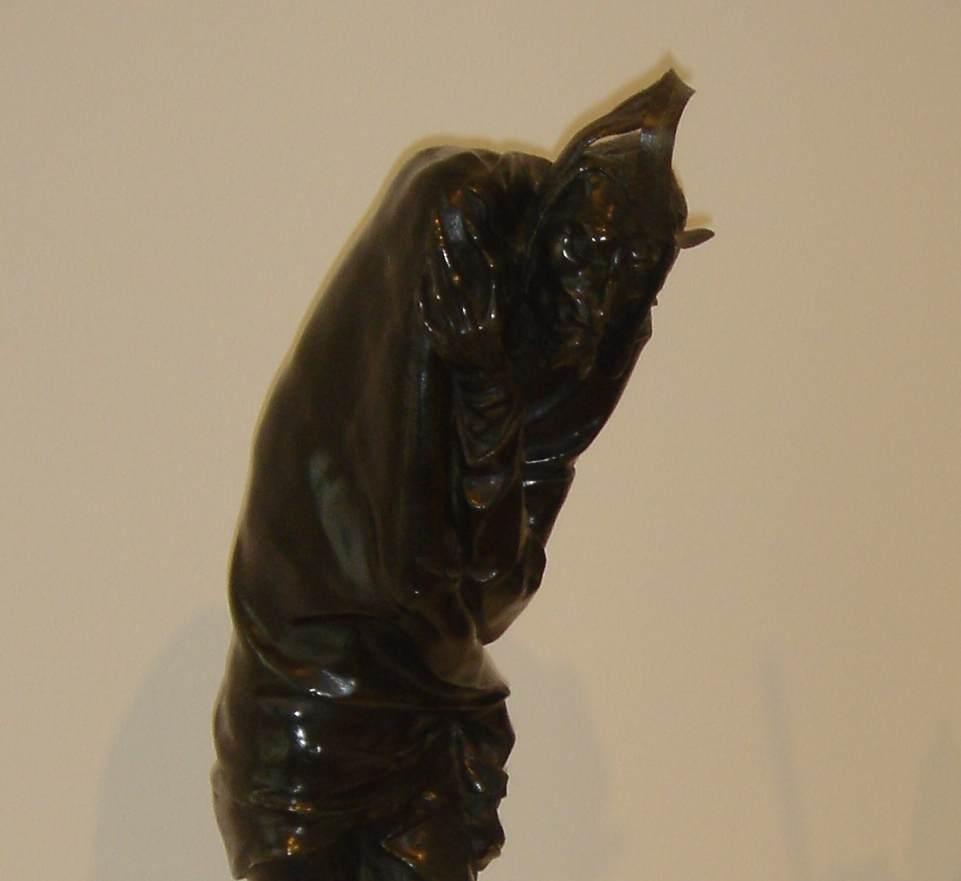
Mephistopheles, a Bronze sculpture by Jacques- Louis Gautier , 1853


Yesterday I finished reading 'Inez' by Carlos Fuentes. The Mexican novelist has this time chosen the musical work 'The Damnation of Faust' by Berlioz to explore the man- woman relationship. I did not find the novel as such very engrossing, except toward the end when it climaxes. Overall, the novel is obscure at most of the places, the threads being too many and they get tied very quickly and ineffectively towards the end. But the concept itself is novel in its usage not so much of the legend of Faust but that of Berlioz's symphony based on it to explore an eternal theme.

I had read Goethe's Faust many years ago, perhaps fifteen if not a little more. It had shaken me at that time, though I got around to re- read it only last year, my interest re-kindled by the reading of Thomas Mann's 'Dr Faustus' and also of Turgenev's lesser known work 'Faust'. I had previously prided myself that I knew of most of Turgenev's works, but this novella was a delightful exception.

Goethe, along with Flaubert, was an abiding influence on Turgenev. The novella is not so much about Faust as much about the impact of the book on a young married woman who has been brought up by her mother away from the 'pernicious' influence of poetry and music for which the mother had apparently paid a dear price in her younger days, and hence decided to keep her daughter away from both and from a similar fate- but destiny had something else in store and the narrator of the story ends up reading Goethe's 'Faust' to the young girl and lends her his copy- with disastrous consequences. Turgenev captures her transformation very poetically and though certainly not in the class of 'Fathers and Sons' or 'Rudin', it made for some memorable reading.

Thomas Mann was far more inspiring. I would rate 'Dr. Faustus' as the best reading on this theme barring Goethe's- it is the familiar Thomas Mann style- patient, laboured, slowly progressing narrative, plodding the reader on- ending in a crescendo with the reality of the musician Hans Castorp's life coming out in the open and shocking the reader with the grotesque barbarity of it all. There would perhaps be few comparable literary examples indicting German fascism.


Reading Dr. Faustus was also a discovery in reverse. It lead me to Schopenhauer and to Wagner - precisely the inspirations for Thomas Mann's work. I would have dismissed Wagner's music as rather dark and gloomy, but after having read the book, I can perhaps relate to it. And wont hesitate to state that I now rather enjoy Wagner- in times when I am in a dark or a blue mood myself, on one of those evenings, when the skies are dark and gloomy too and the night seems to be brimming with the screeching ghosts of existential questions.

Monday, May 30, 2005

Asomiya Literature

I am not sure how Indian regional literature has fared in the last few years, my own forays into Punjabi literature have been few, but I havent carried very positive opinions about it. A friend, a writer in Hindi/Punjabi himself ridiculed me once for being more interested in Latin American writing than that in Punjabi. And my response was that if I can find any writing that equals Mario Vargas Llosa, I will have no qualms in switching over. I did once try to read some of the writers writing in Hindi, and very much liked Rahi Masoom Raza and Shrilal Shukla, and the satire of Harishankar Parsai, who died almost unnoticed few years back (and to whom I was introduced by Ishwar Dost). I feel Hindi as a language is very suited for satire, just as Urdu is, though Urdu is very suited for high flown flights into poetry as well- perhaps on account of it being a confluence of both Hindustani and Persian.

But to come to the point I wanted to make here. I recently read a Mamoni Raisom (Indira) Goswami novel "The Moth Eaten Howdah of the Tusker" in translation of course. I was very much impressed by the novel, and it lead me to read a couple of collections on contemporary asomiya literature brought out by Katha. The narrative is pretty much linear, the plots not very thick or philosophical, both the novel and the stories do not match the spectacular range and experimentation of the Latin Americans, but they do hold the reader's attention, the stories are deeply humane and Indira Goswami's novel impressive in its level of detail in re- creating the Assam of the fifties and sixties. Subsequently, I started reading The Sentinel and the Assam Tribune sites, and they come across as newspapers as they used to be in North India many years ago. They are still newspapers and not advertising sites ! And they carry a bit on the literature of the state. It is this that makes me feel, that probbaly it is no longer Bangla but the literature of the 'lesser' languages like Oriya and Asomiya that regional writing looks more promising.

Sunday, May 29, 2005

Sunil Dutt- A Secularist and a Humanist

I find it tough to believe that a person can be liked by all. Sunil Dutt, who passed away last week in India was perhaps one of the very few. Despite being the victim of Partition, he rose above it, was part of the secular leaning Bombay filmdom, married a Muslim actress of iconic status, Nargis. Sunil Dutt was a secular Punjabi Brahmin, however oxymoronish that may sound today.

A friend tells me that one of the reasons that he remained secular was because of he adored his mother Kulwanti Devi, who asked him to forget the Partition. I am not sure if this explains it all, but frankly I really dont know the reason. His cousin brother Subir Dutt, a notable Urdu poet, was himself married to one of the sisters of Sahir Ludhianvi. And a few years ago, when I thought that the defining aim of my life was to write a definitive biography of Sahir, I planned to see Subir Dutt. He had edited a journal, whose name I forget, that was dedicated to Urdu poets and writers. I had seen many of those at Punjab Book Center in the eighties, when I used to frequent the bookshop in Chandigarh. Sunil Dutt was close to Faiz too, as the numerous pictures of Faiz at Sunil Dutt's house at a site dedicated to Faiz indicates.

I personally felt a lot of warmth for Sunil Dutt, though it was naive on his part to set out on a padyatra during the height of terrorism in eighties and nineties. But he did- and that naivete amidst those senseless days probably defined the man in an age of catastrophe and crisis. I felt, like many others who stand by Nehruvian-Left secularism, a pain when he had to grovel before the Shiv Sena chief. But I guess we all understood his position- and it endeared him to us. It was a moment of intense pride when he resigned from the Congress during the Narasimha days in protest against what he felt was the Party's softness towards Hindutva.

I dont think he was considered a great man during his lifetime. Neither will he be remembered as one. Despite a few years of impeccable success as a film actor, his life was one of struggle- and amidst that his tenacity to stand up for humanist and secular ideals was, to say the least, exemplary.

Thursday, March 07, 2002

TKR: The Portrait of an Editor

TKR: The Portrait of an Editor

I.

Over the last fourteen years I had the opportunity to know T.K. Ramasamy, as an editor, a person, a friend and even as ‘a spinner of yarns’- all at the same time. As I attempt to write about him I can only hope that my perspectives will help to construct or conjure at least a part of the person himself.

Let me begin by admitting that my experience with TKR was above all, highly educative- he instigated one to write but also plodded, corrected and showed the way forward.

As an editor, TKR worked hard on some of the articles and book reviews that he received. In my case, my very first one was substantially changed- for good reasons, for after he had read my review he asked me (rather maliciously as I imagined it then): is it a book review, an article or an essay? I didn’t know the answer. However, I more than understood when I saw the review in print. That was my first lesson in writing.

Subsequently, my relations ship with him was more like an Urdu poet of yore sending his couplets to his ustad, who would bring about corrections here and there and for which one would wait impatiently. Over the years these corrections became less frequent and increasingly nuanced. Once he told me that he had to work very hard on a review that I wrote on a book on Indian nationalism. On reading my published review, I commented that I saw no change to what I had written. He only smiled.

Later when I compared my original review with the published one, I realized that he had indeed modified it: he had cut off its rough edges, chiseled it with an adroitness that smoothed out the words and brought it to an even tenor. Subsequently, it forced me to look for every tittle that he changed- it was an education that one started taking for granted. It upsets me today to think that what I write will not pass through the clinical gaze of TKR. It feels as if a pillar that one had got accustomed to lean on has disappeared.

TKR was a teacher in another way. Having studied engineering at college my forays into social science and literature was mostly by self- learning- an unstructured learning guided by the study of Marxist classics in the company of equally amateurish activist students. It was the Marxist ideologue Mohit Sen, and next only to him, TKR who provided a more mature appreciation of theory. Both, however, were contrasting in their methods. While the former provided, as he continues to provide, broad sweeps and direction, TKR was concerned more with the nuts and bolts. While the former was always convinced about his formulations, allowing little space for disagreement, TKR always retained a streak for skepticism.

TKR’s criticism of a point that I would make was in pointing out small, dark recesses of the argument- rarely a direct or frontal attack. Instead, he would make a statement of fact or offer an opinion countering a seemingly irrelevant point in the case that I would have built. He left extending the argument to its logical conclusion open. In other words, he would leave its generalizations and theorization to me.

Slowly, as I began to understand his method, it often shook me as the flaws in my argument dawned on me. Sometimes, it was overwhelming- because I thought that by making a minor criticism and not questioning my broader argument, he had conceded my main point. Little did I realize that his seeming surrender had been, in fact, a conquest.

Going over to Ramasamy’s house on the weekends that I was in Chandigarh, especially the last few years, had taken on something of a ritualistic rendezvous. I often found him with his regular set of friends, and there would be discussions on everything under the sun, always illuminating.

On less crowded days, he would quiz me about computer viruses or how the Internet worked. I tried to explain the more intricate technologies involved, rather clumsily I suppose. I would get my own back, quite gainfully, when he explained terms and processes in economics, a subject of which I was completely ignorant.

Sometimes the topic would span different terrains- I particularly remember once when he discussed how change in technology affects journalism, in fact, the thought process of the journalist and therefore the content itself. Journalists of his age, he remarked, usually thought out everything in their mind, revised and altered it a number of times in their minds before sitting down behind a typewriter to put them on paper in a single shot- a process that took only the time that depended on the typing speed of the person behind the typewriter.

Not having known many journalists of his times, I am not sure if this applies to everyone, but it surely did for him. The actual time that he took to churn out an editorial was a few minutes- for he had composed and refined it over and over again in his mind.

His own initial opposition to computers melted into a grudging learning of the technology and later to a comfortable co- existence as he tried to learn new features and use the computer for his daily work.

He had his idiosyncrasies. He would insist on using my full name in the byline, while I preferred only the first name. I could never decide what I could buy for him as I scoured the malls and specialty stores abroad. His needs were few, and gifting him something that went beyond those would have offended him. I always came back empty handed.

He would also dislike certain traits in people but suffered them in silence. He would take his drink slowly and avoided eating much, even as he relished talking about delicacies and intricacies of recipes.

What, however, appeared as idiosyncrasies were mostly a manifestation of the world outlook of the man, which was a confluence of many streams- customs of his native South Indian upbringing, his ideological moorings and his liberal dispensation. The last two were especially important, and interesting because while he remained on what he considered to be the more radical version of Marxism, and therefore should have been, I felt, to be more sectarian and less accommodative of contrary opinions, he was quite the opposite.

As I moved quickly in the four years at college from fringe versions of Naxalism to Soviet Marxism and still later to what TKR generously termed as the liberal left, I realize that it was actually TKR who assisted with the transition and made me question a number of my premises. I feel that he never renounced the core of his beliefs as much out of conviction as because of loyalty even as he refused to force others to kowtow his line of thought.
II.

For TKR, like for many others of his generation, Marxism was the contemporary face of humanism. Their embracing of Marxism had involved among other things, a deep commitment to its ideals and a substantive break with the past.

He saw himself as part of a larger army that comprised some of the finest minds of his generation. They felt that not only the future was bright, not only that they had deciphered the genetic code of history and hence mastered the future but also they were its harbingers- the future belonged to them! Only the details had to be worked out. They had a role in shaping this future.

However, unlike many others who aspired or placed themselves at the head of this movement, TKR was content to be a foot soldier. His area of operation remained at the molecular level.

As the years went by to give way to doubts and eventually the smothering of their dreams as fort after fort of ‘existing’ socialism collapsed like a house of cards and their Indian vision began to give way to popular neo- liberal propagandists, it was clear that the dream had soured. The general optimism was giving place to a pessimism- but TKR did not let pessimism lead him into the labyrinth of cynicism.

It did not mean an abandonment of his core beliefs- for him Marxism combined intellectual rigour with an abiding ethical appeal for the underdog. For those like TKR, as he once wrote about himself, who wore their heart firmly on the left, it took on the form a religion in the affirmative sense- a religion for the modern world, a religion whose belief rested in iconoclasm. ‘De omnibus dubitandum’ (‘Doubt everything’), as Marx had put it.

In addition, it imposed a code of personal conduct, Stalin himself had firmly instructed the then Indian communist leadership of Sripad Dange, Rajeshwar Rao and B.T. Ranadive when they went to see him: above all, renounce your personal interests.

TKR’s formative years also coincided with the emergence of the newly independent country. A general optimism suffused the air.

The more impatient ones opted for Marxism as frustration with the relatively bland flavour offered by Nehru-ism became evident. The historic split in the Indian communist movement found TKR on the more radical wing. This was surprising and somewhat contradictory for in his writings he was always balanced and mild. One exception was a eulogy that he wrote on the death of B.T. Ranadive, whom he admired.

At the risk of a hyperbole and over- stretching a historical analogy, one cannot help feeling that while his age produced its fair share of Bazarovs and Rudins, it is yet to produce its Turgenevs.

TKR worked all his life with small newspapers, and before he joined the Tribune, with ideologically left of center papers.

His professional life was guided by ideas and his ideas were moulded in the fire of Marxism, his puritanism a part of not only his moorings in the Old Left but also his Brahmanical upbringing in a South Indian family- a legacy whose living content he continued to uphold and, mediating through his new glasses, channel them in new directions. As a small aside, one can remark that his knowledge of classical music, for example, helped him savour the Punjabi Sufiana qalam of a Puran Shahkoti or the Wadali brothers in whose singing he found a confluence of the classical with the folk, though he did not fully know the language.

To Chandigarh, a city devoid of history and traditions in a country where time is measured not in centuries but in millenniums, TKR brought a part of that history, traces of that tradition and inklings of the social and political struggles that had raged there. He adapted himself and them into the local conditions. Without him, the city is devoid of a piece of architecture that Le Corbusier forgot to design- an edifice of the mindscape.

III.

TKR changed in certain respects over the years, at least with me. The early years (in late 1980s and early 1990s) of debate and verbal criticism gave way when he would recount his days in Nagpur- as a child and as a student. His escapades conjured up images of a little Swamy, not in Malgudi, but in Nagpur as he waded with his listeners through the lanes and by lanes of Nagpur with flourishing portraits of the people he had known.

My last meeting with him was three weeks before his death. I was meeting him after nearly five months and I felt a substantial change in him. He was much weaker physically and somewhat incoherent.

I had noticed, for the past few weeks, small spelling mistakes or a stray typographical error on the book review page- these should have been an indicator enough of his health, so immaculately was this page normally done, which he insisted on doing all by himself. But that winter evening, as we clinked our glasses, my eyes briefly met his- and in that moment I discerned a softness that betrayed resignation. The final news came as a vindication of that momentary encounter when one had desperately hoped for a refutation.

But then death and tragedy had stalked Ramasamy’s home for the last few years of his life. Illness and fatal accidents claimed, first his nephew, then his youngest brother and then the disappearance and presumed death of his remaining younger brother two years ago- all making for a gory sequence that would have made any other person of his age turn to superstition and mysticism. TKR felt emotionally depleted but tried to make as little of this as possible. ‘My grief is my personal grief’, he remarked to a friend, ‘No one can share it.’

Bhupinder Singh
07 March, 2002

Sunday, January 13, 2002

Review of Lenin: A Biography by Robert Service

Lenin: A Biography
By Robert Service
Papermac (Macmillan), London £12 (Special Indian Price £7.20), Pages 494

One of the first actions that symbolically marked the demise of socialism in the former USSR was the bringing down of the statues and pictures of Lenin.

The irony, in the first place, was that the state that he more than anyone else was responsible for bringing into existence had iconized one of the most iconoclastic figures in the pantheon of human history. Lenin himself would have approved the demolition of his statues, though not of much else that accompanied it in 1991.

Robert Service, author of the book under review, is no Leninist, indeed, he has little sympathy for the kind of politics that Lenin espoused. Yet he has written a fairly readable biography though he does not entirely succeed in convincing the reader about why Lenin’s "extraordinary life and career prove the need for everyone to be vigilant". Much of what is contained in the book indicates otherwise.

It must be said to the biographer’s credit that he places his subject to the scrutiny of facts and therefore avoids the extreme conclusions of other authors who have written about the Russian Revolution in general and Lenin in particular. In the last one-decade these include Dmitri Volkogonov, Edvard Radzinsky, Orlando Figes and Richard Pipes.That Service manages to do a doublethink (to borrow a phrase from Orwell’s otherwise flawed "1984"), is another matter.

To this reviewer whose early introduction was to the hagiographies on Lenin churned out by Soviet publishers, the recent researches have tended to be more in the nature of additions of some facts or in the de-mythologization of others.

The qualitatively new dimensions have been few: the impact of Russian agrarian extremists in addition to Marx on Lenin’s thought and his many edicts and decisions during and after the Civil War that can be considered to be the genesis of the later totalitarian state. In the book under review there is new light on Lenin’s exchange of letters with those close to him, particularly Nadya Krupuskaya and Inessa Armand.

Beyond these points, even Service has little to add and there is a reason that despite his attempts to highlight the negative aspects of Lenin, he inaugurates the book with the sentence: "Lenin was an extraordinary man".

With the proverbial wisdom of hindsight, the first point need not really have surprised us. After all, there was substantial material to indicate the violent program of the agrarian socialists and their impact on Russian revolutionaries. Dostovesky’s "The Demons" and particularly Joseph Conrad’s near- prophetic "Under Western Eyes" had underlined these streams of Russian revolutionary thought much earlier.

Regarding Lenin’s role in setting up the later Stalinist State, it needs to be read cautiously. While it is hard to imagine that the Soviet State would have been fundamentally different if Lenin had lived longer or if the leadership had passed on to someone else other than Stalin, it is also incorrect to see Stalinism as being a direct and legitimate continuation of Leninism.

Lenin was, as Service rightly points out, capable of reversing his decisions in the light of new developments- he often took an isolationist position but then used all his force to carry the rest of the Bolsheviks along with him. This was not the case with Stalin, who preferred the somewhat more "convenient" option of physically eliminating his rivals.

If Lenin resorted to polemical pamphleteer- ism for the dissemination of his ideas, Stalin paved the way for simplistic sloganeer-ism masquerading as profound truths. This was carried to its logical culmination in the Red books in Maoist China that pioneered the "communism for dummies" trend, if you will.

Besides, by reversing the early 1920s economic policies, Stalin deviated grievously. Though it may be conjectural to state this, it is possible that the ex- USSR might have developed those policies at an earlier stage that China adopted in the 1970s. As Roy Medvedev has forcefully argued in his recent book "Post- Soviet Russia: A Journey through the Yeltsin years", a pragmatic symbiosis of market features would have been a historically judicious choice compared to the barrack socialism that finally evolved.

The author recounts information about Lenin’s pedigree, including Mongol and Jewish ancestry. The family background of Lenin was generally ignored in the official biographies about Lenin and therefore the chapters on Lenin’s childhood and early upbringing make for interesting reading, if only for their novelty. Even Louis Fischer’s "Lenin: A Life" focused more on his later years.

The author also touches some of the important works like the "April Thesis" and "The State and Revolution"- attributing these generally to Lenin’s whims or wily scheming. Though one expects that he would have discussed these more seriously in his previously published 3-volume work on Lenin’s political thought, it is necessary not to underestimate his theoretical writings and to throw out the baby with the bath water.

A number of principles still carry a lot of weight, one of them being Lenin’s critique of Narodism. In India, for example Narodism in the form of Gandhism and neo- Narodism in the writings of third- world theorists like Ashish Nandy and Vandana Shiva has been a much stronger current than in the Russia. In this regard, one still needs to "go back to Lenin" to use a cliché popularized by Soviet writers. As the early 21st century comes to resemble more and more the early 20th century, this need may become all the more relevant as does a much more critical attitude.

Then there are certain aspects that Service either does not expend himself fully on, or does not touch at all.

For example, he points out that despite all his faults, Lenin was the acknowledged leader among both the Bolsheviks as well as his closest adversaries, the Mensheviks. If Plekanov was respected, Martov loved but still it was Lenin that the people followed, there must have been some reasons. Many of the other leading revolutionaries were extremely educated and forceful personalities in themselves. Despite that, why was there such universal agreement regarding Lenin? Service answers this with a thundering silence.

An aspect of Lenin’s personality that has recently been highlighted by Volkogonov and Radzinsky as well as Service needs attention. This is the supreme importance that Lenin attached to his personal security. While Volkogonov terms this "cowardice", Service does not go so far, but even he does not attempt to provide an explanation.

The reason may be partly psychological and partly borne out of conviction on Lenin’s part. In his seminal work "What is to be Done?" Lenin had indicated that the working class cannot accomplish revolution by itself and there is need for an intelligentsia that grows outside the working class that develops theory and injects class- consciousness into the working class.

Tsarist Russia on the other hand was powerful enough to silence the rebellious intelligentsia. It must be remembered that Nikolai Chernesvesky’s literary and philosophical works were written only in his early years. Once he returned from his incarceration, he became completely silent. His mental faculties had been ruined. Lenin must have been fearful of a similar fate befalling him- his brother Alexander’s execution would have been a gory reminder too.

An aspect that needs attention from Lenin’s biographers and scholars of the Russian Revolution is a more judicious treatment of the personalities that he was associated with. In Service’s account, these personages appear and disappear like passing silhouettes except for Krupuskaya, Inessa Armand and Stalin. This leaves one not only with numerous loose ends but also does not help to adequately compare Lenin with some of the other leading figures in the Russian Social Democratic movement.

This is specially true of the important Menshevik theoreticians Yuli Martov, Pavel Axelrod and Alexander Bogdanov (whom Service considers to be Lenin’s intellectual superior and with whom Lenin engaged in polemics in "Empirio- Criticism and Materialism"), not to mention Trotsky , Stalin and Bukharin.

The last three at least have had their share of biographers (Isaac Deutscher for Trotsky and Stalin, Stephen Cohen for Bukharin). It is the leading Mensheviks who have been ignored by historians.

As for Lenin, the current biographer does not achieve what Deutscher accomplished for Trotsky. The need and the long wait for a definitive biography of Vladmir Illyich Lenin are not yet over.


19 December, 2001
Published: The Tribune, Chandigarh 13 Jan 2002

Sunday, May 20, 2001

Review of The Famous Ghalib by Ralph Russel

The Famous Ghalib
Selected, Translated and Introduced By Ralph Russell
Roli Books, New Delhi Rs. 295 (HB), Pages 192


Ralph Russell came to India as a British soldier during World War II and went on to join the Department of Oriental Studies at Cambridge. His previous works over the years, mostly written along with Khursidul Islam, have made him known as an authority on Urdu literature especially on Mirza Ghalib.

He remarks that, "If his (Ghalib’s) language had been English, he would have been recognised all over the world as a great poet long ago. My translations are an attempt to present some of his poetry in English so that English speakers may be able to judge the work for themselves." However, the book caters well even to those already familiar with the poetry of Ghalib, this is so both in the selection and translations of the poetry and in the accompanying essays.

The sheyrs and ghazals translated into English are followed by the original in Urdu and the transliterated versions in Roman and Devnagari. An essay on 'Getting to Know Ghalib' serves as an insightful introduction to Ghalib, his poetry and the milieu that it grew on. Another essay 'On Translating Ghalib' brings forth the problems and techniques of translating from Urdu to English. These essays help to supplement and explain the translations. They weave together the translated sheyrs into a cohesive whole.

The current translations are marked by a stress on the literal meaning of the sheyrs, though there are some sheyrs and ghazals where the translator has tried to practically recreate both the meaning and the form in English. This is not a mean achievement and as compared to the other two significant translations (one by Qurrat-ul- ain Haider and another edited by Aijaz Ahmed), Russel has attempted -and achieved- much more. One hopes that it will encourage the reader to read the original.

*****

Ghalib roars over and above his predecessors as well as contemporaries, he rarely whimpers. He is a lively, even a gregarious character. For a long time and especially till the age of 25, Ghalib refused to consider any criticism of his poetry. Consider the following sheyr:
Bandagi men bhi vuh azada o khud-bin hain ki ham
Ulte phir ae dar I kaba agar va na hua.

(We serve You, yet our independent self regard is such
We shall at once turn back if we would find the Kaba closed)
This assertion of the self was to reach its crescendo in Iqbal (with the development of the concept of khudi) and still later metamorphosed into the collective individual in the poetry of Faiz Ahmed Faiz:
Aur raaj kareygi khalaq-e-khuda,
Jo main bhi hoon, aur tum bhi ho

(And the Creations of the Lord, which is you and me,
Shall rule the world)
Russel’s selection rightly brings forth this aspect of Ghalib’s poetry. One cannot stress this enough as the traditional ghazal form does not facilitate presentation of the poet’s world- view in a systematic form. Each sheyr is a complete poem in itself, and it is not necessary for a ghazal to express the same mood in all the sheyrs- in that sense it can be said that the form tends to dominate the content. The exposition is, therefore, disparate and scattered in sheyrs across different ghazals. One has to wade through to pick and choose and then reconstruct- a difficult and onerous task.

Understanding Ghalib requires that one understands not only the literal meaning of a verse, but also the allusions that occur in them. Ghalib wrote from within the Muslim tradition and it is therefore necessary to understand that tradition, the religious concepts, references to aspects of the Muslim way of life and so on. Russell explains some of these and illustrates the usage in some sheyrs.

Ghalib himself, however was hardly a 'good' Muslim. For one, he drank wine, as is famously known. He did not keep fasts or say his prayers or go on pilgrimage. In this he follows other Urdu poets who stand on the verge of transgression or beyond. For instance, Mir had said:
Mir ke deen-o-mazhab ko, ab poochtey kya ho, unney toh
Kashka khaincha, dair main baitha, kab ka tark islam kiya

(Do not ask what Mir's religion is, he has
Put on the sacred mark on the forehead (tilak), sits in the idol house, and has given up Islam)
Ghalib wrote much that ridiculed and often put to serious cross-examination many of the religious and Islamic concepts. One of his somewhat cryptic posers is:
na tha kuch, toh khuda tha, na hoga kuch toh khuda hoga
duboya mujhko hooney ney, na hota main, toh kya hota?

(When nothing was, then God was there; had nothing been, God would have been,
My being has defeated me, had I not been what would have been? )
Regarding the references to idol- worship and Hinduism in Ghalib’s poetry, Russell observes that Hinduism was the nearest religion outside Islam known to Ghalib. He points out that the practices of Hinduism afford a vivid symbol of the worship of God through the worship of beauty. "The idol is the symbol of the irresistibly beautiful mistress you 'idolise' and adore... All these concepts make 'Hinduism'- that is, Hinduism as a symbol rather than actual Hinduism- the expression of one of the mystics' key beliefs."

Ghalib was aware that the milieu in which he grew up was in its twilight and was being replaced by a more advanced civilization. At the same time, he saw the emerging world from the framework of ‘medieval ways of thought and shared many of the attitudes of his eighteenth century predecessors in poetry.’ Hence, the conflicting pulls in the following sheyr:
Iman mujhe roke hai, jo khainche hai mujhe kufr
Kaba merey peeche hai, kalisa merey aagey

(My faith restrains me while the lure of unbelief attracts me,
That way, the Kaaba, and this way, the Church before my eyes)
It was the spirit of transgression, of crossing the accepted norms of society that excited Ghalib. "If you are to experience life to the full, you must not confine yourself to actions approved by the virtuous", remarks Russell. This recalls to mind a Punjabi Sufi couplet:

Jo had tapey so auliya, behad tapey so pir
Jo had, behad dono tapey, us noon aakhan fakir

(The one who crosses all boundaries attains the exalted title Auliya, the one who crosses non- boundaries becomes the Pir,
The one who crosses both boundaries as well as non- boundaries, becomes a Fakir)
And Ghalib, of course, prided himself on being a fakir. He remarked:
Banakar fakeeron ka hum bheys ghalib,
Tamasha-e-ahl-e-karam dekhtey hain

(Taking on the garb of a fakir, Ghalib
I watch the goings on of the world with a detached air)
Russell points out that Urdu poetry, unlike poetry written in English, is meant to be primarily recited and not read. "It is significant that in Urdu idiom, you don't write verse; you say verse; and the poet who 'says' it presents it to his audience by reciting it to them. Only later does it appear in print... Clearly, poets who compose in this tradition need qualities which those who compose for a tradition of written transmission do not need at all...."

"The mushaira is a long- drawn out affair and the poet’s main enemy is monotony. If they are to participate effectively in a mushaira, which will perhaps last for hours together, they cannot hope to do so without resort to variety. The audience knows as soon as the first couplet has been recited what the metre and the rhyme scheme are. Unless the ghazal is one of quite exceptional force, uniformity of tone and emotional pitch are likely to pall."

*****

The present selection has a number of sheyrs from what is considered to be one of the finest ghazals that Ghalib wrote in Urdu and whose matla is:
Muddat huee hai yaar ko mehmaan kiye hue
Josh-e-qadah se bazm chiraaghaan kiye hue
Russel has translated this as:

(An age has passed since I last brought my loved one to my house
Lighting the whole assembly with the wine- cup's radiance)

One would only have appreciated if the author had included the ibtidaayi (first) ghazal of Diwan-i- Ghalib. It provides the poet’s own introduction to his diwan, despite it being a little complicated for a beginner:
Naqsh fariyaadee hai kiskee shokhee-e-tehreer ka
Kaaghazee hai pairhan har paikar-e-tasveer ka
Ali Sardar Jafri wrote that visionary is the one who sees and speaks to the future. It is to this exalted group of remarkable men that Mirza Asadullah Khan Ghalib belonged. In his own time, he had rued:
Today none buys my verse's wine, that it may grow old
To make the senses reel in many a drinker yet to come
My star rose highest in the firmament before my birth
My poetry will win the world's acclaim when I am gone
Urdu poetry, Kaifi Azmi once remarked once in an interview, will keep the Urdu language alive. In the last one-decade or so, interest in Ghalib's poetry has seen something of a revival with the increasing presence of audio and visual mediums in addition to print. While the TV serial 'Mirza Ghalib' and the rendering of his poetry by a variety of singers have increased the reach of his poetry, one still has to turn to the written word to drink deep and not merely taste the Pierian Spring. This is clearly illustrated by the book under review- a masterly introduction to the Urdu language’s greatest poet.

April 3, 2001
Published: The Tribune 20 May 2001