Showing posts with label Society. Show all posts

Monday, December 25, 2006

"We locked away Gandhi on Feb 28"

"Terror was unleashed at Godhra Station because this country follows Gandhi, we locked away Gandhi on Feb 28 (2002), reform yourselves or we will forget Gandhi. Till we follow Gandhi's policies of non- violence ... kneeling before Muslims, terrorism cannot be eliminated. Brothers we have to abandon Gandhi."
- Praveen Togadia (quoted from his speech in the video)

A heart wrenching documentary Final Solution on the Gujarat pogrom of 2002 and subsequent elections in the Hindutva laboratory.


Link to google videos

Link via comment at All Things Pakistaniat

Saturday, December 16, 2006

Tips and Tricks to Kill Baby Girls

Renuka Chowdhury, India's Minister for Women and Child Development on India's "distinction" of killing 10m baby girls in the last two decades alone (I will neither comment nor respond to comments on this post; I have no words except unfathomable silences)
"Today, we have the odd distinction of having lost 10 million girl children in the past 20 years," Chowdhury told a seminar in Delhi University.

"Who has killed these girl children? Their own parents."

In some states, the minister said, newborn girls have been killed by pouring sand or tobacco juice into their nostrils.

"The minute the child is born and she opens her mouth to cry, they put sand into her mouth and her nostrils so she chokes and dies," Chowdhury said, referring to cases in the western desert state of Rajasthan.

"They bury infants into pots alive and bury the pots. They put tobacco into her mouth. They hang them upside down like a bunch of flowers to dry," she said.

"We have more passion for tigers of this country. We have people fighting for stray dogs on the road. But you have a whole society that ruthlessly hunts down girl children."

According to the 2001 census, the national sex ratio was 933 girls to 1,000 boys, while in the worst-affected northern state of Punjab, it was 798 girls to 1,000 boys.

The ratio has fallen since 1991, due to the availability of ultrasound sex-determination tests.

Although these are illegal they are still widely available and often lead to abortion of girl foetuses.

Chowdhury said the fall in the number of females had cost one per cent of India's GDP and created shortages of girls in states like Haryana, where in one case four brothers had to marry one woman.

Economic empowerment of women was key to change, she said.

"Even today when you go to a temple, you are blessed with 'May you have many sons'," she said.

"The minute you empower them to earn more or equal (to men), social prejudices vanish."

The practice of killing the girl child is more prevalent among the educated, including in upmarket districts of New Delhi, making it more challenging for the government, the minister said.

"How do we tell educated people that you must not do it? And these are people who would visit all the female deities and pray for strength but don't hesitate to kill a girl
Full report


Sunday, November 12, 2006

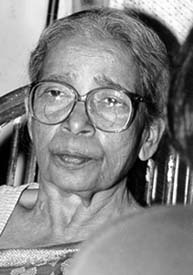
Writing as Resistance- The indomitable Art of Mahasweta Devi

Guest Post by Bhaswati Ghosh

Writers are often cited as perceptive observers of the prevailing human condition. Some of the greatest writers have used the power of their written word to bring across the struggles and sufferings of the exploited before a wider audience. There exists a small section of writers, however, which feels compelled to act as more than mere spectators and reporters of the human condition. They throw themselves into the fight, as it were, of deprived people.

Mahasweta Devi is arguably the finest example of activist writers in India. For more than a quarter of a century now, she has been actively working with tribals in certain Indian states. She fights for their basic rights, helps them unite and become self-reliant, and writes about their life, often reduced to a sub-human level by the rich and powerful. A prolific writer, most of her recent work draws from her association with these marginalized communities.

The Person: Mahasweta was born in undivided India in 1926, about two decades before India’s independence. The daughter of Manish Ghatak, a poet and novelist, and Dharitri Devi, a writer and social worker, Mahasweta probably had literary activism in her genes. It was community service that emerged on the scene before writing, though. As a college student, Mahasweta joined her friends for providing relief to the victims of the infamous man-made Bengal famine (1942-44). They would distribute food, check through dead bodies lying in street to reach out to those still alive, feed them and take them to relief centres. This direct, raw brush with suffering became the seed of Mahasweta’s empathizing disposition.

Marriage came early, at the age of 20, when she tied the knot with Bijon Bhattacharya, a renowned Bengali playwright. Her husband was also a member of the Communist Party of India (CPI), and at the time the couple was establishing its marital life, communists often became the targets of persecution. As a result, it became tough for Bhattacharya to support his family, extended with the birth of their son, Nabarun, two years after their marriage. Mahasweta did several odd jobs to keep the hearth burning—selling dye powder, supplying monkeys for research to the U.S., teaching at a school, private tuitions—before she finally got a government job at the Post and Telegraph department. But this job was not to last for too long either. Someone dropped a few books of Marx, Lenin, and Engels in her office drawer, and Mahasweta was terminated on the charge of being a communist.

The Writer:
This is when she took to the pen—mainly to supplement family income. She started with light fiction for literary magazines. Her first book-length work appeared in 1956. Jhansir Rani or The Queen of Jhansi was a fictional account of the life of Lakshmi Bai, an Indian woman ruler who valiantly led her forces to fight the British, before being killed by them at age 22. Even as a first-time author, Mahasweta showed the impractical sincerity that distinguishes true writers of historical fiction. She borrowed money from family and friends to travel to the Bundelkhand region in north India, where Lakshmi Bai ruled, and walked her way through remote villages and deserts, collecting oral history, folklores, and ballads. Interestingly, this same seriousness of approach in collecting data for her stories would be seen years later, during the activist phase of her life.

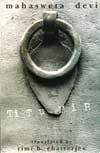
The debut book brought Mahasweta recognition as a writer, and thus started her ascent in the world of Bengali literature. She authored several books, adding the pennies toward sustaining her family, while at the same time mirroring the prevailing social atmosphere. This promising writer went through a period of personal turmoil, during which time her marriage broke apart, and she suffered from acute depression. Bouncing back soon, she completed her master’s degree in English and served as a lecturer of English literature for two decades. This was also the period when she came up with her seminal novel, Hajar Churashir Ma (The Mother of 1084), which deals with the Naxalite movement in West Bengal that saw many young lives ending before their prime. The book captures the sad realities of the movement through the eyes of the mother of one such young boy. In her attempt to understand the violent movement, this mother comes face to face with her sense of estrangement from the double standard-ridden bourgeois society to which she belongs. Poignant, yet shorn of overt sentimental elements, the novel made a big impact on readers across India and was recently taken to the silver screen by director Govind Nihlani.

The Activist: Over the next few years, Mahasweta’s pen took a decisive turn. She started integrating history into her storytelling. This wasn’t the conventionally disseminated history though; this was forgotten history, a part of the past that had been conveniently kept under the wraps. She wielded the power of narrative to document as well as spread stories of tribal resistances against the British and other social exploitations in books such as Aranyer Adhikar (Right to the Forest), and Chotti Munda O Tar Teer (Chotti Munda and his Arrow), among others. Here was a writer who truly wrote what she knew. Her vocation wasn’t divorced from her writing. She is amongst the foremost activists working for a better life for India’s tribals. Not content to stay cosy within her writing room, she ventured deep into the forests to live and work with tribal people.

She founded India’s first bonded-labour organization in 1980, bringing together thousands of bonded labourers to give them an organised platform for raising their voice against forced labour. A year before this, she turned Bortika, a literary periodical edited by her, into an open forum in which tribal people, peasants, factory workers, and rickshaw pullers wrote about their day-to-day experiences and problems.
This effort of hers is groundbreaking, since it records the issues of the underprivileged in their own words, unadulterated and unadorned. She went on to create a tribal welfare society for the Kheria and Shabar tribes, which are among the poorest in India. In 1986, this untiring champion of the voiceless founded the Adim Jaati Aikya Parishad or Ancient Tribes Union, a forum of 38 West Bengal tribal groups.

Nine years ago, at 71, Mahasweta received the Ramon Magsaysay Award for “her compassionate crusade through art and activism to claim for tribal peoples a just and honorable place in India's national life.” While accepting the award, she said, “I will have a sense of fulfillment if more and more young writers took to unbeaten tracks. My India still lives behind a curtain of darkness. A curtain that separates the mainstream society from the poor and the deprived. But then why my India alone? Cannot one say the same for so many countries and societies today? As the century comes to an end, it is important that we all make an attempt to tear the curtain of darkness, see the reality that lies beyond and see our own true faces in the process."

Bhaswati Ghosh is a writer sensitive to social concerns. She blogs at "At Home, Writing".

Images:
Delirium
The Hindu
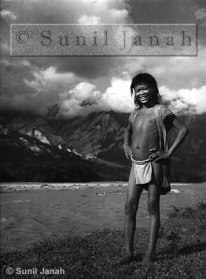
Comrade Sunil Janah's Site
Saturday, October 21, 2006

Remembering a friend this Diwali


To write about Divali in South India is to invite intense fire from saffron troops. For, Ram stands delinked from the festivities. Nor, for that matter, does Lakshmi figure in anything that goes on that day. What kind of a Divali is it then?

An article by friend, comrade, mentor - the late TKR

I was reminded of this article by hip Grandma's post.

Tags: , ,

Tuesday, October 17, 2006

Adivasis and the Environmentalism of the Rich


Indian Tribals ...and...the environmentalism of the rich

Guest post by Ishwar Singh Dost
Whatever I say here, is born of three decades of day-to-day experience of India's poor. And, amongst them, India's tribals share a worse fate. Theirs is a faceless existence. They are in India from ancient times, for thousands of years, yet the mainstream India has continually refused to recognise them. In the tribal society there is no caste division, no dowry system, divorce and widow remarriage is socially sanctioned. They are, after centuries of oppression and neglect, still so civilized! Yet we have simply refused to recognise their worth, have made them bonded slaves in the unorganised sectors, have evicted them from land wherever we have founded industries, or built dams.

Having been denied fundamental human rights, they have joined the floating population of the other poor who follow the contractors and go anywhere for a pittance. The mighty tribal culture, their fantastic dances, music, painting and wood cuttings are lifted by middlemen for a handful of coins and sold at high prices at home and abroad. The artisans receive next to nothing.
- Indian author Mahashweta Devi on the Indian tribals, aka adivasis

In comparison with other sections of Indian poor, the adivasis or the tribals are at the lowest rank of the Human Development Index, much below the Dalits. 50% of the adivasis live below the poverty line- a figure twice of the other rural poor. The Below Poverty Line (BPL) percent for all agricultural labourers is 45% but 61% of the adivasi agricultural labourers live below the poverty line. The number of adivasi cultivators declined from 68% in 1993- 94 to 45% in 1999-2000. Poverty increased by 5% among the rural adivasis and by 30% among the urban adivasis between 1993-94 to 1999-2000.

The Scheduled Tribes are the only strata of Indian population whose number of poor went up during this period- when other vulnerable sections of the population, the scheduled castes, agricultural labourers and urban casual workers have shown some decline in poverty.

Historically, the tribals have been pushed farther and farther into the interiors of the forests and away from cultivable lands- it is no coincidence that they occupy the land rich in minerals, since such land tends to be poor in terms of cultivation.

But it was British rule that dramatically altered the patterns of land and forest use forever. By 1860, Britain had become a world champion of deforestation. Besides denuding forests in its own country, it also ravaged the jungles in its colonies the world over, using the timber in shipbuilding, railways, smelting iron and so on.

The colonial state declared the forests as state property and the dispossession of the adivasis from their own land bagan. While the Forest Department established in 1865 was assigned the role of a revenue generating organ, the Indian Forest Act of 1927 gave arbitrary powers to the forest officers.

Post independence experience of marginalisation and subjugation continued- laws like the Land Acquisition Act of 1894 and the India Forest Act of 1927 are still in force. The pattern of industrialisation reinforced processes introduced by the British, the same laws were retained post 1947 while ensuring that "development" was achieved via internal colonialisation.

The extent of the colonisation of the forests can be discerned from the following statistics:

Export of wood and forest produce was worth Rs. 4,459 crores, about 15% of the total exports from India in 2000-01 from Rs 95 crores in 1960-61. This is despite the fact that the area under forests has continued to shrink from 40% in 1854 to 22% in 1952 to 10% in the 1980s. The revenue from forest lands rose from Rs 24 crores to Rs. 472 crores in 1980-81.

The count of people displaced from the projects like dams, mines and industries ranges between 20 to 30 million. Almost half of these displaced persons are adivasis. They are only 8 percent of total population of India, but constitute 40% of displaced persons. If we add the numbers of displaced persons after 1990, this would go to 50%.

The Forest Policy of 1988, however, brought about some welcome changes to the country's approach to the issue, and to some extent reflected the aspirations of popular movements. It introduced elements of conservation- replacing monoculture cultivation with mixed forests- the World Bank funded Pine project in Bastar had by then proved how disastrous monoculture cultivation- specially of pine, can be.

While adivasis continue to be displaced for ostensibly nationalist projects like construction of dams, reserved forests, sanctuaries and national parks are being seen as the new destination for eco- tourists- that is the new mantra of the international aid agencies, governments, environmental lobbyists and agencies like the World Wildlife Fund.

Recent years have also seen the rise of the fashionable "environmentalism of the rich" within India, which is not unlinked to the Western nations' invocation of conservation- countries that had achieved a degree of progress by destroying the ecology now demanded that the victim countries now help conserve it to save the world from global warming, while evading the question of compensation.

It is also being pushed by a conglomeration of ex- maharajas, ex- shikaris, tourists and other privileged sections.

It is a paradox that while adivasis are being driven out from their habitats, tourist activities are being promoted. The adivasis are being blamed for "encroaching" on their own lands.

A report last year in Down to Earth magazine pointed out:
Tourism is flourishing in Ranthambore, with hotels mushrooming around the tiger in its reserve. Till the mid-1990s, there were just over 10 hotels in and around the forests of the reserve and in the town of Sawai Madhopur some 12 kilometres (km) from the gate of the national park. Now there are 33, of which 26 are prominent. Six new hotels are under construction. Average room rents vary between Rs 400 a night to a staggering Rs 30,000 for a night of ultra-deluxe luxury in the midst of the wild tigers.

...

Lack of regulation has meant that many hotels have come up on agricultural or charagah (grazing) land, within a 500-metre radius of the park boundary. “The demand for new hotels has led to the sky-rocketing of land prices,” says a local hotelier. Along the Ranthambore road, land prices have gone up from Rs 1.25 lakh to Rs 1.5 lakh per hectare (ha) 10 years back to anywhere from Rs 30 lakh to Rs 40 lakh per ha today, depending on the proximity to the park entrance. “Due to the high prices villagers prefer to sell the land near the park,” says Hemraj Meena, a guide at the tiger reserve.

...

Among those who own houses and hotels near the (Ranthambore) park are Valmik Thapar, well-known conservationist and member of the Supreme Court’s Central Empowered Committee, and his relatives, and Fateh Singh Rathore, former field director of Ranthambore and now vice-chairman of Tiger Watch, a non-governmental organisation (NGO), and his family. These properties are within 500 meters of the forest boundary. “Hotel Sher Bagh located at a distance of 104 meters from the forest boundary is run by Jaisal Singh, Thapar’s nephew,” says Chandu Sharma, a local journalist. “Sher Bagh is a deluxe tented camp owned by Valmik Thapar’s family,” confirms wildlifeworldwide.com.
The stark truth brought about by the report is: People who direct conservation policies profit from the regulations that promote tourism and park management.

This is just the continuation of the so- called "Panchsheel policy" established during Jawaharlal Nehru's time. Nehru had himself stated while addressing villagers who were being displaced by the Hirakund dam:
If you are to suffer, you should suffer in the interest of the country.
Mrs Indira Gandhi wrote in the same vein to Baba Amte in a letter dated 30 August 1984:
I am most unhappy that development projects displace tribal people from their habitat, especially as project authorities do not always take care to properly rehabilitate the affected population. But sometimes there is no alternative and we have to go ahead in the larger interests.
The end of the story has remained the same: whether it is the development of the nation or conservation of the environment, the "somebody" who has to pay the price is the adivasi.

Ishwar Singh Dost is a long time activist, researcher and journalist. His paper "Forests, Adivasi Rights and the State" is due for publication in a book edited by Prof. A.V. Afonso

Picture Acknowledgements

Tags: , , , , ,

Saturday, October 07, 2006

A Kashmiri woman's appeal for justice

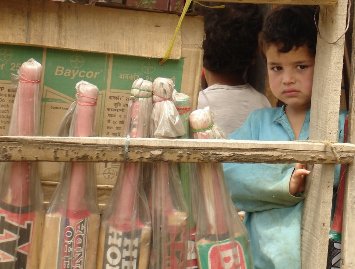
Cricket bats this side, guns on the other: Why he too may turn his back (Image Courtesy: Himalayan Trails)

Amitava Kumar has this post on the letter written by Mohammd Afzal's wife in 2004 and published in Outlook magazine. Though it does not state to whom the letter is addressed, it seems to be written to the Supreme Court.

There is little to add to the letter, it speaks for itself.
In 1990 Afzal was attracted to the movement led by the JKLF, like thousands of other youth. He went to Pakistan for training and stayed there for a little while. However, he was disillusioned by the differences between different groups and he did not support pro-Pakistani groups. He stayed there only three months without getting any training. Afzal returned to Kashmir and he went to Delhi to pursue his studies. He always wanted to study and before he joined the movement he was doing his MBBS.

My husband wanted to return to normal life and with that intention he surrendered to the BSF. The BSF Commandant refused to give him his certificate till he had motivated two others to surrender. And Afzal motivated two other militants to surrender. He was given a certificate stating that he was a surrendered militant. You will not perhaps realise that it is very difficult to live as a surrendered militant in Kashmir but he decided to live with his family in Kashmir. In 1997 he started a small business of medicines and surgical instruments in Kashmir. The next year we were married. He was 28 years old and I was 18 years.

Throughout the period that we lived in Kashmir the Indian security forces continuously harassed Afzal and told him to spy on people they suspected of being militants. One Major Ram Mohan Roy of 22 Rashtriya Rifles tortured Afzal and gave him electric shocks in his private parts. He was humiliated and abused.

...

Some days later they took him to the Humhama STF camp. In that camp the officers, DSP Vinay Gupta and DSP Darinder Singh demanded Rs one lakh. We are not a rich family and we had to sell everything, including the little gold I got on my marriage to save Afzal from the torture.

Afzal was kept in freezing water and petrol was put into his anus. One officer Shanti Singh hanged my husband upside down for hours naked and in the cold. They gave electric shocks in his penis and he had to have treatment for days.

You will think that Afzal must be involved in some militant activities that is why the security forces were torturing him to extract information. But you must understand the situation in Kashmir, every man, woman and child has some information on the movement even if they are not involved. By making people into informers they turn brother against brother, wife against husband and children against parents. Afzal wanted to live quietly with his family but the STF would not allow him.

...

There was no one to represent Afzal in the lower court. The court appointed a lawyer who never took instructions from Afzal, or cross examined the prosecution witnesses. That lawyer was communal and showed his hatred for my husband. When my husband told Judge Dhingra that he did not want that lawyer the judge ignored him. In fact my husband went totally undefended in the trial court. When ever my husband wished to say something the judge would not hear him out and the judge showed his communal bias in open court.

In the High Court one human rights lawyer offered to represent Afzal and my husband accepted. But instead of defending Afzal the lawyer began by asking the court not to hang Afzal but to kill him by a lethal injection.
To sign a petition on behalf of Afzal Guru, go here.

Related article: Not an 'eye' for an 'eye'

Tags: , ,

Monday, August 21, 2006

Bismillah Khan and the Kabir Tradition


Ustad Bismillah Khan passed away in Varanasi today.

What struck one about the Ustad was his life of simplicity and the tradition of syncreticism- also called the ganga jumna tehzeeb that he upheld. He lived and died in the city of Varanasi- also the place associated with Kabir. In both his vocation and life, he represented the continuation of that tradition.

The novelist Dr. Rahi Masoom Raza had illustrated this tradition in the names given to towns like Aligarh- a combination of an Arabic name 'Ali' and a Sanskrit word 'garh' (fort).

This tradition has been particularly strong in Hindustani music and the Ustad embodied this syncreticism in our age, perhaps the tallest one to do so. He lived, ruefully, to see how precarious this tradition is- it often seemed to be on the verge of collapse in the last two decades of his lifetime.

That it has managed to be resilient is because of people like the Ustad.

Brecht summed up the tragic contradiction in great heroes we look upto in times of need: Unfortunate is the land that needs heroes.

Following is a compilation from a few news reports, obituaries and editorials following his demise.
He lived his 91 years out in Varanasi, the temple town, where he often played at the famous Vishwanath Temple.

While several people saw a rift between his religion and the music he played, the Ustad saw the dichotomy as a divine one. A devout Shia, he also worshipped Goddess Saraswati. "Music has no caste," he often said.
...from rediff site
While paying his heartfelt tribute to Ustad Bismillah khan, Singh says no other artiste after Sant Kabir has achieved so much in creating a fusion between Hindus and Muslims. Samsher Singh pays his tributes:
We will remember the Ustad like Sant Kabir

Speaking of his love for the city Kishan Maharaj the famous tabla player, who often accompanied him on the tabla, pointed out that he and Bismillah Khan continued to live in the Varanasi city while the other artists from the city gradually moved to bigger cities like Mumbai, Kolkatta and Delhi.

A family friend and a senior correspondent with a national channel Rajesh Gupta recalled a couplet by local poet Bhiya ji Banarsi which Bismillah Khan was fond of quoting,

“Chana Chabaina, Ganga Jal aur sookhi roti baasi; Dhaat tari London ki, humko pyaari apni Kashi” (Roasted grams, Ganga jal and stale dry bread Who cares for London, I love my Kashi)

Recalling his sense of humour Gupta said when he met the Ustad at his hospital bed two days ago he not only recited his favourite kajri but also reprimanded his grandson Bande Ali for being “out of tune” as he rhythmically stroked oil into his grandfather’s grey hair! Performing for as little as a rupee for a night -long performance, he was now commanding a fee of Rs 5 lakh per performance but continued to be his humble self, pointed out Gupta.

Known as a man of impeccable secular values, old-timers narrate that he not only refused to migrate after partiition but instead rejoiced by playing the shehnai at the Red Fort on August 15, 1947. According to his son Mehtab Khan one of his last unfulfilled wish was to play at the India Gate.
From The Tribune

Varanasi, from the Wikipedia:
The culture of Varanasi is deeply associated with the river Ganga and its religious importance; the city has been a cultural and religious center in northern India for thousands of years. Varanasi has its own style of classical Hindustani music, and has produced prominent musicians, philosophers, poets, and writers in Indian history, including Kabir, Munshi Premchand, Jaishankar Prasad, Pandit Ravi Shankar, and Ustad Bismillah Khan.
Editorial in The Hindu
His house contained a minimum of furniture and little else by way of ornamentation aside from photographs of him being honoured by dignitaries from various corners of the world. It was a cheerfully bare kind of place, in keeping with the maestro's character. Much has been written about the Ustad as a devout Muslim who also worshipped Saraswati, the muse of all artists. His pluralism and tolerance were not learnt. They were instinctive and non-didactic, something that flowed naturally in the context of his being. He belonged to a generation that worshipped naad, the abstract principle of the perfectly tuned note. It was the pursuit of this goal in a culturally composite context that defined his greatness.
Tags: , , ,

Saturday, August 05, 2006

Nanak Lama


While there is a lot of similarity in the beliefs of Buddhism and Sikhism, specially in the advocacy of the middle path and stress on this wordliness and non- ritualism, it is difficult to understand why there has been little or no direct influence of the Buddha in the writings of Guru Nanak

While Nanak borrowed much from other religions specially Upanisaidic Hinduism and Islam, he doesn't seem to have indicated any direct influence of the Buddha.


The land of Guru Nanak- the Punjab- was also the land where Buddhism had once flourished- Gandharva, and as the historian Romilla Thapar has pointed out- Islam and other non- Hindu religions have an unusual overlap with the geographical areas where Buddhism had once reigned.

Some of the janam sakhis- the stories of uncertain origin related to Guru Nanak bear a strong similarity to some of the stories that one heard about the Buddha as well.

The two, however, seem to have encountered each other in Tibet when Guru Nanak, also called Nanak Shah, visited the place in the 16th century.

Harjinder Singh explores and explains why Guru Nanak is referred to as the Guru Rinpoche or Nanak Lama in Tibet, some of the tales he recounts are mythological but fascinating since this is an area that has not been sufficiently explored in both thelogical and historical studies.
If you go to the Golden Temple one of the most interesting things you will observe are some Tibetan pilgrims who come to pray there, bowing down at each of their steps. These people are Buddhists who may belong to one of the numerous sects of Tibetan Buddhism, who regard Guru Nanak as Guru Rinpoche. Guru Padmasambhava brought Buddhism to Tibet and they regard the Guru as a reincarnation of the precious one, 'Rinpoche'....

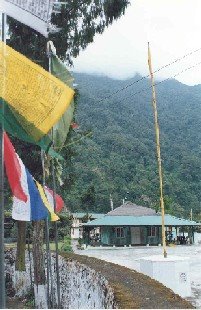
(The picture above is) of gurdwara in Sikkim India where locals hang scriptures along with Nishan sahib and hang sikh scriptures in prayer in bodhic style.

Tags: , , , ,

Technorati Tags:

Sunday, July 02, 2006

Football and the New Global South

As France inched towards victory in yesterday's match between with Brazil, one could not help noticing the composition of the French team- I could see only two or maybe three white faces. Tony Karon puts it well:
And with Brazil out, France is clearly now the representative of the global south, made up as it is by Diaspora Africans and Arabs. I hope they win the whole thing.
Tags: , , , ,

Saturday, April 08, 2006

What men read

Camus and Orwell are the favourite authors among nearly 500 men surveyed in England, a study shows.

"We found that men do not regard books as a constant companion to their life's journey, as consolers or guides, as women do," said Prof Jardine. "They read novels a bit like they read photography manuals." Women readers used much-loved books to support them through difficult times and emotional turbulence, and tended to employ them as metaphorical guides to behaviour, or as support and inspiration.

"The men's list was all angst and Orwell. Sort of puberty reading," she said. Ideas touching on isolation and "aloneness" were strong among the men's "milestone" books.
Some of the observations are contentious- there is an element of stereotyping of both men and women that stands out in the study.

The only observation I could find myself agreeing with is that most men do indeed read fewer women writers.

Related Links:
The Books that Move Men
There are some interesting comments at the guardian blog discussing this article.

My own list of 5 books that helped helped to shape me emotionally over the years:

David Copperfield by Charles Dickens (age of 13)
Mother by Maxim Gorky (at age of 16)
What is to be Done? by Nikolai Chernesvesky (at age of 19)
One Hundred Years of Solitude by Gabriel Garcia Marquez (at age of 24)
The Real Life of Alejandro Mayta by Mario Vargas Llosa (at age of 35)

Technorati Tags: , ,

Sunday, February 05, 2006

Mistaking a Rope for a Snake

A friend of ours wrote a play called Maruti and Champagne. It is genuinely funny and quite exciting. It is not at all nasty or provocative. Its humour is ‘nirvish’ (that is, not malicious, to use a word rather popular in the language of the newspaper reviews in the language of the marathas). No body would have thought that a comic play like that would ever invite anybody’s wrath.

But it did. There is a group called Patit Pawan Sanghatana (PPS). It is one of the five Hindutva-oriented organisations in Maharashtra, the other four being the RSS, the Samarasata Manch, the VHP, and of course the Shiv Sena....It stormed the little theatre where the show was being staged and forced it to close down.

...But the story does not quite end here. The silence that the national press and media observed was deafening. All the so-called local “news lines” faithfully observed a mystifying silence.

In contrast Arundhati Roy’s turning down the Akademi award made greater news. All papers noted it. And look at the irony of the Booker prize winning novelist’s position. When small and defenceless groups are being victimised by non-governmental semi-fascist groups, the “Booker lady” is angry with the government. She does not see who is threatening whom and how. The fact of the matter is that in our country it is less the government and more the semi-fascist groups, which are threatening the cultural rights of the people. To go on attacking the government in such a situation is a classic case of what is known in Sanskrit as ‘Sarpa Rajju Nyaya’ (mistaking a rope for a snake).
Full text here.

Technorati Tags: , ,

Saturday, February 04, 2006

‘They’ve only got my limbs, I’ve still got my voice – I can still sing!’


Hindu mythology tells the story of Ekalavya – the tribal youth who cut off his thumb on the demand of Dronacharya so that Ekalavya would not be a better archer than the kshatriya boys. Ekalavya, being a tribal, must have been a natural archer – but he was mutilated and robbed of his traditional skill and his right to self-defence and survival. Today, one gets the feeling that the story of Ekalavya is being played out again and again.

...

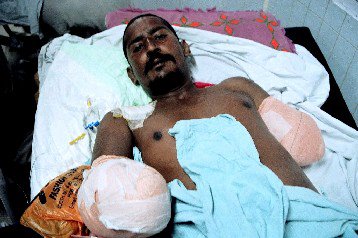
Two hands and a leg amputated. The remaining limb yet to heal, has turned gangrenous and may also have to be removed. His kidneys have been damaged due to excessive bleeding and he can hardly eat and digest any food.

And yet defiance still sparkles in the eyes of Bant Singh, a Dalit agricultural labour activist, as he lies in the trauma ward of a state-run hospital in Chandigarh where doctors are battling to save his only remaining leg and even his life.

It is precisely for this defiance, coming from a ‘lower caste’ Dalit, that Bant Singh from Jhabhar village of Mansa district in Punjab was beaten to pulp and left for dead by armed upper caste men around a fortnight ago.

Bant Singh is known in his village and among his comrades as a singer of rousing protest songs.

...

When his comrades met Bant Singh in hospital, they broke down – but Bant Singh told them, ‘They’ve only got my limbs, I’ve still got my voice – I can still sing!’
Full account here.

Link via Mahmood Farooki.

Technorati Tags: ,

Sunday, January 29, 2006

Gandhi in India Today

Douglas Allen, activist and professor of Philosophy at University of Maine in an interview with The Hindu, an excerpt:
I first came to India in 1963. People felt the need to parrot Gandhian slogans but no one really followed his ideals. In the 1980s, it was mostly the politicians who used him. In the 1990s, I found that politicians could take an open anti-Gandhi stand and still win an election. People were openly critical of Gandhi, something you would not hear in the 1960s.
Technorati Tags: , ,

Saturday, January 21, 2006

Madrasas in West Bengal- Different Strokes

A report on the secularization of madrasas in West Bengal:

While statewide figures reveal that 12 per cent of the 3.29 lakh-odd students in West Bengal's madrassas are Hindus, in some the percentage is much higher. At Badaitari Ujiriar High Madrassa in Jalpaiguri district, 25 per cent of the students are Hindus while at Elmenoor Barkatia High Madrassa in North 24 Parganas, nearly a third of the students are Hindus.

So, why do so many Hindus in West Bengal choose to study in madrassas? "Why not?" asks Dr Abdus Sattar, president of the West Bengal Board of Madrassa Education. "The syllabus is the same as in regular schools, the certificates we issue are recognised and considered as secondary school and high school equivalents all over the country. We also enjoy some advantages over regular schools. We charge minimal tuition fees while providing the same or even better quality of education than schools.
Technorati Tags: , ,

Friday, January 20, 2006

One Nation, One People

I have never been to Pakistan. But I have a strange, unexplicable nostalgia for Lahore and Karachi.

My mother was born in Karachi. My father, in Lahore.

My maternal grandfather came from Hyderabad, Sindh.

As a child, one heard of how they made it across the border after partition. Some of my early childhood years were spent in Jalandhar, on the first floor of a shop where my grandfather, with his white beard with matching turban and Turkish features traded in wood and counted his rupees and coins, read his prayers in Gurmukhi, maintained his records in Urdu and read Urdu newspapers till the end of his life, which was in 1984, as tanks marched towards the Golden Temple and curfew was imposed all over the truncated limb that was called Punjab, but really should have been called East Panjab.

Very much like the Indian Bengal that is still referred to as West Bengal. Somewhere, at the back of the mind, the feeling of One Bengal remains, whatever be the conventions of the modern nation states.

Whenever I read about buses and trains going back and forth between Lahore and Amritsar, I am moved, followed by a strange calmness that overwhelms me. Jaise beemaar ko bewajah karaar aa jaye, as Faiz remarked so poignantly in a different context but so aptly.

I feel as if I am walking in Krishna Mohalla in Lahore. Maybe, my grandfather's house survives there. Maybe. Maybe some walls survive, perhaps even a door and a few windows that look out into the red brick lane that had turned brown and black over the years, as people rush by and my grandmother haggles with the vegetable vendor over the price of brinjals...
Born in Bikaner, near the India-Pakistan border in Rajasthan, Reshma’s family had migrated to Pakistan at the time of Partition.

‘‘What is the difference between India and Pakistan? We’re one people, one nation. There is no difference in the minds of artists and common man,’’ she said.
Technorati Tags: , ,

Saturday, January 14, 2006

Stealing Food from India's Poor

Jayati Ghosh writes on how the UPA government's decison to reduce the distribution of foodgrain to the the poor in India is leading to a situation that is nothing short of a national crisis.

Yet, the dominant media ignores these developments- preferring the story about Chidambram voted as the best Finance Minister in Asia, for example. Meanwhile, the situation of the poorest of the poor turns catastrophic:
Only four respondents out of 1,000 said they had eaten two square meals the previous day. Out of the remaining households, 48 per cent had eaten two poor/partial meals, 35 per cent got one poor/partial meal plus one distress meal, 11 per cent could get just one poor/partial meal, 0.2 per cent had eaten only one distress meal and 5 per cent had eaten only jungle food on the previous day.
The UPA will wait for the next election for being taught the same lesson that the NDA/ BJP government was taught in May 2004.


(Graph: from The Frontline magazine)

Technorati Tags: , , , , ,

Thursday, January 12, 2006

A Partition Story

Here is a touching partition story.

The Samjhauta Express, called ‘Train of Emotions’ today re-united Rabia Bibi with her brothers after a gap of long 58 years. “Now I could die peacefully as Allah (the Almighty) has accepted my prayer to meet my brothers”, said Rabia.

The Sikh brothers, Mr Kesar Singh and Mr Joginder Singh, both residents of Dam Ganj, Amritsar, who were here along with their daughters, sons and grandchildren said that their sister who was only 12 was separated from the caravan which was coming to India.
A related story here.

Technorati Tags: , ,

Friday, January 06, 2006

Nadira

Yesteryear actress Nadira was hospitalised in Mumbai's Bhatia Hospital, five days ago, following a mild stroke.

One is surprised to find that little attention has been paid to Nadira, the actress of Bagdadi Jewish origin who was immortalised in the song "mud mud ke na dekh" in the movie Shree 420, certainly the most powerful of Raj Kapoor's early cinema that bore the mark of not only Raj Kapoor, but many others among them Khawaja Ahmad Abbas.

The song is picturised tantalizingly on Nadira as the hero (Raj Kappor) struggles to decide between Maya (Nadira) and Vidya (Nargis), between the bourgeios ("Maya") and the plebian ("Vidya"). His choice falls on Maya. Few moments in Indian cinema have been as poignant and stark as this particular song.

It stuck me that she is 74, that means that she must have been little over 25 when she acted in that movie.

One wishes Nadira a speedy recovery and a long life.


Sunday, November 13, 2005

Mukhtaran Mai

Three years ago, four men from her village in Pakistan gang-raped Mukhtar, then 33, to punish her brother for an offense they believed he'd committed. Her honor destroyed, she was expected by her community and even her own family to kill herself in shame. Instead, she marshaled deep reserves of dignity and strength to show her village what honor really is. Over her own father's initial objections, she went to the police, ultimately facing her attackers in a trial that put the four men in jail (an appeal that could free them is still pending).

When the government rewarded her with $8,300 in compensation, she chose not to flee with her cash, but to remain in her hometown and use the money to start the village's first-ever schools, even as her rapists' tribesmen continued to threaten her. "If women aren't educated, it's hard for them to speak up for themselves," she has said.

And only education, she believes, will stop future generations of men from abusing women (she has even enrolled her rapists' children).

Coverage of Mukhtaran Mai's press conference in Washington (source: Despardes)

Dr. Manzur Ejaz places Mukhtaran Mai in a wider context of a tradition of women's stuggle in feudal Punjab.
Responding to a question about Dr Shazia Khalid, Mukhtar Mai expressed sympathy and solidarity with her as a fellow victim of rape. However, she made a subtle distinction between herself and Dr Shazia Khalid suggesting that the good doctor may have abandoned the struggle by leaving the country. This reminded me of two famous characters from Waris Shah’s epic story.

Waris Shah distinguishes between love as a vehicle of social struggle — to overcome class, creed and tribal prejudices — and the desire to be with the lover by any means. Heer chooses to fight the predominant socio-economic system by openly embracing a buffalo herder, Ranjha. By contrast, her sister-in-law Sehti, portrayed as a very scholarly woman, seeks personal resolution by eloping with her lover, Murad Baloch. Heer, a woman of knowledge and faith, has to confront her family, tribe, religious institutions and legal system. Sehti takes the easy way out.

Waris Shah makes the point that mere suffering or its awareness are not enough to change an oppressive system. He is so intent on distinguishing between social struggle and efforts for self-gratification that his hero Ranjha refuses to elope even when Heer, in a weaker moment, suggests that. He says,

Heeray ishq na mool swad dainda nal chorian atay udhalian dey
(O Heer, the love, carried through deceit and elopement, is never fulfilling.)
technorati tags:

Tuesday, July 19, 2005

The 'Hindu' Speed of Traffic

In the small town of Nuh in Mewat district in Haryana, I once counted as many as 76 passengers coming out of a single jeep (locally called "maxi- cab"), a very normal mode of transportation in that region that is less than a 100 kilometers, yet a century away from New Delhi.

Its not just the volume, but also, as Praful Bidwai observes, the speed of traffic that is changing:

Most people in big or small cities would say it now takes twice as long to commute from one place to another, as it did a decade, even five years, ago. This is borne out by micro-level studies. For instance, in Mumbai, motorised traffic slowed down from an average of 38 kilometres per hour in 1962 to 15-20 kmph in 1993, in Delhi from 20-27 kmph in 1997 to 15 kmph in 2002. In Chennai, the average speed was as low as 13 kmph in 2002, and in Kolkata a glacial 7 kmph in the city centre.